
Toronto Moving Costs in 2026: The $95 to $199 Reality
Try booking a freight elevator at CityPlace on September 1st. You can't. The waitlist is three weeks deep, the time slots are four hours max, and the building charges $500 if you scratch the padding. Welcome to moving in Toronto – where the logistics start before you even call a mover.
That CityPlace elevator slot is the first domino. Your concierge hands you a checklist: Certificate of Insurance naming the condo corp, a refundable deposit between $200 and $500, a loading dock reservation separate from the elevator booking, and a hard stop at 4pm. Fail any one of those, and your movers wait in the lobby at $125 an hour while you scramble. That $125 median — the midpoint across 514 active GTA moving companies and 57,529 verified Google reviews — is just the baseline. Your building’s rules are the real cost multiplier.
Why Do Toronto Condos Add 30 Percent to Your Moving Bill?
A friend in Mississauga paid $600 for a two-bedroom house move: truck backed into the driveway, crew loaded in three hours, done. You paid $1,100 for the same amount of furniture in a King West condo tower — same hourly rate, same crew size. The difference wasn’t the mover. It was the elevator wait, the 200-metre walk from loading dock to unit, the COI paperwork, and the compressed 4-hour window that forced a third crew member at $179/hour to beat the cutoff.
Here’s how Boxly equips you to take control. As the platform that connects Torontonians with moving companies in Toronto, we put powerful data in your hands: real pricing from 514 active moving companies, backed by 57,529 verified reviews. We track not just the rates but also the building-level complications that impact your actual bill, arming you with insights most consumers never see.
We dug into all of it. No recycled tips with a CN Tower stock photo. Just the real numbers, the neighbourhood patterns, and why that Mississauga move cost half of your downtown one.
The building is the wild card. Picture this: you’re moving out of a one-bedroom near King and Spadina. Your elevator slot runs from 10am to 2pm. An efficient two-person crew at $125/hr wraps the job in four hours — $500–$625. But the freight elevator breaks down for 45 minutes, and the crew ahead of you ran long. Now you need a three-person crew at $179/hr to beat the 2pm hard stop. Same apartment. Same furniture. A bill that jumped $300 because of logistics you didn’t control.
That’s what makes Toronto different from every other Canadian city: the median rate looks reasonable, but the condo infrastructure turns every move into a scheduling puzzle. Let’s break down both sides.
Why Do Toronto Condo Moves Cost $200-$600 Extra?
Toronto has more high-rise residential buildings than anywhere else in North America. That’s not hype—it’s a stat that shapes every part of your moving bill. If you live in a condo, your building’s rules matter more than which mover you hire.
The Elevator Booking Battle
In buildings like CityPlace, Harbour Square, and the endless towers along the Lakeshore, the service elevator is the bottleneck. Most buildings require 2-4 weeks’ advance notice for elevator bookings. Miss that window and your Toronto movers wait in the lobby - on the clock - while you negotiate with the concierge.
CityPlace alone has 10,000+ units in its towers. During peak season (August-September), elevator slots are gone fast. Some buildings have a waitlist. Others just say no if you’re late. This isn’t a minor hassle—it’s a cost multiplier.
The Condo Moving Tax
We call it the “condo moving tax” because that’s exactly how it feels. Every hidden fee is the fallout from Toronto’s push for more condos and high-rises. The city keeps building up, not out, and every planning decision trickles down to your moving invoice. Elevator waits, mandatory COIs, tight time slots—they’re all side effects of a city obsessed with vertical growth. When you plan your move, you’re not just fighting your building’s rules. You’re dealing with the ripple effect of every zoning change in the last decade. Here’s what those building logistics actually add to your bill:
- Elevator deposits: $200-$500 in premium buildings (refundable, but only after inspection)
- Move-in/move-out fees: $150-$300 (non-refundable in many buildings)
- Loading dock reservation: Often separate from elevator booking
- Time-restricted windows: Most buildings limit moves to 9am-4pm weekdays. Some allow Saturdays. Sunday moves are rare
- Certificate of Insurance (COI): Your mover must provide one naming the condo corp as additional insured. Not all budget movers carry this
What This Means for Your Bill
A straightforward one-bedroom move that would cost $500-$625 in a walk-up apartment can easily hit $800-$1,100 in a downtown condo tower once you factor in the compressed time window (forcing a larger crew), elevator wait times, and long carry distances from the loading dock to the unit. Think of each hour waiting for that freight elevator as silently dropping another $80 into the building’s hidden tip jar. These little delays add up, turning what should be a simple move into a surprisingly expensive one.
Pro tip: Call your building management before you even think about calling a mover. Get every rule in writing—elevator booking deadline, deposit, allowed hours, COI requirements. Share all of it with movers when you ask for quotes. The companies who know Toronto condos will ask the right questions. The ones who don’t? That’s your red flag.
Liberty Village, CityPlace, the Harbourfront towers, Yonge and Eglinton, and virtually any building along the downtown subway corridor - these all have their own specific procedures. Your mover has probably dealt with your building before. Ask them.

View from a Toronto condo window
Impressive view of downtown and the CN Tower.
How Toronto Compares to Other Canadian Cities
The assumption most people carry: Toronto must be the most expensive city in Canada for everything, including movers. The data says it's more nuanced than that.
Toronto's $125/hour median matches Calgary exactly. Read that again. Canada's largest city, with its famously high cost of living, charges the same median moving rate as a city with one-third the population.
The comparison gets more interesting from there:
- Hamilton: $130/hour median - 4% more expensive than Toronto, and it’s literally 70km down the QEW
- Ottawa: $130/hour median - the nation’s capital charges more despite having fewer than 40 movers on our platform
- Vancouver: $127/hour median - close to Toronto, which makes sense given similar urban density
- Montreal: $110/hour median - 12% cheaper, reflecting lower operating costs and Quebec’s different market dynamics
Hamilton being more expensive than Toronto surprises everyone. But Hamilton has only 24 active movers compared to Toronto's 514. Less competition means less pricing pressure. The sheer density of Toronto moving companies - over 500 fighting for your business - is what keeps that median where it is.
Montreal’s 12% discount is real, but it comes with a caveat: many Montreal movers require French-speaking drivers, and long-distance moves between the cities are still priced by weight and distance, not local hourly rates.
What this means for you: If you’re relocating from Vancouver or Calgary to Toronto, moving costs won’t shock you. If you’re coming from Montreal, budget slightly more for local moves. And if someone tells you Toronto movers are “the most expensive in Canada,” they haven’t seen the data.
How Much Does It Cost to Hire Movers in Toronto?
Most pricing guides quote an hourly rate and move on. But if you’re searching for the average moving cost in Toronto, it’s important to realize that the $125/hour median from our analysis of 514 Toronto moving companies is really just a baseline, not a final answer.
Your actual bill is shaped by decisions you're making right now - and some factors that are completely out of your control (looking at you, Gardiner Expressway traffic).
What Do Most Toronto Movers Charge Per Hour?
The median rate assumes a 2-person crew. But crew size changes everything about the pricing equation.
Here's the counterintuitive math: a 3-person crew doesn't cost 50% more - they finish 30-40% faster. On time-sensitive condo moves where the elevator booking ends at 4pm, that speed isn't a luxury. It's a requirement.
Our data shows 33 Toronto companies report 3-person crew rates, with a median of $179/hour. That's 43% more per hour, but for a job that takes 3.5 hours instead of 5.5, the total can actually come out lower.
A standard 2-person crew runs $120-$150/hr and handles studios, one-bedrooms, and small moves well, as long as access is straightforward. Step up to a 3-person crew at $150-$190/hr and you're in the sweet spot for two-bedroom condos and any move with a time-restricted elevator window. For a full three-bedroom house or anything involving a loading dock and a tight schedule, 4-person crews at $190-$240/hr are the play. The per-hour cost looks steep, but the math works: a crew of four can finish a Rosedale house in 6 hours, whereas a crew of two would need 10+ hours.
Speed isn’t just convenience in Toronto – it’s money. Every hour your movers spend circling the block looking for parking or waiting for the elevator is an hour on the clock. Larger crews absorb those dead-time costs more efficiently, and in a city where elevator bookings have a hard stop at 4pm, finishing early isn't optional.
Toronto Moving Costs by Home Size
These ranges are based on actual moves booked through Boxly in the GTA. They’re not theoretical – they’re what people paid.
A studio move with a two-person crew typically takes 2-3 hours and runs $280-$450 — straightforward if you're on a ground floor, but add an hour for a high-rise elevator wait. A one-bedroom condo — the most common move type in downtown Toronto — costs $450-$700 with the same crew over 3-5 hours. But here's the catch: that quote assumes reasonable access. Add a 20-story elevator wait, and you’re looking at an extra hour, pushing the real cost to $575-$825.
Two-bedroom moves are where the spread gets dramatic: $700-$1,200 depending on whether you're in a Leslieville walk-up or a Harbour Square tower. Same home size, same city, $500 difference. A three-bedroom house with a 3-4 person crew runs $1,100-$1,800 over 6-9 hours — but a three-bedroom in North York with a driveway lands at the low end while the same square footage in a Yonge and Eglinton condo tower hits the ceiling. For 4+ bedrooms, you're looking at $1,800-$2,800 with a crew of four or more over a full day or two.
The difference comes from factors you can partly control: condo versus house, stairs versus elevator, how much stuff you actually own, whether you're packed and ready, and whether you're moving on a Tuesday in February or a Saturday in August.
The Toronto-specific wrinkle: Those ranges assume smooth access. Add $200-$600 for downtown condo complications — elevator wait, long carries from the loading dock, restricted hours forcing larger crews. The 905 suburbs tell a different story: a Mississauga three-bedroom with a driveway runs $600-$1,400, about 20% less than the equivalent move in North York, because access is never the bottleneck. Ask yourself: stairs, elevator, or driveway? This quick self-check instantly clarifies which side of the price equation you’ll end up on—and helps you focus your planning where it counts.
The Calendar Factor
Timing in Toronto isn't just about weather - it's about competing with 2.9 million other people who all seem to move on the same weekends.
Toronto's peak moving periods:
- September 1st: The single most expensive day to move in Toronto. University leases turn over, students flood The Annex and Kensington Market, and every mover in the city is booked. But here’s a curveball for your calendar: Can you guess which long weekend quietly rivals September for sudden price spikes? If you’re thinking of saving money by moving outside the student surge, you’ll want to read on—because one popular weekend might just ambush your budget.
- July-August weekends: Standard summer peak. Month-end weekends in July are chaos
- May long weekend: The unofficial start of moving season
When to save:
- January-March: Toronto's moving market is quiet. Movers have open schedules and motivation to negotiate. Winter moves can cost 15-20% less than summer equivalents
- Tuesday-Thursday: Less competition for crews. Weekend premiums of 10-20% are standard
- Mid-month: Avoid the first and last week of every month when leases turn over
Here's a negotiation approach that works: "I can move any day the week of the 15th. What's your best rate for a mid-week slot?" That question gets dramatically different answers in February versus September.
Toronto movers generally won't volunteer discounts. But during slower periods, they have empty trucks. Your flexibility is leverage - use it.

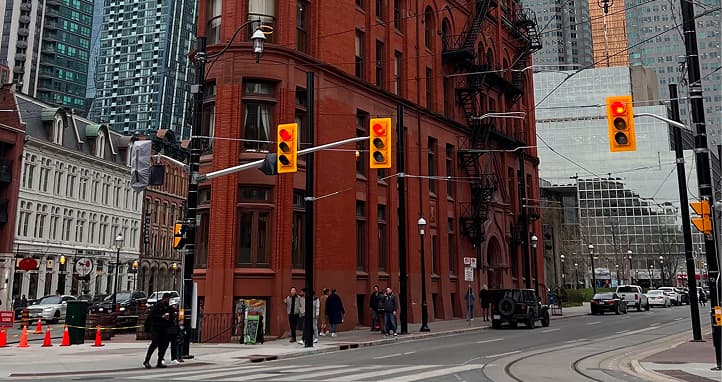
Downtown Toronto
The central historic part of the city.
What's the Real Price Gap Between Moving in the 416 vs 905?
The 416/905 divide isn’t just an area code thing. For moving purposes, it’s the difference between a tactical operation and a straightforward job. Picture Sam in Mississauga: he backs his moving truck straight into a long driveway, loads up his three-bedroom house, and is done in under three hours. Now meet Zoe in King West: her move starts with a frantic search for a legal parking spot, a scramble for the elevator key, and endless trips through narrow hallways. Seven hours later, the same-size move is finally over, with half the time spent waiting instead of moving. This isn’t just about geography—it’s the lived reality of moving in Toronto’s 416 versus the 905 suburbs.
The 416 Experience (Downtown Toronto)
Picture this: your movers arrive at your Victorian semi in The Annex. There’s no driveway. Street parking requires a City of Toronto permit, which you hopefully applied for 10 days ago. The truck blocks a bike lane and a TTC bus route. The front door is up 8 steps. The hallway is 32 inches wide. That sectional sofa from Article? It's not making the turn at the landing.
Now multiply that by 25 floors and add a service elevator with a 4-hour booking window, and you have the downtown condo experience.
Common 416 cost multipliers:
- Parking permits: ~$21-$45
- Long carry fees: $75-$125 (truck can't park within 20 metres of most downtown buildings)
- Stairs fees: $50-$75 per flight (walk-ups in The Annex, Parkdale, Leslieville)
- Elevator wait time: Billed at the hourly rate while your crew stands in the lobby
- Narrow-hallway premium: Some movers charge extra for buildings where standard moving equipment doesn't fit
The 905 Experience (Mississauga, Brampton, Markham, Vaughan, Oakville)
Wide streets. Double-car garages. Driveways that fit a moving truck and two cars. The truck backs right up to the front door. No permits needed. No elevator booking. The movers load, drive, and unload.
A 3-bedroom house in Brampton with a double garage and wide hallways might take 5 hours at $125/hour - that's $625. The same amount of stuff in a 2-bedroom condo at Yonge and Eglinton takes 7 hours because of elevator waits, long carries, and a parking situation that requires a degree in urban planning. That's $875 - for objectively less space and fewer belongings.
The honest math: At the same hourly rate, a downtown Toronto move costs 30-50% more than the same volume of belongings moved in the 905. Not because movers charge different rates - because downtown takes longer. Every. Single. Time.

Toronto, Downtown, Toronto Business Centre
An area with condominiums, numerous cafes and restaurants, and vibrant nightlife.
Who Are the Best-Rated Movers in Toronto?
That $95 to $199 spread across 514 Toronto moving companies isn't random. It reflects two distinct market segments, and understanding which you need is the single biggest decision you'll make.
"Established Professionals": $140-$199/hour
These are the companies that have been navigating Toronto's condo towers and Victorian houses for years. They carry $2-5 million in liability insurance. Their crews know which CityPlace building has the slow freight elevator and which Annex house has the impossible staircase. They've seen it all.
The reviews tell the story. Companies in the $150-$160/hour premium tier consistently earn 5.0-star ratings across hundreds of reviews — some with 150-250+ verified reviews apiece. These operations earn their premium. When a $3,000 marble dining table needs to go down 30 floors and through a loading dock, experience matters.
"Hungry Competitors": $95-$130/hour
This is where Toronto's massive market works in your favour. Several well-reviewed Toronto movers charge $95-$129/hour with 4.8-5.0 star ratings across hundreds of verified reviews — proving that budget doesn't mean bad. You'll find companies at $95/hour with 400+ reviews, others at $109-$120/hour holding perfect 5.0 ratings across 150-350+ reviews.
One standout at $129/hour has accumulated over 1,300 five-star reviews. That's not a budget mover. That's a company that has figured out how to deliver premium service at mid-market pricing. Over a thousand five-star reviews are not an accident.
Our honest take: For a standard condo-to-condo move with IKEA furniture and no antiques, a well-reviewed budget mover in the $95-$130 range is probably the smart call. For a 4-bedroom house in Rosedale with a baby grand piano and your grandmother’s china cabinet, spend the extra. The $50-$70/hour difference adds up to $300-$500 on a typical move. Whether that’s worth it depends entirely on what you’re protecting.
What to Look for in the Best Toronto Movers
With 514 companies competing in the GTA, narrowing down feels impossible. Use these five filters to protect your wallet and sanity: here’s what the data says separates the best from the rest:
Reviews that tell stories, not just stars. Minimum 4.5 stars with at least 50 reviews. Toronto's market is big enough that review manipulation gets diluted - companies with 200+ genuine reviews have earned that reputation. Look for detailed accounts of actual moves, not vague "great service!" comments.
Condo experience. In Toronto specifically, ask: "How many condo moves have you done this month?" A company that primarily handles suburban houses may quote you a great rate but waste two hours figuring out the loading dock at your CityPlace building. Experience with Toronto condo moves is a distinct skill set.
Active insurance with COI capability. Most Toronto condos require a Certificate of Insurance naming the condo corporation. Budget movers sometimes can't provide this. Ask before booking - not on move day.
Clear pricing with Toronto-specific fee disclosure. "We charge $125/hour" isn't a complete answer in Toronto. Ask about stairs, long carry, elevator wait time, travel time, and fuel surcharge. A transparent Toronto moving company will walk you through every possible charge for your specific situation.
Professional communication. In a city of 514 movers, you don't have to settle for someone who takes 3 days to return a call. Responsiveness before the move predicts reliability on move day.
National Van Lines vs. Independent Toronto Movers: What the Price Gap Actually Reflects
Toronto's moving market splits into two tiers that are worth understanding before you book.
National van lines ($155–$200+/hr): The largest national carriers carry enterprise-level liability insurance ($2–$5M+), have corporate relocation programs, and are designed for government postings, long-distance moves, and employer-reimbursed relocations. Their Toronto pricing reflects that overhead — documentation standards, audit trails, national dispatch networks. For a local condo move, that infrastructure rarely translates into a better physical move. If your employer or a government program is paying, national carriers are the safe, paperwork-friendly choice.
Well-reviewed local independents ($95–$140/hr): Toronto's 514-company market contains movers with 4.8–5.0 star ratings across 300–1,300+ reviews at mid-market rates. These companies compete on local knowledge — building-level familiarity with downtown loading docks, heritage staircase quirks, and condo elevator timing patterns. Review volume is the key signal: a 5.0 average from 50 reviews is statistically weak; the same average from 500+ reviews reflects a genuine performance track record.
The decision framework: If your move involves corporate documentation, long-distance transport, or employer reimbursement, a national carrier's overhead adds real value. For a standard 1- or 2-bedroom Toronto move — even a complex condo — a well-reviewed independent at $95–$130/hr typically delivers equivalent physical quality at 20–40% less cost. The premium tier earns its rate on complexity and accountability, not on moving furniture faster.
Local Movers Toronto: Neighbourhoods and Service Areas
Whether you're searching for "movers near me" in Liberty Village or need local movers for a Markham relocation, Toronto's geography creates dramatically different moving experiences depending on where you are.
Toronto Neighbourhoods Served by Local Movers:
Downtown Core: Financial District, Entertainment District, St. Lawrence Market, Harbourfront, CityPlace, Fort York, Bathurst Quay
Midtown & Central: Yorkville, The Annex, Rosedale, Summerhill, Forest Hill, Casa Loma, Yonge and Eglinton, Davisville, Chaplin Estates
East End: Leslieville, The Beaches, Riverdale, Greektown (Danforth), East York, Upper Beaches, Woodbine Corridor
West End: Liberty Village, King West, Parkdale, Roncesvalles, High Park, Junction, Bloor West Village, Swansea, Dovercourt
North York: Willowdale, Bayview Village, Don Mills, Sheppard corridor, Finch corridor, Downsview, York Mills, Lawrence Park
Scarborough: Scarborough Town Centre, Agincourt, Malvern, Rouge, Birch Cliff, Cliffside, Guildwood, Port Union
Etobicoke: Mimico, New Toronto, Long Branch, Islington, Kingsway, Humber Bay, The Queensway
GTA Suburbs (905): Mississauga, Brampton, Markham, Vaughan, Richmond Hill, Oakville, Burlington, Ajax, Pickering, Oshawa, Whitby, Milton, Newmarket, Aurora
The Hardest Toronto Neighbourhoods to Move In
CityPlace / Fort York: The poster child for difficult moves. Over 10,000 units across multiple towers. Loading dock scheduling is competitive. Elevator waits are legendary. Narrow unit hallways. No street parking. If your building has two service elevators, consider yourself lucky - some have one, shared among 800 units. Even experienced Toronto movers budget extra time here.
The Annex / Kensington Market: Victorian-era houses with narrow stairways, tight turns, and zero driveways. Street parking requires permits. Deliveries compete with U of T student traffic. A third-floor walk-up in a hundred-year-old house is essentially a puzzle - getting a queen mattress up those stairs requires geometry skills.
Yorkville / Rosedale: Money doesn't solve logistics. These streets are narrow, winding, and lined with mature trees. Driveways are short. Many homes have been renovated with modern furniture that doesn't fit through heritage doorways. Premium movers who know these addresses charge accordingly.
Harbourfront / Queens Quay: Towers with complex loading dock procedures, condo boards with strict rules, and wind off the lake that makes carrying anything outdoors an adventure. The Gardiner Expressway creates access challenges from certain directions.
Parkdale: Walk-ups everywhere. Street parking is a daily war between residents, commuters, and now your 26-foot moving truck. Beautiful Victorian houses with character-building staircases and impossibly narrow hallways.
Easiest neighbourhoods to move in: Scarborough's post-war bungalows, Mississauga's subdivisions, Vaughan's new builds, Brampton's townhouse developments. Wide streets, driveways, ground-floor access. The suburbs were designed for trucks.
St. Lawrence Market area
A charming neighbourhood just outside downtown.
Piano Movers Toronto: What Specialists Charge vs. General Movers
Toronto has one of the most active piano moving markets in Canada, driven by a city of music conservatories, Victorian walk-ups, and condo towers where a Steinway upright has to navigate a 28-inch doorway and a freight elevator.
Why Piano Moves Are Different
A standard two-person crew at $125/hr can move your couch and dining table. A piano is different. An upright weighs 180–270 kg and has to be balanced while navigating stairs. A baby grand requires disassembly, specialized rigging, and reassembly at the destination. The wrong equipment or an untrained crew is a costly damage claim waiting to happen — and pianos are not standard household goods when it comes to insurance valuation.
How Piano Movers Price the Job
Dedicated piano movers in Toronto typically quote fixed rates per job rather than hourly — the job is scoped by instrument type, floor access, and building logistics, not by time alone. Get a written fixed-rate quote before booking, not an hourly estimate. The fixed-rate structure protects you from a slow job running over, and protects the mover from underquoting a complex building situation.
For condo piano moves, the standard Toronto condo complexity applies — elevator booking, loading dock access, COI requirements — on top of the instrument-handling challenge. Mention your building type, floor, and elevator access when requesting quotes.
The Annex and Rosedale Problem
These neighbourhoods present the hardest piano moves in the city. Stairways built in 1910 were designed for people and trunks, not a 230 kg upright. Companies that specialize in Toronto piano moves have navigated these properties hundreds of times. A general mover encountering a Rosedale heritage staircase for the first time may take three hours where a specialist takes ninety minutes.
Appliance Movers Toronto
The same specialist logic applies to heavy appliances: fridges, washers, dryers, dishwashers. Stair climber dollies, appliance straps, and experience disconnecting plumbing properly matter. For condo buildings, verify that your mover has handled appliance moves in high-rise buildings specifically — the freight elevator timing and building access rules are the same complications as any Toronto condo move, plus the disconnection/reconnection skill.
Compare piano and specialty movers in Toronto on Boxly to find companies with specific experience for your instrument type and building.
What to Ask a Piano Mover Before Booking
- Do you have a piano board and stair-climbing dolly? Not every mover does. General movers sometimes attempt piano moves with furniture dollies — ask specifically.
- Have you done this building before? For condo moves, a mover who has navigated your building's loading dock and elevator knows the timing and access challenges.
- Is the rate fixed or hourly? Piano specialists typically quote fixed rates. Hourly pricing for a specialty job creates incentive to be slow.
- What insurance covers damage to the piano? If the instrument has significant monetary or sentimental value, confirm valuation coverage before booking.
- Do you disassemble and reassemble baby grands? This requires technical knowledge of the instrument. Ask for piano-specific references if your instrument requires disassembly.
Moving Companies in North York Toronto: Local Expertise for a Distinct Market
North York occupies a distinctive position in the Toronto moving market: close enough to downtown to be covered by all 514 GTA movers, but operationally different enough to warrant its own consideration.
What North York Actually Covers
North York is a swath of the former City of North York that merged into the amalgamated City of Toronto in 1998. For moving purposes, it includes:
- Willowdale (Yonge and Sheppard, Mel Lastman Square area): High-rise residential corridor, condo-heavy, elevator bookings required — but with somewhat easier logistics than downtown due to newer buildings and less congested loading infrastructure
- Bayview Village: Upscale mid-rise and detached, excellent truck access, well-designed residential streets
- Don Mills: Canada's first planned community — wide curved streets, townhouses and detached homes, among the easiest move logistics in the entire GTA
- Sheppard Corridor (Sheppard and Leslie east to Consumers): Mixed high-rise and townhouse, newer buildings with better loading infrastructure than downtown towers
- Finch Corridor: Largely post-war bungalows and apartment towers, broad commercial streets with good access
- Downsview: Diverse housing stock, York University proximity drives student moving demand, generally straightforward access
Why North York Moves Cost Less Than Downtown
The main cost factors that inflate downtown Toronto moves — freight elevator wait times, one-way street navigation, COI requirements, underground loading docks, and simultaneous move congestion — are reduced in North York. Most North York residential streets accommodate a 26-foot moving truck without parking permits. Suburban detached homes and low-rise apartments have surface driveways and ground-floor access.
Typical North York moving costs (2026):
- Studio or 1-bedroom apartment (low-rise): $350–$550, 3–4 hours
- 1-bedroom high-rise (Yonge-Sheppard corridor): $450–$700, 3–5 hours
- 2-bedroom detached or townhouse: $550–$850, 4–6 hours
- 3-bedroom detached: $750–$1,200, 5–7 hours
These are 15–30% lower than equivalent downtown Toronto moves.
Finding Movers Who Know North York
All 514 Toronto movers serve North York, but local familiarity matters. A company based in North York or with regular experience in Willowdale and Bayview Village navigates Don Mills' curved streets and the Sheppard corridor access roads without GPS confusion. Compare moving companies in North York Toronto on Boxly and filter by service area to find companies who list North York as their primary territory.
How Much Do Tech Corridor Moves Cost in Toronto?
Toronto's tech boom has created a distinct moving pattern: young professionals cycling through the same high-density neighbourhoods on 12-18 month lease rotations. If you're a software engineer moving from Liberty Village to King West, or a startup founder relocating from CityPlace to the emerging East Harbour, you’re part of a migration pattern that Toronto movers know well.
The Tech Corridor Loop:
- Liberty Village: The original tech hub. Condo towers packed with remote workers. Moving in and out requires navigating the Liberty Village traffic circle, limited loading zones, and buildings designed before anyone imagined this many people living here
- King West: The upgrade from Liberty Village. Sleeker buildings, better restaurants, same condo logistics. The Entertainment District bleeds into King West, meaning weekend moves compete with construction and event traffic
- CityPlace: The density hub. More affordable units, more complex buildings. Moving here means mastering the loading dock reservation system and accepting that your elevator window is non-negotiable
- East Harbour / Port Lands: Toronto's emerging tech campus. Still developing, which means construction traffic competes with moving trucks. The payoff: newer buildings with better loading infrastructure
- Yonge and Eglinton: Midtown tech migration. The Eglinton Crosstown construction has made moving here a logistics challenge, with road closures and truck routing restrictions that add time and cost
The Pattern: These are almost exclusively condo-to-condo moves. Same furniture (IKEA Kallax shelves, Article sofas, standing desks), same challenges (elevator booking, parking, long carries), same 1-2 bedroom unit sizes.
Smart approach: If you're doing this move, you probably don't need a premium white-glove service. A well-reviewed mover in the $100-$130 range who specializes in condo moves is likely the right fit. Several companies in this price range handle these tech corridor moves all day, every day — they know your building's loading dock procedure better than you do.
Browse Toronto condo movers on Boxly to find companies with specific experience in your building or neighbourhood.

Toronto. CN Tower
The city's observation tower, featuring a rotating restaurant.
How Does the September Student Surge Affect Toronto Moving Prices?
Every Canadian city has a September moving bump. Toronto has a September earthquake.
Four major universities - University of Toronto, Toronto Metropolitan University (formerly Ryerson), York University, and Humber College - plus a constellation of smaller institutions, funnel tens of thousands of students into a handful of neighbourhoods during the last week of August and the first week of September.
The Impact Zones:
- The Annex: U of T's backyard. September 1st in The Annex is a spectacle - moving trucks double-parked on Bloor, students hauling mattresses down Spadina, the intersection of Harbord and Bathurst becomes a loading zone. Booking a mover for September 1st in The Annex is effectively impossible if you wait until August.
- Kensington Market: Adjacent to U of T, cheaper rents, even narrower streets. Moving here in September means competing with food delivery trucks, market vendors, and 47 other people moving into the same block
- Bloor West / High Park: York University student overflow. More suburban feel, but still congested in early September
- North York (Keele & Finch): York University's immediate neighbourhood. Student housing turnover is massive
- Dundas & Jarvis area: TMU student territory. Downtown location means all the urban moving challenges amplified by student volume
Student Moving Strategies:
1. Avoid September 1st. This is the single most important piece of advice. If your lease starts September 1st, negotiate early access on August 29th or 30th. The difference in mover availability (and price) is dramatic. Labour Day weekend is nearly as bad.
2. Split costs with roommates. A 2-person crew at $125/hour for 3 hours is $375. Split among three roommates, that's $125 each - comparable to renting a van and destroying your back.
3. Book micro-movers for small loads. Several Toronto companies offer small-load services specifically for student moves. You don't need a 26-foot truck for a bedroom's worth of furniture.
4. Book in July. Seriously. By mid-August, every reputable Toronto mover is fully booked for the September window. The companies with availability on September 1st at that point are either brand new or have a reason they're not booked.
5. Consider off-peak alternatives. Some budget movers in Toronto offer September specials for weekday moves. Tuesday September 3rd is dramatically easier than Saturday August 31st.

University of Toronto
The globally top-ranked public research university in Toronto.
When Is the Cheapest Time to Move in Toronto?
Toronto's moving calendar is shaped by three forces: weather, lease cycles, and the sheer volume of people competing for the same moving crews. The goal is to find windows where all three work in your favour.
Toronto Moving Calendar:
The city has distinct moving seasons that don’t perfectly align with the actual seasons.
- The Dead Zone (January-March): Cold, yes. But this is when Toronto movers are hungry for work. Rates are negotiable. Availability is wide open. If you can handle moving in -10°C, you'll save 15-20% and have your pick of companies
- The False Spring (April-May): Warming up, but still off-peak. Good balance of weather and pricing. May long weekend is a mini-peak - avoid it
- The Frenzy (June-August): Peak season. Every weekend is booked. Month-end dates are chaos. Expect to pay full rates with zero negotiating leverage
- The September Tsunami: See the university section above. The worst single week to move in Toronto, bar none
- The Sweet Spot (October-November): Weather is still pleasant, summer rush is over, students are settled. This is the best time to move in Toronto if you have any flexibility
Day of Week Matters
Tuesday through Thursday means less competition for crews. Saturday is the most expensive day. Sunday availability is limited - many Toronto buildings don't allow Sunday moves anyway.
Mid-month beats the first and last weeks when leases turn over and everyone moves simultaneously.
Toronto Weather and Moving
Toronto's climate is genuinely four-season, and each creates specific moving considerations.
Winter (December-February) hovers between -15°C and -1°C — cold but manageable, and the cheapest time to move in the city. Most days are workable, and underground condo parking means your belongings rarely touch the outdoor air. Spring (March-May) ranges from 2°C to 18°C with unpredictable rain; it's solid value before summer pricing kicks in, though March can swing 20°C in a single week. Summer (June-August) brings 22°C to 35°C — the best weather, the highest prices, and a humidity factor that genuinely slows crews down. Then there's fall (September-November) at 5°C to 20°C: ideal moving conditions undermined by September's university-driven demand spike. October and November are Toronto's true sweet spot.
Summer humidity: Toronto's July and August humidity isn't just uncomfortable - it's a moving factor. Movers work more slowly in 35°C with 80% humidity. Heat exhaustion is real. Some companies limit working hours on extreme heat days. Your move might take longer than estimated.
Winter's surprise advantage: Toronto winters are milder than Calgary, Edmonton, or Ottawa. Most days are workable. Underground parking in condos means your belongings never touch the cold. The real challenge is ice on walkways and driveways - Toronto movers won't carry heavy items on icy surfaces for liability reasons. Salt your path before they arrive.
Spring's false starts: March in Toronto can be 15°C on Monday and 5°C with freezing rain on Wednesday. Book a spring move, but have a weather contingency plan.
The best months to move in Toronto are October and November - comfortable temperatures, post-summer pricing, excellent availability, and no student surge to compete with.

Toronto in autumn
The most beautiful time of year in Ontario.
How Much Does a Long-Distance Move From Toronto Cost?
The pricing model shifts fundamentally once you leave the GTA. Local Toronto movers charge by the hour. Long-distance moves are quoted by weight and distance.
Local Zone (Hourly Rates)
Everything within the GTA uses hourly billing — your movers charge for time spent loading, driving, and unloading. Mississauga (28km), Vaughan (28km), Richmond Hill (30km), and Markham (32km) are all solidly in the hourly zone. Brampton and Oakville (both ~40km) are standard local moves. Even Hamilton at 70km down the QEW stays hourly for most companies. Barrie, at 108km, sits on the boundary — some movers quote hourly, others switch to flat rates.
Long-Distance Routes from Toronto
Beyond ~100km, pricing switches to weight-based flat rates. Boxly tracks 5 dedicated long-distance movers in Toronto with a median rate of $0.85 per pound.
Hamilton (70km) is the closest intercity route, and it still costs $500-$900 for a two-bedroom move. Barrie (108km) flips to flat-rate territory at $600-$1,000. Head to Niagara Falls (130km) and you're looking at $1,200-$2,200. The two big Ontario corridors – Ottawa (450km, $2,000-$4,000) and Montreal (540km, $2,500-$5,000) — are the most common long-haul routes from Toronto, priced entirely by weight. Cross-country moves to Calgary (3,400km, $4,500-$8,000) and Vancouver (4,400km, $5,000-$10,000) require 7-14 days transit time, and shared-load options can cut costs if you're flexible on delivery dates.
The GTA traffic factor: A Scarborough-to-Mississauga "local" move is 50km. On a good day. With the Gardiner and the 401, that drive can take 90 minutes each way. Some movers bill travel time from their depot. If they're based in North York and you're moving from Scarborough to Etobicoke, that's potentially 2-3 hours of driving time on the clock. Ask where they're based, and when billing starts.
For long-distance quotes: Always request in-home or virtual estimates. The difference between "I don't have that much stuff" and your actual inventory is typically 30%. That Peloton you forgot about? It weighs 135 pounds.
Toronto Moving Truck Parking Permits
Where will the 26-foot truck park? In Toronto, this question is not optional - it can determine whether your move goes smoothly or descends into chaos.
City of Toronto Temporary "No Parking" Permits
If you're moving in downtown Toronto, Midtown, or any neighbourhood with residential permit parking, you need a temporary parking permit for the moving truck.
Permit Details:
- Apply through the City of Toronto website
- Processing: 3-5 business days (do not wait until the last minute)
- Cost: $20.74 per 24 hours, $29.97 per 48 hours, or $44.94 per week, plus HST
- Temporary "No Parking" signs must be posted 24 hours before the move
- The permit reserves a specific space for your moving truck
Do You Need a Permit?
- Downtown / Midtown / Annex / Parkdale / Leslieville: Almost certainly yes
- Residential permit zones: Yes, if on-street parking is restricted
- Suburbs (Scarborough, North York, Etobicoke): Usually, no – driveways and wide streets mean the truck has space
- 905 municipalities: Different permit processes - check with Mississauga, Brampton, Markham, etc. directly
- Condo buildings: The building typically handles loading dock reservations separately
Without a permit:
Green P enforcement in Toronto is aggressive. A moving truck parked illegally downtown will get a $150+ ticket within the hour. In some areas, illegally parked commercial vehicles can be towed. That's a $300-$500 tow fee plus the ticket - and your move grinds to a halt while you sort it out.
Budget the ~$21-$45 permit fee. It's one of the cheapest forms of insurance on your entire move.
Some established Toronto moving companies handle permit applications as part of their service. Ask when booking - it's one fewer thing on your list.
The Condo Exodus and Return: How Toronto Rates Surged 22% and Stabilized
Context matters. Where does today's $125/hour median sit in historical perspective?
Toronto's moving rates surged during the pandemic - but not for the reason most people assume. It wasn't just inflation. The 2020-2022 period saw an unprecedented wave of Torontonians fleeing downtown condos for suburban houses, then moving back as offices reopened, then moving again as remote work settled in. Moving volume spiked while crew availability dropped (due to pandemic restrictions and border closures limiting immigrant labour).
The result: a roughly 22% increase in rates from 2020 to 2024.
But 2025-2026 tells a different story. New companies entered the market aggressively. The immigrant workforce returned and expanded. Toronto's mover count grew to 514 active companies - creating pricing pressure that has stabilized rates.
The current $125/hour median is actually reasonable by historical standards. Adjusted for inflation, it's comparable to 2019 rates. The market has corrected itself.
2026 Outlook: Expect the $120-$130/hour median to hold through the year. Toronto's sheer market density - 514 companies serving a metro area of 6+ million people - creates a natural pricing equilibrium. Dramatic increases would require a supply shock (movers leaving the market), which is unlikely given current immigration patterns and economic conditions.
What could change: fuel prices. A significant fuel cost spike would push the median up $5-$10/hour across the board. But the base rate? It's found its level. Consumers in 2026 are getting fair value at $125/hour.
Is It Worth Hiring Movers in Toronto?
The temptation to DIY is understandable. Rent a U-Haul, bribe friends with pizza, save hundreds. In theory.
In Toronto, the math doesn't just "not work" — the city actively fights your DIY plan in ways that don’t exist in Calgary, Edmonton, or Ottawa.
The Condo Wall: Why DIY Fails Before It Starts
Here's what kills most Toronto DIY moves before a single box gets loaded: your condo won't let you. Most buildings require a Certificate of Insurance (COI) from the moving company. Your buddy with a pickup doesn't carry $2 million in liability coverage. Without that COI, the concierge won't give you the freight elevator. Without the freight elevator, you're carrying a sofa down 25 flights of fire stairs. Good luck.
Even if your building is lenient, the elevator booking is the hard constraint. You get a 4-hour window. Professional movers with a crew of three can load a one-bedroom in that window. You and two friends who've never moved a couch through a narrow condo hallway? You'll blow past the time slot, lose the elevator, and face a rebooking fee.
The Parking Nightmare
Try parking a 26-foot U-Haul on a downtown Toronto street without a permit. Green P enforcement issues $150+ tickets within the hour. Applying for a temporary parking permit takes 3-5 business days — how many DIY movers plan that far ahead? And that's if you can even find a legal spot. Near TTC subway stations, there's literally no legal truck parking within 200 metres of most addresses.
The GTA Traffic Multiplier
A "quick trip" from Scarborough to Etobicoke? That's 2+ hours on the 401 during any reasonable moving time. In a rented truck that maxes out at 100km/h and handles like a boat. Your $120 U-Haul rental covers one day, but a GTA move in traffic can easily eat that entire day on driving alone. If you need a second day, the rental doubles.
The September U-Haul Famine
Planning a DIY move in late August or early September near U of T, TMU, or York? U-Haul trucks within a 30km radius of campus are sold out weeks ahead. The rental locations near The Annex and Kensington Market might as well not exist during frosh week. Even if you find a truck in Mississauga, you're burning 90 minutes of your rental just driving it downtown.
Where DIY Actually Makes Sense: The 905
Here's the honest take. If you're moving between suburban houses in the 905 — Brampton driveway to Markham driveway, ground-floor access, no condo rules — DIY can genuinely save money. The truck backs up to your door. No permits needed. No elevator booking. No COI. Wide streets, easy parking. This is what U-Haul was designed for.
The Real Cost Comparison
DIY in Toronto runs $400-$700 in hard costs (truck rental at $120-$350, fuel at $50-$80, damage waiver at $30-$50, equipment at $50-$100, parking ticket at $150+) plus your entire day, your friends' goodwill, and the risk to your furniture and your condo's hallway. Professional Toronto movers handle a typical two-bedroom condo for $700-$1,200 – insured, COI-compliant, done in 4-6 hours.
The delta is $300-$500. In the 905 suburbs with driveways, that delta is worth pocketing. In a downtown condo tower? The $300 you "save" buys you a day of stress, a parking ticket, and a scratch on your building's elevator that costs you your deposit.
How Do You Choose the Right Moving Company in Toronto?
514 options. How do you narrow that down without losing your mind? In Toronto, the answer isn't "find the cheapest quote." It's "find the company that already knows your building."
Start with the Condo Question
If you're moving in or out of a condo — and statistically, you probably are — this is filter number one. Ask the mover: "Do you have a COI on file for [your building or property management company]?" Experienced Toronto movers who regularly work in CityPlace, Tridel, or Menkes buildings already have standard COIs prepared. A company that asks "What's a COI?" is telling you they don't do condo moves often. Next.
Ask About Their Elevator Booking Process
This question alone separates the Toronto veterans from the newcomers. A mover who has done 50 moves in your building knows the loading-dock procedure, the elevator booking quirks, and which concierge is flexible on timing. Ask: "How do you typically handle the elevator booking at [your building]?" If they have a specific answer, they've been there before. If it's vague, they're learning on your dime.
Verify GTA Coverage (Not All "Toronto" Movers Go Past Steeles)
Some companies listed as "Toronto movers" are downtown-only operations. If you're moving to Markham, Mississauga, or Brampton, confirm that they service the 905 area code. Conversely, if your mover is based in Brampton and you're downtown, ask when billing starts — the drive from their depot to your condo is potentially 60+ minutes each way.
The September Test
If you're moving between August 15 and September 15, ask about availability now. Reputable movers book out 6-8 weeks ahead for the September window. A company with wide-open availability on September 1st either just launched or has a reason they're not booked.
Check Reviews for Condo Moves Specifically
A five-star review from a Brampton house move tells you very little about how that company handles a 30th-floor condo in Harbour Square. Look for reviews that mention specific buildings, elevator logistics, or downtown challenges. On Boxly, you can filter reviews by move type.
Ask About Their Parking Strategy
"Where will the truck park at [your address]?" is the most Toronto question you can ask a mover. A company that answers confidently — "We'll use the loading dock on the south side" or "We'll need a temporary parking permit on your street, I can handle the application" — knows your neighbourhood. A company that says "We'll figure it out" will figure it out on the clock, at your hourly rate.
Red Flags That Are Worse in Toronto:
- Can't provide a COI (your building will turn them away at the door)
- No answer on elevator booking logistics (they'll waste your reserved time slot figuring it out)
- "We charge $89/hour" with no mention of extras (that $89 becomes $160 with stairs, long carry, travel, and fuel — guaranteed)
- Asking for cash-only payment (legitimate Toronto companies accept cards)
On Boxly, COI capability, insurance status, pricing, and neighbourhood-specific reviews are all visible on mover profiles — compare Toronto movers to see who actually knows your building.
How We Calculate Toronto Moving Costs
Understanding how we arrive at these numbers matters. Our methodology isn't rocket science – it's just rigorous data collection and statistical honesty.
Data Sources
According to Boxly's comprehensive marketplace analysis as of February 2026:
- Live pricing from 514 active Toronto moving companies – verified business licenses, current contact information, active booking systems
- 57,529 verified Google reviews – updated weekly, cross-referenced with Better Business Bureau ratings
- Hourly rates by crew size – 2-person teams, 3-person teams, 4-person teams
- Real booking data from Boxly marketplace – actual transactions from 2024-2026, not marketing claims
- Service area verification – confirmed coverage for Toronto, Mississauga, Brampton, Markham, Vaughan, and entire GTA
Calculation Method
Median pricing, not average – We use median rates because they represent the middle 50% of movers and exclude extreme outliers. The median $125/hr means half of Toronto movers charge more, half charge less.
70% outlier threshold – According to our statistical standards, any mover charging below 70% of the market median ($87.50/hr or less) gets excluded from rate calculations. Why? These are often bait-and-switch operations or companies missing critical insurance. They skew the data and don't represent legitimate pricing.
Price ranges represent 25th to 75th percentile – When we say $700-1,200 for a 2BR condo, that's the middle 50% of actual quotes. 25% of movers charge less, 25% charge more. This gives you realistic budget expectations, not best-case fantasies.
Confidence intervals – Statistical ranges like "Median $125/hr (±$15 standard deviation)" mean 68% of Toronto movers fall within $110-140/hr. The ± shows you the spread, not just the center point.
Update Frequency
We're not publishing stale data and calling it research:
- Pricing data: Updated monthly from active marketplace listings
- Review counts: Updated weekly via automated Google Business Profile API
- Content refresh: Quarterly reviews (January, April, July, October) to catch seasonal shifts
- Last major update: February 2026
According to Boxly's data pipeline, the median rate of $125/hr you see on this page was calculated from pricing active as of February 1-15, 2026. Not last year's numbers, not aspirational estimates – current market reality.
Why This Matters
Transparency builds trust. Other sites show you "average moving costs" without explaining where those numbers come from. We're showing you the methodology so you can judge the credibility yourself. When we say Toronto's median rate is $125/hr based on 514 active companies, you know exactly what that means – and what it doesn't.
Our goal: Give you enough data to negotiate intelligently. You're not trying to memorize statistics – you're trying to avoid getting ripped off. Knowing that 95% of legitimate Toronto movers charge between $98-189/hr gives you instant BS detection when someone quotes you $65/hr or $250/hr.
Moving to Toronto: What the 416/905 Divide Means for Your Move
Toronto's vertical density, the 416/905 divide, and the condo-dominated housing stock explain the patterns of movement in this guide.
Why people move here (and why 514 movers exist): Toronto is Canada's economic centre — Big Five bank HQs, a tech sector rivalling Austin, world-class universities and hospitals. Net migration to the GTA exceeds 100,000 annually. This demand sustains 514 active moving companies and keeps the market competitive despite the city's complexity.
The vertical city problem: Toronto has more high-rise residential buildings than any North American city outside Manhattan. Over 70% of downtown moves involve condos or apartments — meaning elevator bookings, COI paperwork, loading dock scheduling, and time-restricted windows. This is fundamentally different from Calgary or Edmonton where 60%+ of moves involve houses with driveways. The $125/hr median is identical to Calgary's, but the total bill is consistently higher because condo logistics add 1-3 hours of non-loading time.
The 416/905 divide is real for moving: Within the 416 (City of Toronto proper), expect parking permits (~$21-$45), narrow Victorian-era streets, limited loading zones, and buildings where the elevator is your bottleneck. In the 905 (Mississauga, Brampton, Markham, Vaughan, Oakville), expect driveways, garages, double-car widths, and ground-level access. Same hourly rate, 30-50% lower total cost in the 905.
Housing stock by area: Downtown/Midtown is condo-dominated. The East End (Leslieville, Beaches) mixes Victorian houses with new condos. The West End (Junction, Roncesvalles) features narrow lots and 2- to 3-storey walk-ups. North York and Scarborough mix suburban houses with condo clusters at major intersections. Each area presents different moving challenges and costs.
Traffic patterns that affect your move: The Gardiner Expressway and DVP are Toronto's arterial bottlenecks. A move from Scarborough to Etobicoke during rush hour can add 45-60 minutes of billable drive time per trip. The 401 corridor is Canada's busiest highway. Smart movers schedule around peak hours or use residential routes.
Growth direction: The GTA is building outward (Milton, Pickering, Ajax) and upward (every major intersection is getting condos). Both patterns sustain moving demand — suburban expansion creates house-to-house moves, densification creates condo-to-condo lateral moves within the core.
Find Your Toronto Mover
Picture next month’s moving day chaos spilling out onto your building entrance: movers idling by the curb, trucks circling for a legal spot, a frustrated concierge guarding a clipboard, and the clock ticking down on your narrow elevator window. Your building needs a freight elevator booking with two weeks’ notice. The property manager wants a Certificate of Insurance before they will even confirm your slot. The loading dock has a strict 4-hour window, and if your movers run late, you’ll have to reschedule the entire thing. Meanwhile, you’re trying to figure out which of 514 companies actually knows how to handle a condo move without blowing past your reserved time.
That’s exactly why Boxly exists for Toronto. Not to give you another generic list of phone numbers – but to let you filter by COI capability, building experience, and verified insurance before you even pick up the phone.
Moving somewhere in the 416? The 905? Anywhere across the GTA? It doesn’t matter. Boxly covers the entire Greater Toronto Area – Etobicoke to Scarborough, Vaughan to Mississauga, Markham to Burlington. One search. Every licensed mover in your area.
And if you’re planning a September move – especially near U of T, Ryerson, or York – stop reading and start comparing today. Student season turns Toronto into a moving war zone. The best-rated companies with condo experience are fully booked by mid-August. Waiting until Labour Day weekend to start looking is how you end up paying $1,800 for a one-bedroom.
Skip the spreadsheet. Skip the 50 phone calls that end up in voicemail. Skip the “we’ll send you a quote in 3-5 business days” runaround. On Boxly, pricing, reviews, insurance verification, and service details are all visible instantly – side by side, for every mover in your neighbourhood.
In a city where the best movers book out weeks in advance, the advantage goes to whoever starts comparing first. Browse Toronto movers on Boxly and lock in your move before someone else takes your slot.

Boxly helps you find and book movers anywhere in Canada
Search, compare, and hire movers all in one place.
Frequently Asked Questions
Why does a 30th-floor condo move cost more than a house move in Toronto?
Three reasons unique to Toronto high-rises: elevator logistics, building fees, and time windows. Most Toronto condos give you a single freight elevator for a max of 4 hours. Your movers spend 30-60 minutes just waiting for elevator cycles on busy move days. Buildings charge $200-$500 in refundable deposits plus $150-$300 non-refundable move-in fees. Add the mandatory Certificate of Insurance (COI) your mover must provide. A 2-bedroom house move with a driveway: $700-$1,200. The same volume in a CityPlace tower: $1,000-$1,600. The furniture is identical – the building is the tax.
What is the COI requirement for Toronto condo moves?
A Certificate of Insurance (COI) names your condo corporation as an additional insured on the mover's policy. In Toronto, virtually every condo building requires one before allowing access. Your mover requests it from their insurer (takes 1-3 business days), and you submit it to building management. No COI, no freight elevator. This is why hiring an uninsured mover for a Toronto condo is a non-starter — 244 of 514 companies on Boxly carry verified insurance. Ask any prospective mover to provide a COI before booking.
How does the September student surge affect Toronto moving prices?
September 1st is Toronto's worst moving day — not July 1st like Montreal. Over 200,000 students return to U of T, TMU, York, and Humber, triggering a wave of lease turnovers in The Annex, Kensington Market, Harbord Village, and Bloor West. Mover availability drops to near-zero. Rates spike 20-40% above normal. Streets around campus clog with trucks, U-Hauls, and parents' minivans at the same time. If you're not a student, avoid booking August 25 through September 7. If you are a student, book movers by mid-July or expect to carry your IKEA bed up three flights yourself.
How much does a condo move cost in Toronto?
A Toronto condo move typically costs $200-$600 more than an equivalent apartment or house move due to the "condo moving tax" - elevator booking, loading dock scheduling, COI requirements, and time-restricted windows. A 1-bedroom condo move runs $600-$900, while a 2-bedroom condo costs $900-$1,400. Premium buildings in CityPlace, Harbourfront, and Yorkville may add $200-$500 in elevator deposits and move-in fees. Budget extra for buildings with single-service elevators or complex loading dock procedures.
Do I need an elevator booking for my Toronto condo move?
Yes - virtually every Toronto condo requires an elevator booking for moves. Most buildings require 2-4 weeks’ advance notice. Expect $200-$500 refundable deposits in premium buildings and $150-$300 non-refundable move-in/move-out fees. Time windows are typically 9am-4pm weekdays, with limited Saturday availability. Your moving company must provide a Certificate of Insurance (COI) naming the condo corporation as an additional insured. Contact your building management before booking movers to get all requirements in writing.
What are the hardest Toronto neighbourhoods to move into?
CityPlace/Fort York is the most challenging due to high density, competitive elevator scheduling, and complex loading dock procedures. The Annex and Kensington Market have narrow Victorian staircases, zero driveways, and street parking wars. Yorkville and Rosedale have narrow winding streets despite premium prices. Harbourfront towers have strict condo board rules and are subject to wind exposure. Parkdale features walk-ups with tight hallways. The easiest neighbourhoods: Scarborough bungalows, Mississauga subdivisions, Vaughan new builds - anywhere with driveways and wide streets.
How much does it cost to move from Toronto to Montreal?
Moving from Toronto to Montreal (540km) typically costs $2,500-$5,000 for a 2-bedroom household. Long-distance moves are priced by weight and distance, not by the hour. Our data shows a median long-distance rate of $0.85 per pound across Toronto's 5 dedicated long-distance movers. A typical 2-bedroom weighs 4,000-6,000 lbs. Always get an in-home or virtual estimate - phone quotes are typically off by 20-30%. Book 4-6 weeks ahead for the best rates.
How does moving near Rogers Centre on a game day work in Toronto?
Game days at Rogers Centre create a moving nightmare in the Entertainment District and CityPlace. Road closures along Bremner Boulevard, surging pedestrian traffic on Blue Jays Way, and parking enforcement clearing truck zones near the stadium can cost you 1-2 hours of billable time. If you live within a 5-block radius of Rogers Centre and have a move scheduled on a Jays home game or a concert night, confirm event timing at rogerscentre.com before locking in your move window. Experienced Toronto movers will suggest starting before 9am to finish loading well before the pre-game congestion hits around 4pm for evening events.
Is it cheaper to move from Toronto to the 905?
Moving within the GTA (Toronto to Mississauga, Brampton, Markham, etc.) uses hourly rates, the same as any local move. The 905 destination itself is typically cheaper to move into - wide streets, driveways, and easy access mean faster loading and unloading. A Toronto-to-Mississauga move (28km) for a 2-bedroom might cost $600-$900. The same volume moved downtown-to-downtown could cost $900-$1,300 due to access complications. The hourly rate is the same; the total hours are what differ.
When is the worst time to move in Toronto?
September 1st is the single worst day to move in Toronto. University lease turnovers at U of T, TMU, York, and Humber create a moving tsunami in The Annex, Kensington Market, and surrounding neighbourhoods. Every mover is booked, rates spike, and streets become gridlocked with trucks. The Labour Day weekend is nearly as bad. Beyond September, avoid month-end weekends in July and August (standard peak season) and the May long weekend. The best times: October-November and January-March.
Do Toronto movers handle TTC-adjacent addresses?
Yes, but some charge a premium of $50-$100 for addresses within 200 metres of TTC subway stations. The reason: narrow streets near stations often have no legal truck parking, bike lanes that prevent double-parking, and TTC bus routes that attract enforcement attention. Movers may need to park further away, increasing carry distance and time. When requesting quotes for TTC-adjacent addresses, mention the nearest intersection so movers can assess parking options. A temporary parking permit from the City of Toronto (~$21-$45) can help secure legal parking.
How do I get a parking permit for a moving truck in Toronto?
Apply through the City of Toronto website for a Temporary "No Parking" permit. Processing takes 3-5 business days. Cost is $20.74 per 24 hours, $29.97 per 48 hours, or $44.94 per week, plus HST. You must post temporary no-parking signs 24 hours before the move. In downtown, The Annex, Parkdale, Leslieville, and any residential permit zone, this permit is essentially mandatory. Without one, expect $150+ tickets. Some established Toronto movers handle permit applications as part of their service.
How do Don Valley Parkway closures affect Toronto’s moving routes?
The DVP closes partially or fully for maintenance on select weekends (usually spring and fall), and accidents can shut lanes for hours on any given day. If your move crosses the city north-south on the east side — say, Scarborough to downtown or Don Mills to the Distillery District — a DVP closure reroutes your truck to Bayview Avenue, the 404, or local streets, adding 30-60 minutes per trip. At $125/hour, two round-trip DVP detours can add $125-$250 to your bill. Check the City of Toronto road closure calendar before your move date, and ask your mover what their backup route is if the DVP is down. Crews based in Scarborough or the East End deal with this routinely and have alternate routing strategies.
How does the Gardiner Expressway affect my Toronto moving quote?
The Gardiner and DVP create a time tax on cross-city moves. A Scarborough-to-Etobicoke move that takes 25 minutes on a Sunday takes 90+ minutes during weekday rush hour — and you're paying hourly. Movers factor this in: quotes for moves crossing the downtown core during peak hours include 1-2 extra hours of drive time. The fix: schedule your move to start at 7am (before traffic) or choose a weekend. Some movers will do a "split load" — pack one day, deliver the next — to avoid the worst traffic windows entirely.
What's the real price difference between a 416 and 905 move?
The hourly rate is identical – $125/hr median across the GTA. But the total cost diverges sharply. A 2-bedroom move in Mississauga (driveway, parking, wide streets) takes 4-5 hours: $500-$625. The same volume in a downtown 416 condo (elevator wait, long carry, parking search, COI paperwork) takes 6-8 hours: $750-$1,000. That's 50-60% more, same furniture. The 905 also has fewer peak-season bottlenecks – you can book a Brampton move with 1 week’s notice in August. Try that in Liberty Village.
Can I move into a Toronto condo on the weekend?
Some buildings allow Saturday moves (usually 9am-4pm), but Sunday moves are rarely permitted. Many newer buildings in CityPlace, Harbourfront, and King West restrict moves to weekdays only. Always check with your building management first — some charge a premium for weekend elevator bookings ($100-$300 extra). The silver lining: weekday moves are cheaper from the mover's side (10-20% less), so the building's restriction accidentally saves you money on labour.
How do Liberty Village and King West's narrow streets affect moving costs?
Liberty Village was designed for cars, not 26-foot moving trucks. One-way streets, no-stopping zones, shared laneways, and zero visitor parking create a logistics puzzle. Movers familiar with the area know the loading spots (the brief legal zone on Liberty Street, the alley behind the Toy Factory Lofts). Unfamiliar movers may circle for 20 minutes and start the clock while parked illegally. King West adds streetcar tracks and bike lane enforcement. Expect $100-$200 in extra time costs compared to a straightforward neighbourhood. Ask prospective movers specifically about their experience in Liberty Village.
What should I know about moving to The Annex or Kensington Market?
Victorian houses with no driveways, narrow interior staircases, and some of Toronto's most competitive street parking. Your mover will charge stair fees ($50-$75 per flight) and long carry fees ($75-$125 if the truck parks more than 30 metres away). Many Annex homes have tight 90-degree turns between floors that require furniture disassembly. Kensington Market adds the complication of market-day pedestrian traffic. A parking permit (~$21-$45) is essential here — tickets run $150+ and are frequent. Book movers who know these blocks.
What should I know about moving from Toronto to Muskoka cottage country?
Moving from Toronto to Muskoka (Gravenhurst, Bracebridge, Huntsville — 170-230km via Highway 400 and Highway 11) is a seasonal specialty that few GTA movers handle well. The drive alone is 2-3 hours each way, and cottage access roads around lakes like Muskoka, Rosseau, and Joseph are often unpaved, narrow, and steep — a full-size 26-foot truck may not fit. Many cottage moves require a smaller shuttle vehicle for the final stretch, adding $200-$400 in relay fees. Summer weekends are the worst time for this route: Highway 400 northbound on Friday afternoons is gridlocked from Barrie to Parry Sound. Book a weekday departure and confirm your mover has experience with rural Muskoka access. Expect $1,500-$3,500 for a 2-bedroom cottage setup, depending on access difficulty and load size.
What should I know about Yorkville condo moving fees and building rules?
Yorkville condos are among the strictest in Toronto for move-in logistics. Buildings like The Yorkville, 1 Yorkville, and 77 Charles routinely charge $300-$500 refundable elevator deposits, $200-$400 non-refundable move-in fees, and require COI submission at least 10 business days before your move. Freight elevator windows are typically 9am-4pm, Monday to Friday, with Saturday availability rare and highly competitive. Many Yorkville buildings also mandate floor runners in hallways and dedicated moving pads on elevator walls — your mover must bring their own. The narrow side streets off Yorkville Avenue and Hazelton Avenue make truck access tight, so confirm parking arrangements with both the building concierge and your moving crew in advance.
What's the impact of the 407 ETR toll on Toronto moving costs?
If your move crosses the northern GTA (say, Markham to Mississauga), the 407 ETR saves 30-60 minutes but costs $20-$50 in tolls for a moving truck. Some movers use the 407 and pass along the toll; others take the 401 and bill you for an extra hour of drive time. Do the math: an extra hour at $125/hr costs more than the toll. Ask your mover their routing preference and whether tolls are included or billed separately. For long east-west moves across the GTA, the 407 often pays for itself.
Are there movers who specialize in Toronto walk-up apartments?
Yes — and they're worth seeking out. Pre-war walk-ups in Parkdale, Leslieville, and The Danforth have narrow staircases, tight landings, and 3-4 floors with no elevator. Experienced walk-up movers bring stair-climbing dollies, furniture sliders, and know how to angle a sectional around a 90-degree Victorian staircase. They're also faster, which saves you money at hourly rates. On Boxly, filter by service area and read reviews that specifically mention stairs or walk-ups.
How do I handle a 4-hour elevator window for my Toronto condo move?
Four hours is tight for anything larger than a 1-bedroom. Strategy: have everything packed, disassembled, and staged by the door before movers arrive. Pre-load boxes on dollies. Brief the crew on the building's rules before they start. Skip the wrap-every-item approach — protect essentials, move fast. A 3-person crew ($179/hr median) moves 30-40% faster than a 2-person crew and is worth the upgrade when the clock is literally ticking. If your building offers an extension, book it — $50-$100 extra beats a half-finished move.
What's the cheapest GTA suburb to move to from downtown Toronto?
Looking at total moving cost (not just mover rates, which are equal across the GTA): Scarborough and North York offer the shortest distances from downtown with house-level access (driveways, no condo fees). Brampton and Ajax have the cheapest housing, but add 60-90 minutes of drive time per trip. Mississauga hits the sweet spot for many — 30 minutes from downtown, excellent road access, and mostly newer builds, making it easier to move. The real savings: moving from a downtown condo to any suburban house reduces your total by 30-50% by eliminating building complications.
What happens if my Toronto mover can't find parking?
They'll double-park, start the clock, and hope for the best. This is exactly why you want a temporary no-parking permit (~$21-$45 from the City of Toronto). Without one, your mover either eats a $150+ ticket (and passes the cost to you) or parks a block away and charges long-carry fees ($75-$125). In no-parking zones near TTC routes, enforcement is aggressive — bylaw officers are familiar with moving trucks and will ticket within 20 minutes. The permit is the cheapest insurance for any downtown Toronto move.
What are the challenges of moving to Roncesvalles and High Park?
Roncesvalles Village and the streets bordering High Park combine narrow residential lots, mature tree canopies, and zero driveways on most pre-war homes. Roncesvalles Avenue itself is a streetcar corridor — TTC tracks and overhead wires restrict where a 26-foot truck can legally stop, and enforcement is swift. Side streets like Fern, Geoffrey, and Grenadier are so narrow that two parked cars leave barely enough room for a moving truck to pass. A City of Toronto temporary parking permit (~$21-$45) is essential here. Stair fees apply to most homes as the area is dominated by 2-3-storey Victorian and Edwardian houses with steep interior staircases. Budget an extra $150-$300 for access complications compared to a typical suburban move.
How much does it cost to move from Toronto to Ottawa?
A Toronto-to-Ottawa move (450 km via Highway 401 and 416) costs $2,000-$4,000 for a typical 2-bedroom household. Pricing switches from hourly to weight-based at this distance: roughly $0.85 per pound. A 2-bedroom household weighs approximately 4,000-6,000 lbs. Transit time is 1-3 business days. The Highway 401-to-416 corridor is straightforward — no mountain passes, no ferries, no border crossings. Book 3-4 weeks ahead and get an in-home estimate; phone quotes for long-distance moves are typically off by 20-30%.
What should I know about moving to Scarborough?
Scarborough is the easiest part of Toronto to move into — wide streets, driveways, bungalows, and plenty of truck parking. A 2-bedroom move within Scarborough runs $400-$700 compared to $700-$1,200 for the same volume downtown. The catch: if your mover is based downtown or in the west end, they're on the clock for the 30-60 minute drive to Scarborough from their depot. Ask where the truck starts its day — a Scarborough-based crew eliminates 1-2 hours of billable transit time. The Scarborough RT replacement construction on Eglinton East can add delays near Kennedy Station.
How do Eglinton Crosstown construction zones affect moving?
The Eglinton Crosstown LRT construction has disrupted Yonge and Eglinton and the Midtown corridor for years. Lane reductions on Eglinton Avenue between Laird and Keele mean moving trucks face unpredictable detours, temporary no-parking zones, and construction staging that blocks building access. If you're moving near an Eglinton Crosstown station site, confirm with your building and your mover that truck access hasn't changed recently — barriers shift weekly. Movers who work Midtown regularly check construction updates 48 hours before each job. Budget an extra 30-60 minutes for any Yonge-Eglinton area move.
What does a Distillery District move cost in Toronto?
The Distillery District is pedestrian-only during business hours, which creates unique moving complications. Moves must be scheduled before 10am or after 6pm on weekdays (when vehicle access is permitted), and weekend timing varies by season. The heritage cobblestone streets are hell on dollies — experienced movers bring rubber-wheeled carts instead. Newer towers like the Canary District condos have standard loading docks, but the converted heritage lofts in the original distillery buildings have narrow entrances and freight-only elevators. Budget $700-$1,200 for a 1-2 bedroom, including the access premium.
How much does a North York condo move cost?
North York condos along the Yonge corridor (Finch, Sheppard, Empress Walk) cost $500-$900 for a 1-2 bedroom move — less than their downtown equivalents because buildings tend to have better loading dock access, less elevator competition, and wider streets for truck parking. The Sheppard subway corridor towers are generally easier than CityPlace or King West buildings. However, stair fees still apply for walk-up units, and COI requirements are standard. North York to downtown adds 45-90 minutes of drive time per trip depending on DVP/401 traffic.
What happens during CNE season if I live near Exhibition Place?
The Canadian National Exhibition runs for 18 days in August through Labour Day, and road closures around Exhibition Place, Lakeshore Boulevard, and the Dufferin Gate area make moving near Liberty Village and Parkdale significantly harder. Lakeshore becomes one-way or restricted during peak CNE hours. Parking near the grounds is consumed by CNE visitors. If you live within a 10-block radius of Exhibition Place, avoid scheduling your move during CNE — or start at 7am before the gates open. Post-CNE (early September) is a terrible alternative because of the student surge. Late July or mid-September are the safe windows.
How do I move from a Toronto house to a condo?
Downsizing from a house to a condo is one of Toronto's most common moves, but the logistics are asymmetrical. Loading from a house is fast (driveway, wide doors, ground level), but unloading into a condo is slow (elevator wait, hallway protection, loading dock queue). Your quote should reflect this — the same hourly rate will produce a 6-hour bill instead of a 4-hour one, even though you're moving less stuff. Declutter aggressively before moving day: a 3-bedroom house has roughly 2x the volume of a 2-bedroom condo. Many Toronto movers offer hybrid packing-and-moving packages for downsizers that include disposal runs to donation centres.
Are there movers who specialize in Danforth and Greektown moves?
The Danforth corridor (Broadview to Woodbine) features a mix of above-store apartments, semi-detached Edwardian homes, and 1960s walk-up apartment buildings. The main challenges are narrow side streets, mature tree root systems that buckle sidewalks (hazardous for dollies), and limited driveway access on homes south of Danforth Avenue. Movers familiar with Greektown know to park on the side streets rather than busy Danforth itself, and they bring stair-climbing equipment for the prevalent 2-3 storey walk-ups. A 2-bedroom move in this area runs $600-$1,000, with stair fees adding $50-$75 per flight.
What should I know about moving to Etobicoke from downtown Toronto?
Etobicoke offers some of the easiest moving logistics in the GTA. South Etobicoke near the Queensway has wider lots, older bungalows with driveways, and direct Gardiner/QEW access. North Etobicoke (Rexdale, Albion) has newer townhouses and apartment buildings with proper loading infrastructure. The Kingsway is a premium neighbourhood with larger homes and tree-lined streets — similar to Rosedale's housing stock but with actual driveways and truck access. A downtown-to-Etobicoke move takes 20-40 minutes on the Gardiner depending on traffic, making it one of the shorter cross-city runs. Budget $600-$1,000 for a typical 2-bedroom move from downtown.
How do I handle a multi-stop move within the GTA?
Multi-stop moves (e.g., picking up furniture from a storage unit in Mississauga, then loading from your Bloor West apartment, then delivering to a Markham house) are billed hourly from start to finish — including all drive time between stops. Each stop adds 30-60 minutes of logistics. The key: minimize distances between stops and sequence them geographically. A mover who charges $125/hr for 9 hours (multi-stop) costs $1,125 versus $625 for a simple 5-hour direct move. If you can consolidate to a single pickup, do it. If not, plan the route with your mover to avoid GTA backtracking.
What are the real risks of hiring an unlicensed Toronto mover?
Ontario does not require a provincial moving licence, but legitimate movers carry $2-$5M in commercial general liability insurance and WSIB coverage. The risk with unlicensed movers: no COI capability (meaning your condo building will refuse access), no insurance (you absorb all damage costs), no WSIB (if a mover is injured in your home, you may be liable), and no recourse if they ghost you mid-move. Of 514 Toronto movers on Boxly, 244 carry verified insurance. The price difference between insured and uninsured is typically $15-$30/hr. For a 5-hour move, that's $75-$150 — not worth the risk on $20,000 worth of furniture.
How does Markham's residential layout affect moving costs from Toronto?
Markham is 32 km from downtown Toronto — a 30-minute drive off-peak, but 60-90 minutes during rush hour on the 404/DVP. The good news: Markham's housing stock (newer builds, wide streets, garages, driveways) is among the easiest to load and unload in the GTA. A downtown Toronto-to-Markham 2-bedroom move runs $700-$1,200, with drive time being the primary variable. Unionville's heritage main street has tighter access, but most of Markham (Cathedraltown, Cornell, Berczy) is purpose-built for suburban logistics. Ask your mover to avoid Highway 7 during weekday rush — Steeles or the 407 ETR are faster alternatives.
What is the best time of year to move within Toronto?
October and November are Toronto's sweet spot — comfortable 5-20°C weather, post-summer rates, no September student surge, and 15-20% negotiating room on quotes. January through March offers the deepest discounts (10-20% off) despite cold temperatures — underground condo parking protects belongings from the elements. The worst period is August 25 through September 7 (student surge + Labour Day), followed by July 1 weekend and month-end weekends in June-August. Mid-week moves (Tuesday-Thursday) cost 10-15% less than weekend moves year-round. The smartest hack: tell your mover "I can move any day the week of the 15th" and ask for their best mid-week rate.
How much does it cost to move from Toronto to Hamilton?
Toronto to Hamilton (70 km via the QEW) costs $800-$1,500 for a typical 2-bedroom household. This distance falls in the local-to-transitional zone — most movers still charge hourly rather than weight-based. The drive is 45-90 minutes depending on QEW traffic (Burlington Skyway congestion is notorious). Hamilton's housing stock — older mountain-side homes with steep driveways, downtown heritage walk-ups — can add loading time similar to Toronto's older neighbourhoods. Despite Hamilton's $130/hr median being 4% higher than Toronto's $125/hr, the total move cost from Toronto to Hamilton is usually driven by drive time, not destination complexity.
What should I know about moving near the Ontario Science Centre area?
The Don Mills and Flemingdon Park area around the Ontario Science Centre features a mix of 1960s apartment towers and newer condo developments. The apartment towers have single-service elevators with limited booking availability, and some buildings charge move-in fees of $100-$200. The Don Valley ravine system means steep terrain on nearby streets — moving trucks can struggle with loaded ascents on roads like Overlea Boulevard in winter. Flemingdon Park is one of Toronto's more accessible apartment neighbourhoods for movers due to wide internal roads and ample surface-level parking. Budget $450-$800 for a 1-2 bedroom in this area.