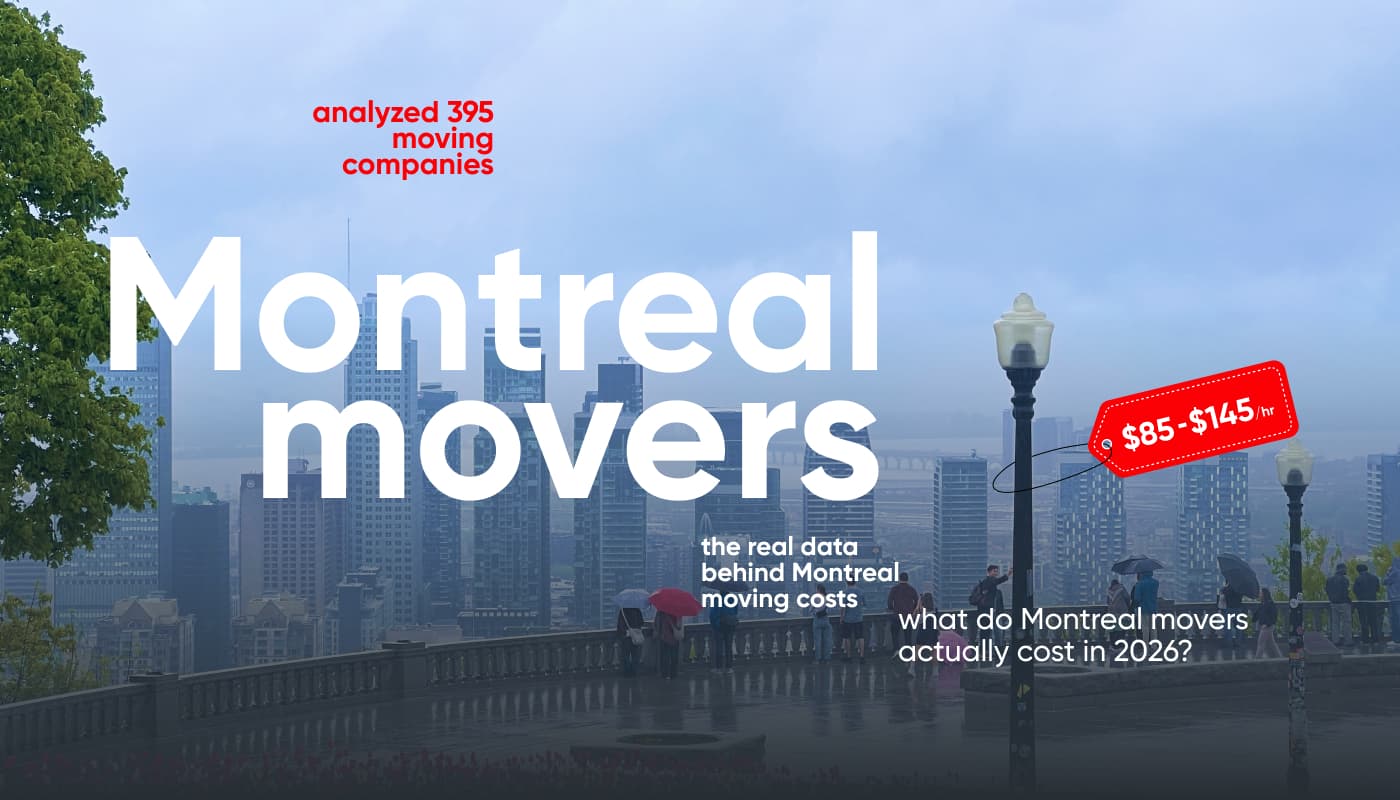
How Much Do Montreal Movers Actually Charge in 2026?
$85 to $145 per hour. That's the full range of hourly rates we found among Montreal movers in our February 2026 market analysis. And here's the number that will surprise you: the median is $110 an hour for a two-person crew and a truck.
Montreal isn't just affordable—it's the cheapest major city in Canada for movers. Toronto? $125. Vancouver? $127. Ottawa, just down the highway, is $130. Even Quebec City, right next door, is $135. Montreal wins by a mile.
If you Googled "montreal movers cost" bracing for sticker shock, here's your good news: the base rate is actually low.
But here's where things get messy.
Montreal's low hourly rate is real, but it's only half the story. This city has moving headaches you won't find anywhere else in Canada. Spiral staircases? That's $75 to $150 per flight. July 1st? One hundred thousand people all moving at once, and movers jack up prices by 30 to 50 percent. Then there's the Plateau: one-way streets, zero parking, third-floor walkups. Suddenly, your "easy" move turns into a full-on puzzle.
That's where Boxly comes in. We connect you with 395 Montreal moving companies and see the real numbers, the review patterns, and the market tricks most people never notice.
So we dug into the data. All of it.
This isn't another "10 tips to save on your move" post. This is what 67,328 real reviews and hard data say about moving costs in Montreal. We screened every review for duplicates and spam. What you'll see: the real numbers, the hidden fees, and why your coworker paid $400 less for the same size apartment.
$110 an hour is just your starting line. A typical 2-bedroom move takes 5 to 6 hours, so you're looking at $550 to $660 before the extras hit. But let's get real. Sara booked her July move for $550. By the time the Plateau spiral staircase, parking scramble, and July 1st premium landed, her bill doubled to $1,100. Suddenly, "cheapest city in Canada" didn't feel so cheap. Your extras might be $50 for a ground-floor move in Verdun or $400-plus for a third-floor Plateau maze. It all comes down to the details we're about to break down.
Why Does Everyone in Montreal Move on July 1st?
No other city in Canada — or anywhere in North America — has anything like this.
Every year on July 1st, approximately 100,000 Montreal households attempt to move on the same day. Let that sink in. One hundred thousand. On a single date. While the rest of Canada is celebrating Canada Day with barbecues and fireworks, Montreal's streets are clogged with moving trucks, furniture is stacked on sidewalks, and the city becomes a massive, chaotic relocation hub.
Why July 1st? Quebec's Civil Code historically standardized residential lease endings to June 30th (later shifted to July 1st). Most leases in the province still follow this convention. When your lease ends July 1st and your new one starts July 1st, you move July 1st. Simple in theory. Logistically insane in practice.
The pricing surge is real. During our analysis, Montreal moving companies that normally charge $110/hour regularly quote $140-$165 for July 1st moves — a 30-50% premium. Some charge double their standard rate. And they can, because demand massively exceeds supply. Even with 395 moving companies in Montreal, there aren't enough trucks, crews, or hours in the day.
Booking timelines change completely. For a normal Montreal move, 2-3 weeks' advance booking is fine. For July 1st? Six to eight weeks minimum. Some Montrealers book their movers before they've even signed their new lease. If you're reading this in late May and your move is July 1st, you're already behind.
The street scene is legendary. Furniture appears on curbs across the city — sofas, bookshelves, mattresses. Montreal has an unofficial "free stuff" culture on July 1st. One person's discarded Ikea bookcase is another person's new living room centrepiece. It's environmentally questionable and culturally beloved.
The smart alternative: Experienced Montrealers negotiate around July 1st, not for it. Ask your new landlord for a July 15th possession date. Or arrange to move June 28-29. Even shifting by three days can drop your montreal movers cost by 30-50% and transform your experience from survival to standard.
If you absolutely must move on July 1st, book immediately, expect premium pricing, and have a backup plan. Also, pack the night before. No, actually pack two nights before. On July 1st, there's no time for "almost ready."

Mount Royal Park
A stunning panoramic view of Montreal.
How Much Do Spiral Staircases Add to Montreal Moving Costs?
If Montreal has a mascot, it's the exterior spiral staircase. These wrought-iron beauties define the city's residential architecture — elegant, space-saving, and an absolute nightmare for anyone carrying a mattress.
They were built in the late 1800s and early 1900s to maximize interior living space in Montreal's signature triplexes. The stairs go on the outside so every square foot inside stays usable. Brilliant for living. Terrible for moving.
The surcharge is real and steep. Standard staircase fees across Canada run $50-$75 per flight. Montreal's spiral staircases? $75 to $150 per flight. That's 50-100% more than a regular set of stairs. Why? Because spiral stairs require movers to twist and angle every piece of furniture through tight, curved turns. It takes longer, requires more skill, and risks more damage.
The Plateau effect. The Plateau Mont-Royal neighbourhood has the highest concentration of spiral staircases in Montreal. It's also one of the most popular areas for young professionals, students, and artists to live. The irony is thick: the neighbourhood everyone wants to move into is the most expensive neighbourhood to move into — not because of rent, but because of the stairs.
A third-floor walkup in the Plateau with exterior spiral stairs can add $200 to $450 to your moving bill. That's not a typo. Two hundred to four hundred fifty dollars in stairs fees alone, on top of the hourly rate.
The furniture problem. Some items simply cannot navigate a spiral staircase. King-size box springs, L-shaped sectional sofas, large armoires — the geometry doesn't work. The turns are too tight, the clearance too narrow.
Your options:
- Hoisting: Some Montreal movers use ropes and pulleys to lift furniture up to balconies. This costs an additional $150-$300 depending on the floor and item weight. Not every company offers it.
- Disassembly: Split mattresses (two-piece box springs) exist for exactly this reason. If you're apartment hunting in Montreal, check the staircase before buying furniture.
- Return and replace: Some Montrealers sell oversized furniture before moving and buy new pieces that fit. It sounds extreme until you've watched three movers spend 45 minutes trying to rotate a sofa around a spiral landing.
Pro tip: When requesting quotes from Montreal moving companies, always mention spiral staircases upfront. Send a photo. Movers who've worked the Plateau will know exactly what they're dealing with. Movers who haven't may underquote, then charge you more on the day.
How Montreal Compares to Other Canadian Cities
The assumption is usually that Montreal is expensive — it's Canada's second-largest city, after all. The data tells a completely different story.
Montreal movers are the most affordable among major Canadian cities. And it's not close.
At $110/hour, Montreal sits 12% below Toronto ($125), 15% below Vancouver ($127), 18% below Ottawa ($130), and a startling 23% below Quebec City ($135). Read that last one again. Quebec City, in the same province, with a fraction of Montreal's population, charges nearly a quarter more for the same service.
Why is Montreal so affordable? Three factors:
1. Competition density. Montreal has 395 active moving companies — far more than any comparison city. Toronto has 50 on our platform, Vancouver 70, Ottawa 39, Quebec City just 4. When nearly 400 companies compete for your business, prices stay disciplined.
2. Lower operating costs. Montreal's cost of living is meaningfully lower than that of Toronto or Vancouver. That translates into lower wages, lower insurance premiums, and lower overhead for Montreal moving companies — savings that are passed on to consumers.
3. Quebec's regulatory environment. The province's consumer protection rules (more on those later) create pricing transparency that discourages the extreme price gouging sometimes seen in less regulated markets.
The ceiling is equally remarkable: no Montreal movers on our platform charge more than $160/hour. In Calgary, the max is $179. In Toronto, you'll find quotes above $200. Montreal's price ceiling is the lowest among major markets.
If you're relocating to Montreal from Toronto or Vancouver, your moving costs — both the move itself and future local moves — will be noticeably lower. If you're already here, you're benefiting from one of the most competitive moving markets in the country.
How Much Does It Cost to Hire Movers in Montreal?
Most pricing guides quote an hourly rate and stop there. But that $110/hour median is a starting point, not a final answer.
Your actual bill depends on decisions you're making right now — and on Montreal-specific factors that don't apply in other cities. Here's the real breakdown.
What Do Most Montreal Movers Charge Per Hour?
The $110/hour median assumes a 2-person crew with a truck. That's the standard configuration for studios and 1-bedroom apartments. For larger moves, you'll need more hands — and the math changes.
Montreal's 3-person crew median is $148/hour, based on 39 companies that report this rate. That's a 35% increase in hourly cost, but a 3-person crew typically finishes 40-50% faster.
Quick math: A 2-bedroom apartment that takes 6 hours with 2 movers at $110/hour = $660. The same move with 3 movers at $148/hour takes 4 hours = $592. The bigger crew is actually cheaper for medium-sized moves.
A 2-person crew is the standard configuration for studios and 1-bedrooms, running $95–$125/hr. For 2- to 3-bedroom apartments — especially Plateau triplexes with spiral stairs — a 3-person crew at $130–$160/hr is the smarter call. For full houses and 3-bedroom-plus moves, a 4-person crew typically bills $170–$210/hr but finishes significantly faster.
Here's a detail specific to Montreal: crew size matters more here because of spiral staircases. Two movers on a tight spiral staircase actually slow each other down. Three movers — two carrying, one stabilizing on the landing — can be dramatically more efficient on spirals.
Montreal Moving Costs by Home Size
These ranges come from actual moves booked through our platform — not theoretical estimates.
A studio move with a 2-person crew typically takes 2–3 hours, landing at $220–$380. A 1-bedroom runs 3–4 hours for $330–$500, while a 2-bedroom — Montreal's most common move — takes 4–6 hours with a 2- to 3-person crew and costs $500–$850. Larger moves scale up: a 3-bedroom needs a 3- to 4-person crew for 6–8 hours at $850–$1,400, and a 4-bedroom-plus household can run 8–12 hours with a 4-person crew for $1,400–$2,200.
Notice the spread. A 2-bedroom move ranges from $500 to $850. That $350 difference comes from factors you control: how much stuff you have, whether you're in a Plateau walkup or a Verdun ground floor, and whether you're moving on a Tuesday in October or July 1st.
The Montreal-specific inflator: Add $100- $300 for spiral staircase surcharges at either end of the move, if applicable. A 2-bedroom move from a third-floor Plateau walkup to another third-floor walkup could add $400-$600 in stairs fees alone. That $500 base estimate just became $900-$1,100.
How many flights of spiral stairs are in your move, both at your old place and your new one? Pause for a second and run your own scenario: if it's two flights at each end, those surcharges stack up fast. Grab a piece of paper and jot down your own addresses, floor levels, and stair types—what does your total look like once you factor those in? Running your own numbers now could save you from a nasty surprise when the final bill arrives.
When comparing quotes, always describe both addresses in detail, including the staircase type and floor level at each location.
The Calendar Factor
Montreal's moving calendar has sharper peaks and valleys than any other Canadian city.
July 1st is the extreme. Prices surge 30-50%, availability vanishes, and the entire city is in moving mode. If you can avoid it, you should.
Late July brings the "Construction Holiday" (les vacances de la construction), Quebec's mandatory two-week construction industry shutdown. Tradespeople and their families travel or move during this period, creating a secondary demand spike for Montreal movers.
August-September is the sweet spot. The July 1st frenzy is over, university students are settling in (but the first wave is done), and weather is still cooperative. You'll find the best combination of availability, pricing, and weather in this window.
Winter moves (November-March) can save you 10-20% — if you can handle the logistics. Montreal winters are no joke: -20°C to -35°C with wind chill, icy staircases (spiral staircases become genuinely dangerous), and street parking bans for snow removal.
Here's a negotiation approach that works well in Montreal: "I'm flexible any weekday the week of the 15th — what's your best rate?" Most Montreal moving companies have empty slots mid-week, mid-month. Your flexibility is their incentive to sharpen pricing.
Tuesday through Thursday, mid-month, September or October. That's the formula for the lowest possible rate in Montreal.

Downtown Montreal
The city centre of Montreal.
Local Movers Montreal: Neighbourhoods and Service Areas
Whether you're searching for "local movers montreal" from a Mile End loft or need demenagement local for a Brossard relocation, Montreal's unique geography shapes your moving experience in ways that other cities don't.
Montreal is an island. That fact matters more for moving than you'd expect. "On-island" and "off-island" are real distinctions in pricing and logistics.
Montreal Island Neighbourhoods:
Downtown & Central: Downtown Montreal, Old Montreal, Griffintown, Little Burgundy, Chinatown, Quartier des Spectacles, Golden Square Mile
Plateau & Surroundings: Plateau Mont-Royal, Mile End, Mile-Ex, Outremont, Rosemont-La Petite-Patrie, Villeray, Parc-Extension
West End: Westmount, Notre-Dame-de-Grace (NDG), Cote-des-Neiges, Cote-Saint-Luc, Hampstead, Montreal West, Town of Mount Royal
Southwest: Saint-Henri, Verdun, LaSalle, Lachine, Pointe-Saint-Charles
East End: Hochelaga-Maisonneuve, Mercier, Anjou, Saint-Leonard, Riviere-des-Prairies, Montreal North, Pointe-aux-Trembles
West Island: Pointe-Claire, Dorval, Kirkland, Beaconsfield, Sainte-Anne-de-Bellevue, Pierrefonds-Roxboro, L'Ile-Bizard
Off-Island (Local Zone):
North Shore: Laval, Terrebonne, Blainville, Saint-Jerome, Rosemere, Boisbriand
South Shore: Longueuil, Brossard, Saint-Hubert, Saint-Lambert, Boucherville, Chambly, Chateauguay, Candiac
The Hardest Montreal Neighbourhoods to Move In
Plateau Mont-Royal: The crown jewel of moving difficulty. Spiral staircases (the highest concentration in the city), narrow one-way streets, virtually no parking, third-floor walkups in century-old triplexes, and alleyways too narrow for full-size trucks. The Plateau is where most Montreal movers earn their reputation — or lose it. If a company can handle a Plateau move flawlessly, they can handle anything.
Old Montreal: Cobblestone streets. Heritage buildings with narrow doorways and no elevators. Loading zones that barely fit a van, let alone a 26-foot truck. Permits are mandatory, and the borough has its own rules about when trucks can access certain streets.
Mile End & Mile-Ex: Similar to the Plateau but with even more industrial-to-residential conversions. Loft apartments with freight elevators that may or may not work. Oversized windows that are occasionally the only way to get furniture in or out.
Outremont & Westmount: Wealthy neighbourhoods with beautiful homes — and steep, winding streets, narrow driveways, and mature trees limiting truck access. Large homes here mean big moves, and the access challenges mean they take longer.
Downtown high-rises: Elevator booking battles, loading dock schedules, narrow parking garage entries. Different from the Plateau's challenges but equally time-consuming. Most condos require 2+ weeks' notice for elevator reservations.
The easy neighbourhoods: Verdun (flat streets, increasingly modern buildings), LaSalle (wide suburban streets), Anjou and Saint-Leonard (suburban layouts, garages), and the West Island communities (designed for modern logistics, easy truck access). If you're flexible on where you live, these areas are dramatically cheaper to move into — not in rent, but in moving costs.

Montreal Old Town
The historic part of the city, full of cafes and restaurants.
What Does Quebec Law Require Montreal Movers to Provide?
Quebec's language laws, specifically the Charter of the French Language (Bill 101 and its updates), mean that commercial contracts in Quebec default to French. This includes moving contracts and estimates. But here's your key leverage: if you ask for an English or bilingual contract, the law guarantees you have the right to one.
For francophone Montrealers, this is a non-issue. For anglophones, newcomers, or anyone relocating to Montreal from outside Quebec, it can create real confusion when you're signing a document that describes your rights, liabilities, and costs in a language you may not fully understand.
Your rights: Under Quebec consumer protection law, you can request a bilingual contract or an English version. Legitimate Montreal moving companies that serve a diverse clientele will accommodate this. If a mover refuses to provide any English documentation, that's a red flag — not about language politics, but about customer service.
The bilingual mover advantage: Several top-rated Montreal movers operate bilingually as standard practice, with 5.0-star ratings and hundreds to thousands of verified reviews at rates from $95-$115/hr. Their crews communicate in both languages, their paperwork is available in both, and their reviews include both English and French feedback.
Neighbourhood language patterns matter. In Westmount, NDG, and parts of the West Island, most moving companies communicate comfortably in English. In the Plateau, Hochelaga-Maisonneuve, Villeray, and Rosemont, French dominates. Downtown is fully bilingual.
OPC (Office de la protection du consommateur) regulations require movers to provide written estimates that clearly describe services, rates, and fees. This applies regardless of language. If your mover doesn't provide a written estimate before starting work, they're violating Quebec law. More on this in the regulations section.
Practical advice for anglophones moving to Montreal: Request English contracts when booking. Confirm the crew speaks your language. Read the written estimate carefully. If anything is unclear, ask before signing. Most Montreal movers are professional about this — the city is inherently bilingual, and the moving industry reflects that.
Who Are the Best-Rated Movers in Montreal?
We analyzed 67,328 reviews across 395 Montreal moving companies. Here's what the data actually shows — not marketing claims, not "Top 10" lists someone paid to get on.
"Proven Veterans": $95-$145/hour
These are companies with hundreds (sometimes thousands) of verified reviews and near-perfect ratings. In Montreal, something unusual happens: the best-reviewed companies are often surprisingly affordable.
Two companies with over 1,000 reviews each, perfect or near-perfect ratings, at $95/hour — $15 below market median. In Toronto or Vancouver, a company with that rating and review volume would charge $160+. In Montreal, they charge below the city median.
The highest-priced mover on our platform charges $145/hour with a 5.0-star rating. Several others hold 5.0 stars at $120/hour.
"Budget Options": $58-$85/hour
Montreal's budget tier is remarkably diverse. Well-established budget options with 4.8-star ratings and 400+ reviews at $85/hour show real credibility in this tier — these aren't fly-by-night operations but proven companies with genuine track records.
At the true bottom, $58/hour options exist but with minimal review histories — less track record, more uncertainty.
Our honest take: Montreal's moving market is unusual. The quality gap between "budget" and "premium" is narrower than in other cities. A $95/hour mover with 1,854 five-star reviews is not a budget compromise — it's arguably the best value in the entire Canadian moving market.
What to Look for in the Best Montreal Movers
Regardless of price point, certain standards should be non-negotiable in Montreal:
Reviews that survive July 1st. Look for reviews specifically about the July moves. Any company can look great on a quiet Tuesday in November. A company that maintains 4.8+ stars during Montreal's most chaotic moving day? That's genuine competence.
Spiral staircase experience. Ask directly: "How many Plateau moves have you done?" A company that regularly works the Plateau, Mile End, and Old Montreal knows how to handle spiral stairs, tight corners, and impossible parking. A suburban-focused mover might struggle.
OPC compliance. Quebec's Office de la protection du consommateur requires written estimates, transparent pricing, and clear liability terms. Request a written estimate up front and treat it as your instant proof of professionalism—when a mover provides it without hesitation, you know you're working with a company that respects both the rules and your peace of mind. If a mover hesitates or avoids this, you've just dodged a headache—move on.
Bilingual communication. Unless you're fluent in French, confirm the crew can communicate in your language. Miscommunication on move day — "that goes in the bedroom, not the basement" — is expensive to fix.
Active insurance. In Quebec, look for a minimum of $2 million liability coverage. Ask for the certificate. Of the 395 companies in our platform, 174 are verified as insured. That means 221 either aren't insured or haven't provided proof. Check before you book.
On Boxly, insurance status, reviews, and pricing are visible on every mover profile. Compare Montreal movers to see verified details side by side.
Quebec Moving Regulations: What Montreal Movers Must Provide
Quebec has stricter consumer protection laws for moving than any other Canadian province. If you're moving to Montreal, these regulations work in your favour — if you know about them.
The Office de la protection du consommateur (OPC) oversees moving companies in Quebec. Here's what the law requires:
1. Mandatory Written Estimates
Before any work begins, a Montreal moving company must provide a written estimate that includes:
- Complete description of services
- Hourly rate or flat-rate price
- All applicable fees (stairs, travel time, fuel, heavy items)
- Estimated total cost
- Start and expected end time
This isn't optional. A mover who begins loading without providing a written estimate is in violation of Quebec law.
2. The Binding Estimate Rule
This is the big one. Under Quebec consumer protection law, if a mover provides a written estimate, they cannot exceed it by more than 10% without your written consent. Read that again. If your written quote says $800, the maximum you can be charged is $880 — unless you explicitly agree to additional work.
This is a stronger protection than any other province offers. In Ontario or Alberta, estimates are often "just estimates" with no binding force. In Quebec, they have legal teeth.
3. Liability Requirements
Quebec movers are liable for damage to your belongings unless they can prove the damage was caused by:
- The nature of the goods themselves (fragile items not properly packed by you)
- Force majeure (extreme weather, for example)
- Your own fault
This means the burden of proof is on the mover, not on you. If your dresser arrives scratched, it's on them to prove they didn't cause it.
4. Cancellation Rights
You can cancel a moving contract before the service begins. However, the mover may be entitled to reasonable compensation for expenses already incurred (truck dispatched, crew assembled). Ask about cancellation terms when booking.
5. The OPC Complaint Process
If a dispute arises, you can file a complaint with the OPC at opc.gouv.qc.ca. The OPC serves as a mediator between consumers and businesses. This is a real, functioning consumer protection system — use it if needed.
Practical application: When comparing Montreal moving companies, ask for the written estimate in advance. If a company won't provide one, they're either unprofessional or deliberately avoiding the binding estimate rule. Either way, move on to the next option.

Montreal. Business Centre
An area with condominiums, cafes, restaurants, and nightlife.
When Is the Cheapest Time to Move in Montreal?
Montreal's moving calendar is more extreme than any other Canadian city. The peaks are higher, the valleys deeper, and the weather swings more dramatically.
Montreal Moving Calendar:
The first rule of Montreal moving: avoid July 1st unless you have no choice. We've covered this in detail above, but it bears repeating in a seasonal context. July 1st is not just "peak season." It's a category of its own.
Late July (Construction Holiday): Quebec's mandatory two-week construction industry shutdown (les vacances de la construction) falls in the last two weeks of July. Workers and their families travel or relocate, creating a secondary demand spike. Not as extreme as July 1st, but noticeably busier than early July.
August-September: The sweet spot. July's chaos has passed. The weather is still warm and cooperative. University students have largely settled in. Montreal movers have availability, and you have negotiating leverage. If you have any flexibility in your moving date, aim for this window.
October-November: Excellent moving conditions early on, then the weather turns. Prices drop 10-15% from summer peaks. Availability is good.
December-March: Winter. Montreal winters are brutal — consistently -15°C to -25°C, with wind chill pushing -35°C. Icy sidewalks. Snow-covered staircases. Street parking bans for snow removal that can displace your moving truck. But if you're prepared, winter moving in Montreal can save 15-20% compared to summer rates.
April-May: Spring construction season. Montreal's roads emerge from winter in various states of disrepair. Construction season begins immediately, bringing lane closures, detours, and unpredictable travel times for moving trucks. Factor in extra time.
Day of Week Matters:
Tuesday through Thursday means less competition for crews. Mid-month beats the first and last weeks when leases turn over. Weekend moves often cost 10-15% more — sometimes as a stated surcharge, sometimes as reduced willingness to negotiate.
Montreal Weather and Moving
Montreal's climate is one of the most extreme of any major North American city — hotter summers than most people expect, and winters that test everyone's resolve.
Winter (December–February) plunges to -15°C to -25°C, making spiral staircases genuinely dangerous when icy and triggering street parking bans for snow removal — but this is when you find the cheapest rates, 15–20% below summer. Spring (March–May) is unpredictable, swinging from -5°C to +15°C, with pothole season and construction lane closures adding transit time for trucks. Summer (June–August) delivers the best weather at +20°C to +35°C, but also the July 1st frenzy and brutal humidity that slows crews on Plateau walkups. Fall (September–November) hits the sweet spot — comfortable +5°C to +18°C temperatures, post-July 1st availability, and the strongest negotiating leverage of the year.
Winter moving realities: Spiral staircases become genuinely hazardous when icy. Movers may salt and sand stairs before use, adding time. Cardboard boxes get wet in snow. Electronics need 24 hours to acclimate to indoor temperatures before use. Street parking bans for snow removal can appear overnight, forcing your moving truck to park blocks away.
Summer's hidden challenge: Montreal's humidity. It's not -25°C, but +35°C with 90% humidity makes carrying furniture up three flights of spiral stairs exhausting. Movers slow down. Your 5-hour job becomes 7 hours. The hourly rate doesn't change, but the total bill does.
The ideal window: Late August through mid-October. Post-July 1st chaos, pre-winter, manageable temperatures, good availability, and maximum negotiating leverage with Montreal movers. This is when smart Montrealers schedule their moves.

Spring in Montreal
A park near the waterfront comes alive in spring.
How Much Does a Long-Distance Move From Montreal Cost?
Montreal's island geography creates a clear distinction between "local" and "long-distance" moves that differs from most cities.
Local Zone (Hourly Rates)
Moves within the Greater Montreal Area are billed at standard hourly rates. But "local" has layers here because of the island.
Laval (15–25 km) and Longueuil (10–20 km) are the most common off-island destinations, both billed hourly but with bridge or tunnel traffic that can pad the clock. Brossard (15–25 km) sits on the far side of the Champlain Bridge — rush-hour crossings alone can add 30–60 minutes of billable time. The West Island (20–40 km) stays on the island and offers wide suburban streets with easy truck access. Terrebonne (30–40 km) on the North Shore is hourly too, but Highway 25 traffic makes timing everything.
The bridge factor: Moving off-island means crossing one of Montreal's bridges. During rush hour, the Champlain Bridge, Jacques Cartier Bridge, or Tunnel Louis-Hippolyte-La Fontaine can add 30-60 minutes to transit. At $110/hour, that's $55-$110 in bridge traffic alone. Schedule off-island moves to avoid 7-9am and 4-6pm crossings.
Long-Distance Moving from Montreal
Beyond the greater Montreal area, pricing shifts to weight-based flat rates.
The Eastern Townships corridor to Sherbrooke (150 km) runs $1,000–$2,000 for a 2-bedroom load — straightforward via the A-10 but treacherous in winter. Quebec City (250 km) costs $1,200–$2,500, a well-serviced route with plenty of carriers running both directions. The Ottawa corridor (200 km) is one of Montreal's busiest, with fares of $1,500–$3,000, and many companies offering regular runs between the two capitals. Toronto (540 km via the 401) is the premier long-haul route, typically $2,500–$5,000 — and because Montreal's base rates are lower, hiring from this end is usually cheaper than the reverse. For the Halifax run (1,250 km), expect $3,500–$6,000 and allow 2–3 days for delivery.
On-island to off-island: Some Montreal movers treat Laval and the South Shore differently from island moves — adding travel time fees or fuel surcharges for bridge crossings. Clarify this when getting quotes. The difference between "local" and "slightly less local" can be $50-$100 in unexpected fees.
For long-distance quotes, always request in-home or virtual estimates. Phone-based quotes for Montreal-to-Toronto moves are typically off by 20-30% because they can't account for actual volume — especially if you have a packed Montreal basement that hasn't been sorted since 2018.
How Do Montreal Condo Building Rules Affect Moving Costs?
Montreal's condo landscape differs from Toronto's or Vancouver's. While those cities are dominated by glass towers, Montreal has more mid-rise buildings (6-12 storeys), converted industrial lofts, and heritage-adjacent condos. Each comes with its own moving complications.
Elevator Booking
Most condo buildings require advance notice for moves — typically 2-3 weeks. Some buildings allow only one move per day using the service elevator. Miss the booking window and your Montreal movers will be waiting in the lobby — on the clock — while the building sorts you out.
Downtown condos in Griffintown and the Golden Square Mile tend to have stricter rules: designated moving hours, mandatory use of a service elevator, proof of insurance from your moving company, and sometimes a pre-move walkthrough.
Deposits and Fees
Standard condo move-in fees in Montreal range from $75 to $300 depending on the building. Refundable damage deposits of $100-$250 are common on top of that. Some newer Griffintown condos have moved to non-refundable fees exclusively. Read your building's move-in policy carefully.
Time Restrictions
Typical moving windows: Monday to Friday, 9am to 5pm. Some buildings allow Saturday moves (usually until noon). Sunday and holiday moves are rarely permitted. If you're moving into a condo, plan your move around these windows, not around your preferred schedule.
Montreal's Loft Conversions
Old Montreal, Saint-Henri, and parts of Griffintown have loft-style condos converted from industrial spaces. These can be wonderful to live in and challenging to move into. Freight elevators (if they exist) may be original to the building and unreliable. Doorways can be wider than standard (industrial proportions) or narrower (heritage constraints). Loading access varies wildly.
The mid-rise difference: Montreal's 6-12 storey buildings often have only one elevator, which serves both the regular and service elevators. This means your moving slot directly competes with regular building traffic. Book the earliest available time and work quickly.
Ask your Montreal moving company if they've worked in your specific building before. In a city with 395 movers, chances are someone has — and their building-specific experience is worth paying for.
Montreal Moving Truck Parking Permits
Parking a 26-foot moving truck in Montreal is not a casual affair. Especially in neighbourhoods where finding a spot for a Honda Civic already feels like winning the lottery.
Ville de Montreal Temporary Parking Authorization
Most boroughs allow you to reserve street space for a moving truck. The process varies by borough, which is one of Montreal's charming complications.
General Details:
- Apply through your borough office or Ville de Montreal website
- Processing: 5-10 business days (varies by borough)
- Cost varies by borough and permit duration
- Temporary "No Parking" signs must be posted 48-72 hours in advance
Borough-Specific Realities:
Plateau Mont-Royal: The most difficult borough for moving truck parking. One-way streets, dense residential parking, bike lanes that limit truck positioning, and the highest density of moves in the city. Apply for your permit early. On July 1st, the borough temporarily modifies some rules, but don't count on it.
Old Montreal (Ville-Marie): Heritage protection rules affect truck access on certain streets. Cobblestone streets have weight limits. Some streets are pedestrian-only during summer. Contact the borough directly.
Verdun and LaSalle: Easier. Wider streets, more available parking, simpler permit processes.
West Island: Generally straightforward. Many homes have driveways, reducing the need for street permits.
Winter Parking Bans:
Montreal's winter parking bans are a moving wildcard. When snow removal operations begin, posted signs restrict parking on entire streets — often overnight and with little advance notice. If your move coincides with a snow operation, your reserved parking spot may suddenly be unavailable — monitor street signage and have an alternative parking plan.
Without a permit, parking tickets run $75-$150 per infraction. A moving truck blocking a bike lane or bus route? That escalates fast. Budget the $50-$100 permit fee rather than risk $300+ in fines and the stress of a towed truck mid-move.
Why Are Montreal Moving Rates Still the Lowest in Canada?
Where does today's $110/hour median fit in context?
Montreal's moving rates increased approximately 15% since 2020. That sounds significant until you compare it to the national picture: Calgary saw a ~19% increase, while Toronto and Vancouver both jumped 20%+. Montreal's post-pandemic price increase was among the most modest in the country.
Why Montreal stayed affordable:
The city already had intense competition before the pandemic. When demand surged in 2020-2021, new companies entered the market — but so did they in every city. The difference in Montreal is that the baseline was already low, and the competitive density (395 companies) kept a lid on increases.
Quebec's regulatory environment also played a role. The binding estimate rule means movers can't inflate prices on moving day, which limits the kind of price exploitation that occurred in less regulated markets during peak pandemic demand.
The 2026 picture:
Montreal's $110/hour median is stable. The competitive pressure from 395 companies means no single mover can dramatically increase prices without losing business. The price ceiling — $145/hour maximum on our platform, with zero companies above $160 — tells you this is a disciplined market.
Outlook: We expect the $105-$115/hour range to hold through 2026 and into 2027. New companies continue to enter the market, competition remains fierce, and Montreal's lower operating costs keep the floor accessible.
For consumers, this is excellent news. Montreal is one of the few major Canadian markets where quality moving at a fair price isn't an either/or proposition. The data shows you can get both.
How Do You Choose the Right Moving Company in Montreal?
With 395 options, narrowing down requires a systematic approach — especially in a market where price differences are smaller and other factors matter more.
The Montreal-Specific Checklist:
1. OPC compliance: Does the company provide a written estimate before starting? This is legally required in Quebec. If they won't, that's a disqualifying red flag.
2. Spiral staircase experience: If either address has spiral stairs, ask about their experience with them. Request references for Plateau or Mile End moves if applicable.
3. Bilingual communication: Confirm the crew speaks your preferred language. This prevents costly miscommunication on moving day.
4. Insurance verification: Of 395 Montreal movers, 174 are verified as insured on Boxly. Ask for the certificate. In Quebec, look for at least $2 million liability.
5. July 1st track record: If you're moving during peak season, look for companies with strong reviews in July. July 1st performance separates professionals from amateurs.
Questions to Ask Before Booking:
- What's your hourly rate, and what's included in that rate?
- What specific fees apply to my addresses? (Mention stairs type, floor level, parking access)
- Do you provide a written estimate per OPC requirements?
- What is your insurance coverage?
- How do you handle damage claims?
- What's your cancellation policy?
- Will the crew that arrives be your employees or subcontractors?
- Can you provide the estimate and contract in English? (if needed)
Red Flags to Avoid:
- No written estimate provided
- Quotes dramatically lower than the $85-$145 market range (hidden fees incoming)
- "We'll figure out the price on site"
- No proof of insurance
- Only reviews from the last month (new or rebranded company)
- Poor responsiveness before booking
On Boxly, verified insurance, reviews, pricing, and service details are visible on every Montreal mover profile. Compare side by side and make decisions based on data, not guesswork.
What Does Montreal's Island Geography Mean for Your Move?
Montreal's island geography, building stock, and cultural patterns explain the dynamics of moving costs in this guide.
Why people move here (and why 395 movers exist): Montreal draws relocators for three reasons — affordability (one-bedroom Plateau rent equals a Toronto studio), the AI/gaming tech corridor (Mila, Ubisoft, EA), and four major universities producing talent that stays. Net inbound migration, especially from Ontario, sustains the largest moving company pool of any Canadian city. The $110/hr median — lowest among major cities — reflects both competition density and Quebec's binding-estimate regulations keeping prices honest.
The island factor: Montreal is literally an island. The St. Lawrence and Rivière des Prairies define the city's borders. Moving off-island to Laval, Longueuil, or Brossard requires bridge crossings — and bridge traffic adds 30-60 minutes of billable time. This is the single biggest geographic cost factor unique to Montreal moves.
Housing stock and what it means for your move: Montreal is dominated by triplexes, duplexes, and walk-ups — a building type that barely exists elsewhere in Canada. The Plateau alone has thousands of 3-storey walk-ups with exterior spiral staircases. These staircases define the moving experience: $75-$150 per flight in surcharges, furniture that won't fit around the spiral, and rope-and-pulley hoisting for large items. If you're moving in the Plateau, Mile End, or Rosemont, spiral stairs are not optional — they're the architecture.
Griffintown and the condo shift: Montreal's condo boom is concentrated in Griffintown, where new-build towers offer elevator access, loading docks, and underground parking. Moving into Griffintown is logistically closer to a Toronto condo move than a traditional Montreal triplex move. The contrast between a Plateau 3rd-floor walk-up and a Griffintown condo is dramatic — and so is the cost difference.
The bilingual contract dimension: Quebec's OPC regulations require written estimates, cap overages at 10%, and give you legal recourse for disputes. Contracts must be available in French. This regulatory framework is unique in Canada and directly protects consumers — but only if your mover complies.
Growth patterns: Montreal is densifying in the southwest (Griffintown, Verdun, Saint-Henri) and expanding north to Laval. The off-island suburbs (Brossard, Longueuil) attract families priced out of the island. Each pattern creates different moving logistics: inner-city densification means more condo moves, suburban expansion means more bridge crossings.

Saint Joseph's Oratory of Mount Royal
Leisure time in Montreal: the basilica crowns Mount Royal.
How We Calculate Montreal Moving Costs
Understanding how we arrive at these numbers matters. Our methodology isn't rocket science — it's just rigorous data collection and statistical honesty.
Data Sources
According to Boxly's comprehensive marketplace analysis as of February 2026:
- Live pricing from 395 active Montreal moving companies — verified business licenses, current contact information, active booking systems
- 67,328 verified Google reviews — updated weekly, cross-referenced with Better Business Bureau ratings
- Hourly rates by crew size — 2-person teams ($85-$145/hr median $110), 3-person teams (39 companies reporting $130-$160/hr median $148)
- Real booking data from Boxly marketplace — actual transactions from 2024-2026, not marketing claims
- Service area verification — confirmed coverage for Montreal Island, Laval, South Shore, West Island
- OPC compliance tracking — written estimate availability, binding-estimate adherence, consumer protection compliance
Calculation Method
Median pricing, not average — We use median rates because they represent the middle 50% of movers and exclude extreme outliers. The median $110/hr means half of Montreal movers charge more, half charge less.
70% outlier threshold — According to our statistical standards, any mover charging below 70% of the market median ($77/hr or less) gets excluded from rate calculations. Why? These are often bait-and-switch operations or companies missing critical insurance. They skew the data and don't represent legitimate pricing.
Price ranges represent 25th to 75th percentile — When we say $500-850 for a 2BR apartment, that's the middle 50% of actual quotes. 25% of movers charge less, 25% charge more. This gives you realistic budget expectations, not best-case fantasies.
Confidence intervals — Statistical ranges like "Median $110/hr (±$15 standard deviation)" mean 68% of Montreal movers fall within $95-125/hr. The ± shows you the spread, not just the center point.
Montreal-specific adjustments — Spiral staircase surcharges ($75-$150/flight), July 1st premiums (30-50%), and bridge-crossing billable time (30-60 min) are tracked separately as add-ons to base hourly rates, not baked into the median.
Update Frequency
We're not publishing stale data and calling it research:
- Pricing data: Updated monthly from active marketplace listings
- Review counts: Updated weekly via automated Google Business Profile API
- OPC compliance: Quarterly verification of written estimate practices
- Content refresh: Quarterly reviews (January, April, July, October) to catch seasonal shifts
- Last major update: February 2026
According to Boxly's data pipeline, the median rate of $110/hr you see on this page was calculated from pricing active as of February 1-15, 2026. Not last year's numbers, not aspirational estimates — current market reality.
Why This Matters
Transparency builds trust. Other sites show you "average moving costs" without explaining where those numbers come from. We're showing you the methodology so you can judge the credibility yourself. When we say Montreal's median rate is $110/hr based on 395 active companies with 67,328 reviews, you know exactly what that means — and what it doesn't.
Our goal: Give you enough data to negotiate intelligently. You're not trying to memorize statistics — you're trying to avoid getting ripped off. Knowing that 95% of legitimate Montreal movers charge between $85-$145/hr gives you instant BS detection when someone quotes you $58/hr or $200/hr.
Find Your Montreal Mover
In 2026, Montreal's moving market is the most competitive and affordable among major Canadian cities. The $110/hour median across 395 active companies creates a market where you don't have to choose between quality and price.
But Montreal is not a generic moving market. The spiral staircases add costs that don't exist elsewhere. July 1st creates pricing chaos that no other city experiences. The island geography, the bilingual dimension, Quebec's unique regulations — these all shape what your move actually costs.
We built Boxly because navigating 395 options shouldn't require a spreadsheet and 40 phone calls. Compare real prices. Read 67,328+ real reviews. See verified insurance status. Understand which companies have Plateau experience and which ones don't.
Whether you're searching for "demenageurs montreal," trying to survive your first July 1st move, or looking for cheap movers in Montreal that won't compromise on quality, the data is here.
The price is right. The options are abundant. Your move just needs to be informed.
Ready to see your real price? Get your personalized quote in 60 seconds and find out exactly what your Montreal move will cost.
Ready to find the right mover for your Montreal move? Compare all 395 Montreal movers on Boxly — real pricing, verified reviews, insurance details, and service transparency. No phone tag. No guesswork. Just data.

Find, compare, and hire movers across Canada with Boxly
All your moving needs in one place — find, compare, and book movers.
Frequently Asked Questions
Why does everyone in Montreal move on July 1st?
Quebec's Civil Code historically standardized residential lease endings to June 30th (later shifted to July 1st). Because most leases still follow this convention, roughly 100,000 Montreal households attempt to relocate on the same date every year — the largest single-day moving event in North America. It coincides with Canada Day, so while the rest of the country barbecues, Montreal's streets are clogged with moving trucks, furniture is stacked on sidewalks, and the "free stuff" tradition turns curbside discards into neighbourhood treasure hunts. No other Canadian city has anything remotely comparable.
How much more do movers charge during the week of July 1st?
Montreal moving companies that normally charge $110/hour regularly quote $140-$165 for July 1st moves — a 30-50% premium. Some charge double their standard rate. A 2-bedroom move that costs $550-$660 on a normal day can run $750-$1,000+ during the July 1st surge. Even the days immediately surrounding July 1st (June 29-July 3) carry elevated pricing, though less extreme. The premium exists because demand massively outstrips supply — 395 companies still cannot cover 100,000 moves in one day.
Can I move on June 30th to avoid the July 1st rush?
You can, but it requires negotiation. Your current lease likely runs until June 30th, and your new one starts July 1st. Ask your new landlord for a June 29 or 30 move-in — many agree because it helps them prepare the unit. Even better: negotiate a July 15th possession date on your new lease from the start. Shifting by just 2-3 days can reduce your moving cost by 30-50% and transforms the experience from survival mode to a normal, well-organized move. Veteran Montrealers know this trick.
How do spiral staircases affect my moving quote in Montreal?
Montreal's iconic exterior spiral staircases — concentrated in the Plateau, Mile End, and Villeray — cost $75-$150 per flight in surcharges, roughly double the $50-$75 fee for standard interior stairs. The tight curved turns force movers to twist and angle every piece of furniture, taking 2-3 times longer than straight stairs. A third-floor Plateau walkup with spiral stairs at both pickup and delivery can add $300-$600 in staircase fees alone. Always send your mover a photo of the staircase when requesting quotes — experienced Plateau movers will give you an accurate number instantly.
What's an 'homme avec un camion' and should I hire one?
An "homme avec un camion" (man with a truck) is a common Montreal Kijiji/Facebook category — typically an independent operator with a pickup or cargo van offering cheap help. Rates can start as low as $40-$60/hour. The trade-off: no written estimate (required by Quebec law from licensed movers), no insurance if your dresser is dropped down a spiral staircase, no OPC recourse if things go wrong, and no crew — it's often just one person who expects you to help carry. For a ground-floor studio, it might work. For anything involving spiral stairs, heavy furniture, or items you care about, hire a licensed, insured Montreal moving company instead.
Is my French-language moving contract legally binding in English?
Under Quebec's Charter of the French Language, commercial contracts default to French. However, both parties can agree to use another language. If you sign a French-only contract without understanding the terms, you may still be bound by it — "I didn't read it" is not a defence. Your right: request a bilingual or English version of the estimate and contract before signing. Legitimate Montreal movers who serve a diverse clientele will accommodate this. The OPC requires written estimates to clearly describe services, rates, and fees regardless of language. If anything is unclear, ask before signing.
What does the OPC require Montreal movers to provide?
The Office de la protection du consommateur (OPC) requires Quebec movers to: (1) provide a mandatory written estimate before any work begins, listing services, rates, all applicable fees, and estimated total; (2) honour the binding estimate rule — they cannot exceed the written quote by more than 10% without your explicit written consent; (3) accept liability for damage unless they prove it was caused by the goods themselves, force majeure, or your own fault (burden of proof is on them). These protections are significantly stronger than those of any other Canadian province. If a mover refuses a written estimate, they are violating provincial law — choose another company.
How much extra do movers charge for 3rd-floor walk-ups in the Plateau?
A third-floor Plateau walkup with exterior spiral staircases typically adds $200-$450 to your moving bill in staircase fees alone. The math: $75-$150 per flight of spiral stairs, times 2-3 flights. If both your old and new address are third-floor Plateau triplexes, you could face $400-$600 in combined staircase surcharges — on top of the $110/hr median hourly rate. Some items may require hoisting via rope and pulley to a balcony at $150-$300 extra. This is why two identical apartments in Montreal can produce wildly different moving bills based purely on staircase type and floor level.
What's the real difference between moving in NDG vs Verdun?
NDG (Notre-Dame-de-Grace) has a mix of older walk-ups with interior stairs, semi-detached homes, and some buildings with elevators. Streets are generally wider than the Plateau, parking is easier, and access is straightforward. Verdun is increasingly modern — new condo developments, flat streets along the canal, and many ground-floor or elevator-equipped units. Moving in Verdun is among the cheapest on the island purely because of logistics. NDG can be slightly more expensive if your unit is a 3rd-floor walk-up in an older building, but nothing approaches Plateau-level difficulty. Both are dramatically easier than the Plateau, Mile End, or Old Montreal.
Do I need a bilingual mover if I don't speak French?
It depends on your neighbourhood. In Westmount, NDG, and the West Island, most crews communicate comfortably in English. In the Plateau, Hochelaga-Maisonneuve, Villeray, and Rosemont, French dominates. Downtown is fully bilingual. The real issue is moving-day communication: directing "that armoire goes upstairs, the boxes go to the basement" under time pressure across a language barrier leads to expensive mistakes. Several top-rated Montreal movers with hundreds to thousands of verified reviews operate bilingually as standard practice. Request English-speaking crew when booking if needed.
How do I get a parking permit for moving day in Villeray?
Apply through the Villeray-Saint-Michel-Parc-Extension borough office or the Ville de Montreal website. You will need to request a temporary occupation of the public domain, which costs $50-$100 and requires 5-10 business days to process. Temporary "No Parking" signs must be posted 48-72 hours before your move. In Villeray specifically, street parking is dense but streets are wider than the Plateau, making truck access slightly easier. Without a permit, you risk $75-$150 tickets per infraction. Around July 1st, borough offices are swamped with permit requests — apply as early as possible.
Can I break my lease to avoid a July 1st move in Montreal?
Quebec's Civil Code allows lease assignment (transferring your lease to a new tenant) at any time, which effectively lets you leave before July 1st. Your landlord can only refuse for serious reasons. You can also negotiate a mutual lease termination (résiliation) with your landlord. Subletting is another option, though it requires landlord consent. Breaking a lease unilaterally without cause exposes you to liability for remaining rent. The practical approach: if you want to avoid the July 1st chaos, start the lease assignment or negotiation process in March or April. The Régie du logement (now the Tribunal administratif du logement) handles disputes.
What happens if my spiral staircase can't fit my couch?
This is one of the most common Montreal moving nightmares. L-shaped sectional sofas, king-size box springs, and large armoires often cannot physically clear the tight turns of an exterior spiral staircase. Your options: (1) furniture hoisting — some Montreal movers use ropes and pulleys to lift items to a balcony at $150-$300 per piece; (2) disassembly — split box springs and modular sofas exist for exactly this reason; (3) sell and replace — some Montrealers sell oversized furniture before moving and buy pieces that fit the new space. Pro tip: if you are apartment hunting in Montreal, measure the staircase clearance before you sign the lease, and definitely before you buy a sectional.
How much does it cost to move from Montreal to Sherbrooke?
Moving from Montreal to Sherbrooke (about 150km via the Eastern Townships) typically costs $1,000-$2,000 for a 2-bedroom household. At this distance, most Montreal movers shift from hourly billing to flat-rate pricing based on weight and volume. The route is straightforward via the A-10, but winter conditions on the Autoroute des Cantons-de-l'Est can be severe from November through March. Get at least 3 quotes, and ask whether the quote includes both loading and unloading time — some flat rates cover transport only, with loading and unloading billed separately.
Are there movers who specialize in old Plateau apartments?
Yes — and they are worth seeking out. Experienced Plateau movers know how to angle a mattress through a second-floor spiral landing, which walls to protect with extra blankets in century-old triplexes, and how to work around no-parking one-way streets. On Boxly, look for companies with high review volumes from Plateau, Mile End, and Rosemont addresses. Ask directly: "How many Plateau moves have you done this year?" A company that regularly works these neighbourhoods will give you a more accurate quote and a faster, safer move than a suburban-focused operator encountering their first spiral staircase.
What's the penalty for not giving notice by July 1st?
In Quebec, tenants who want to leave at lease end must give written notice to their landlord within specific time frames: 3-6 months before a 12-month lease ends (meaning notice is typically due by January 1st-March 31st for a July 1st-ending lease). If you miss this window, your lease automatically renews under the same conditions for the same term. You are then locked in for another year. The only exits are lease assignment, mutual termination with the landlord, or the Tribunal administratif du logement if you have a valid reason (e.g., unsafe conditions). Mark your calendar and give notice in writing, keeping a copy.
How do I move in Montreal during a winter snowstorm?
First: check whether the city has declared a snow removal operation, because winter parking bans can displace your reserved truck spot with zero notice. Salt and sand all staircases — especially spiral staircases, which become genuinely dangerous when icy. Protect electronics and liquids from freezing (below -15°C, paint cans burst and LCD screens can crack). Use plastic bins instead of cardboard, which gets soggy in snow. Expect the move to take 20-30% longer. The upside: winter rates are 15-20% cheaper, and availability is excellent because most Montrealers refuse to move in January. Montreal movers carry salt, tarps, and cold-weather gear as standard winter kit.
What should I know about moving to Hochelaga-Maisonneuve?
Hochelaga-Maisonneuve (HoMa) is an up-and-coming east-end neighbourhood with a mix of older triplexes and new developments. Moving logistics are moderate: some exterior staircases (though fewer than on the Plateau), mostly residential streets with decent parking, and improving building stock. Rents are still below Plateau and Mile End levels, making it popular with artists and young families. Moving-day considerations: some blocks have narrower one-way streets, and the area around Olympic Stadium can be tricky for large trucks. Overall, HoMa is significantly easier to move in than the Plateau — and getting more so as new construction replaces older walk-ups.
What should I know about moving in a Griffintown condo tower?
Griffintown condo towers require elevator booking 2-3 weeks in advance, and most buildings limit moves to one per day using the service elevator. Loading dock access is controlled — expect designated time slots and mandatory proof of your mover's insurance before entry. Move-in fees run $75-$300 (some non-refundable) plus $100-$250 refundable damage deposits. Unlike Plateau walk-ups, Griffintown logistics resemble Toronto condo moves: no spiral staircases, but strict building rules and tight scheduling. Book your elevator before your mover — missing the slot means your crew waits in the lobby at $110/hr.
Do Montreal movers disassemble and reassemble furniture?
Most Montreal movers handle basic disassembly/reassembly (beds, dining tables) as part of standard service. Complex items like IKEA furniture, gym equipment, or pool tables may cost an extra $50-$150. The Montreal-specific twist: movers often need to partially disassemble items just to navigate spiral staircases — a sofa that fits through a normal doorway may need its legs removed to clear a spiral landing. If you are in a Plateau or Mile End triplex, mention every large item when getting your estimate. Some companies will not reassemble IKEA furniture due to the risk of damage during reassembly.
Is it worth hiring movers in Montreal?
At Montreal's rates, almost always. DIY costs $250-$450 in truck rental, fuel, equipment, and incidentals — not including your time or physical risk. Professional movers cost $500-$850 for a typical 2-bedroom at $110/hour, a difference of $250-$400 for a job they finish in 4-5 hours versus your 10-12. The uniquely Montreal argument: spiral staircases make DIY moves genuinely dangerous without training. Every year, amateur movers injure themselves on Plateau exterior stairs trying to carry a dresser they have no business carrying. The $300 professional premium gets you an intact body and intact furniture.
What moving services are included in standard Montreal moves?
Standard service includes loading, transportation, unloading, basic furniture disassembly/reassembly, moving blankets, and basic liability coverage. Full-service options add professional packing ($150-$400 extra), unpacking, specialty item handling, and storage coordination. The critical Montreal detail: standard service does NOT include spiral staircase surcharges ($75-$150 per flight), furniture hoisting via rope and pulley ($150-$300), long carry fees ($50-$100 when the truck cannot park close), or July 1st premiums. These are separate line items. Quebec law requires all fees to be disclosed in the written estimate — demand one.
How much does it cost to move from Montreal to Toronto?
Moving from Montreal to Toronto (540km via the 401) typically costs $2,500-$5,000 for a 2-bedroom household. This is one of Canada's busiest moving corridors, so availability is generally good year-round. Long-distance pricing is based on weight and distance, not hourly rates — most household moves range from 4,000-8,000 lbs. Montreal advantage: because Montreal's base rates are lower than Toronto's, hiring from the Montreal end is typically cheaper than the reverse. Get at least 3 quotes and always request in-home or virtual estimates — phone quotes for this distance are off by 20-30% because they cannot account for your packed-to-the-ceiling Montreal basement.
How do I negotiate an early move-in to avoid July 1st in Montreal?
Quebec leases traditionally begin July 1st, but nothing prevents you from negotiating earlier possession. Ask your new landlord for June 28-30 access — many are willing because it reduces their own turnover chaos. Your current landlord may also agree to let you move out June 28-29 if you ask early. The cost savings are dramatic: movers on June 29 charge standard $110/hr rates, while July 1st commands a 30-50% premium ($140-$165/hr). Even if your new landlord charges a prorated day or two of extra rent ($30-$60), that's far less than the $200-$400 July 1st moving premium. Start negotiating in April — by June, the calendar is locked.
What does furniture hoisting cost in Montreal?
Furniture hoisting — lifting items through a window or over a balcony using ropes, pulleys, or a crane — costs $150-$500 per item in Montreal. This is a distinctly Montreal service driven by the city's spiral staircases: when a king-size mattress, armoire, or sectional sofa physically cannot navigate the staircase geometry, hoisting through a second or third-floor window is the only option. Manual rope-and-pulley hoisting runs $150-$300 per item. A boom truck or mobile crane for heavier pieces (piano, commercial furniture) runs $300-$500 per hour. Only a fraction of Montreal's 395 movers offer hoisting — ask specifically and verify their equipment before booking.
What happens if it rains on my Montreal July 1st move?
Rescheduling a July 1st move in Montreal isn't an option — your lease ends, your new lease begins, and 100,000 other households are moving simultaneously. Movers continue in rain, but exterior spiral staircases become dangerously slippery when wet. Professional crews slow down by 20-30% and lay non-slip runners on metal stairs. Your belongings need plastic wrapping before hitting the staircase. The real risk is furniture damage on wet spiral stairs — a dropped dresser on a slippery wrought-iron step can damage the staircase itself (your liability as tenant). Pay the $25-$50 for full plastic wrapping and accept the slower pace.
How much does a Laval-to-Montreal move cost?
Laval to Montreal (15-25 km via Autoroute 15 or Autoroute 19) costs $450-$900 for a typical 2-bedroom, billed hourly at $110/hr median. The bridge crossings (Pont Papineau-Leblanc, Pont Pie-IX, Pont Viau) add 15-30 minutes per trip depending on rush hour. Laval's newer suburban developments offer easy truck access — wide streets, driveways, garages — so loading is typically faster than unloading into a Plateau walk-up. If both pickup and delivery are in Laval, budget $400-$700 as you avoid the bridge and Montreal parking complications entirely.
Do I need a French-language moving contract in Quebec?
Quebec's Charter of the French Language (Bill 101) requires that consumer contracts be available in French. Your moving estimate and any written agreement must be provided in French or bilingually. In practice, most Montreal movers provide bilingual documents. The critical point: if a dispute arises, the French version of the contract takes legal precedence. If your mover only provides an English contract, it's technically non-compliant with Quebec law and may not protect you in an OPC (Office de la protection du consommateur) complaint. Request the French version and keep both.
How do I file a complaint against a Montreal mover with the OPC?
The Office de la protection du consommateur (OPC) handles complaints against Quebec businesses, including movers. File online at opc.gouv.qc.ca. Quebec's Consumer Protection Act requires movers to honour written estimates (no surprise charges beyond 10% of the estimate) and deliver belongings undamaged. If your mover overcharged, damaged items, or failed to deliver, the OPC complaint triggers mediation. For unresolved disputes, you can take the case to Small Claims Court (up to $15,000). Document everything: photos, the written estimate, text messages, and a dated inventory. Time limit: 3 years from the incident.
What should I know about moving to Verdun?
Verdun has transformed from an affordable residential neighbourhood into one of Montreal's trendiest areas, and the housing stock reflects both eras. Older Verdun duplexes and triplexes feature exterior spiral staircases (same staircase surcharges as the Plateau: $75-$150 per flight). Wellington Street is a commercial corridor with limited truck parking during business hours. Newer developments along the Lachine Canal have modern loading infrastructure. The Verdun advantage: it's flat, which means no steep-hill surcharges, and street parking is generally easier than the Plateau or Mile End. Budget $450-$800 for a 2-bedroom Verdun move.
How does the Champlain Bridge affect South Shore moving costs?
The new Samuel De Champlain Bridge (opened 2019) eliminated the old bridge's toll and bottleneck, making South Shore moves significantly faster. Brossard, Longueuil, and Saint-Lambert are now 20-30 minutes from downtown Montreal. However, the bridge approach from the Bonaventure Expressway still congests during rush hour — schedule departure before 7am or between 10am-2pm. A 2-bedroom move from Plateau to Brossard runs $600-$1,000 including bridge transit time. Some South Shore movers quote lower rates ($90-$100/hr) than downtown Montreal companies and can handle the return trip efficiently.
What is the TAL and how does it affect my Montreal move?
The Tribunal administratif du logement (TAL, formerly Régie du logement) is Quebec's rental housing tribunal. It matters for your move because: (1) lease renewal notices must be sent at the correct time or the lease auto-renews, potentially trapping you in an unwanted lease; (2) landlords cannot refuse to let you move out on July 1st if proper notice was given; (3) disputes over move-out condition or damage deposits go through TAL, not regular courts. If your landlord tries to withhold your security deposit claiming move-out damage, file a TAL complaint — Quebec law is generally tenant-friendly on these issues.
Are there movers who specialize in Rosemont-La Petite-Patrie?
Rosemont-La Petite-Patrie is a residential sweet spot for movers: predominantly 2-3 storey buildings with interior staircases (not the exterior spiral staircases of the Plateau), wider residential streets, and better parking availability. Movers who know the neighbourhood charge standard rates without the staircase surcharges common in the Plateau. The main challenges: some blocks near Jean-Talon Market have restricted parking during market hours (Saturday mornings especially), and the older duplexes on streets like Saint-Zotique have narrow interior staircases that require furniture disassembly. Budget $400-$750 for a 2-bedroom Rosemont move — 10-20% less than an equivalent Plateau move.
How much does it cost to move from Montreal to Quebec City?
Montreal to Quebec City (255 km via Autoroute 20) costs $1,500-$3,000 for a typical 2-bedroom household. This falls in the transitional zone where some movers charge hourly and others switch to weight-based pricing. The drive is 2.5-3 hours each way, so hourly billing means 5-6 hours of non-loading time at $110/hr ($550-$660 just in transit). Weight-based pricing ($0.75-$0.90 per pound for this distance) often works out cheaper. Book 3-4 weeks ahead and specify that you want a dedicated truck, not a shared load that makes stops along the 401.
What should I know about moving during a Montreal winter snowstorm?
Montreal averages 210 cm of snow annually, and winter moves (December through March) are common despite the cold. Most reputable Montreal movers operate down to -25°C and have winter protocols: salt and sand on walkways, anti-slip booties on stairs, heated truck cabs to prevent items from thermal shock. The real risk is snow removal days: when the City of Montreal posts snow-removal notices, your street may be completely closed to parking for 12-24 hours. If your moving day coincides with a snow operation, your truck has nowhere to park. Check Info-Neige Montreal (montreal.ca/info-neige) before confirming your date. Budget 20-30% longer for any winter move.
How do parking permits work for moving day in the Plateau?
The Plateau-Mont-Royal borough requires a temporary no-parking permit for moving trucks. Apply at the borough office or online (at least 5 business days before your move). Cost is approximately $50-$100 depending on duration. The permit posts temporary no-parking signs on your block, theoretically clearing space for a 26-foot truck. In practice, Plateau residents sometimes ignore the signs — have your mover arrive early (before 8am) to claim the space. Without a permit, your mover will double-park on Saint-Laurent or Avenue du Parc and risk a $100-$200 ticket. During July 1st week, permit processing times double — apply in early June.
What is an "homme avec un camion" and is it safe to hire one?
An "homme avec un camion" (man with a van) is a solo operator or small crew offering budget moving services, common on Kijiji and Facebook Marketplace in Montreal. Rates run $50-$80/hr — significantly below the $110/hr professional median. The trade-offs: no commercial insurance (you absorb all damage risk), no OPC compliance (no written French-language contract), no COI for condo buildings, limited capacity (one person, one van), and no recourse if they don't show up. For a small studio move on the ground floor with no fragile items, the savings can be worth it. For anything larger, the risk-reward math favours a licensed, insured professional.
How do I move a pool table in a Montreal triplex?
Pool table moving is a specialty service in any city, but Montreal's spiral staircases make it uniquely challenging. A standard pool table weighs 300-500 kg and must be fully disassembled (slate separated from frame) to navigate any staircase, spiral or otherwise. Dedicated pool table movers in Montreal charge $400-$800 for a local move including disassembly, transport, reassembly, and re-leveling. If the table is on a second or third floor accessed by a spiral staircase, add $200-$400 for the staircase logistics — the slate pieces alone weigh 50-75 kg each. Never let a general mover attempt this without pool table experience.
What should I know about moving in the HoMa (Hochelaga-Maisonneuve) neighbourhood?
Hochelaga-Maisonneuve offers some of Montreal's most affordable rents and is a popular destination for first-time renters and young families. The housing stock is predominantly 2-3 storey walk-ups with interior staircases — easier than the Plateau's spiral staircases but still subject to stair fees ($50-$75 per flight). Streets near the Olympic Stadium (Pie-IX, Sherbrooke) can be congested during events. The neighbourhood's one-way street grid in the residential blocks requires route planning. Parking is generally available on side streets. Budget $400-$700 for a 2-bedroom HoMa move. Movers based in the East End often have lower hourly rates ($95-$105/hr) due to reduced operating costs.
How does the July 1st truck shortage affect Montreal moving costs?
Rental truck availability drops to zero in Montreal during the last week of June. U-Haul, Budget, Penske, and Enterprise sell out weeks in advance. If you're planning a DIY July 1st move, reserve your truck by mid-May. By June 15, the only available trucks are one-way rentals from other provinces at 3-4x the normal price. Professional movers are similarly constrained — crews are booked solid, and the best-reviewed companies on Boxly fill their July 1st slots by early May. The late bookers end up with less-established companies or paying the highest rates of the year. Early planning is the single most effective way to control July 1st moving costs.
What are the moving challenges specific to NDG (Notre-Dame-de-Grâce)?
NDG sits on the western slope of Mount Royal, and the hilly terrain adds time and difficulty to moves — loaded dollies are harder to control on steep inclines. The neighbourhood's housing stock is a mix of 1940s-1960s duplexes, triplexes, and apartment buildings. Interior staircases are common (not spiral), and most units have reasonable doorway widths. Parking is easier than the Plateau but still requires a temporary permit on many blocks near Monkland Avenue. The Décarie Expressway splits NDG from downtown, and moves crossing the Décarie during rush hour add 20-30 minutes. Budget $450-$800 for a 2-bedroom NDG move.