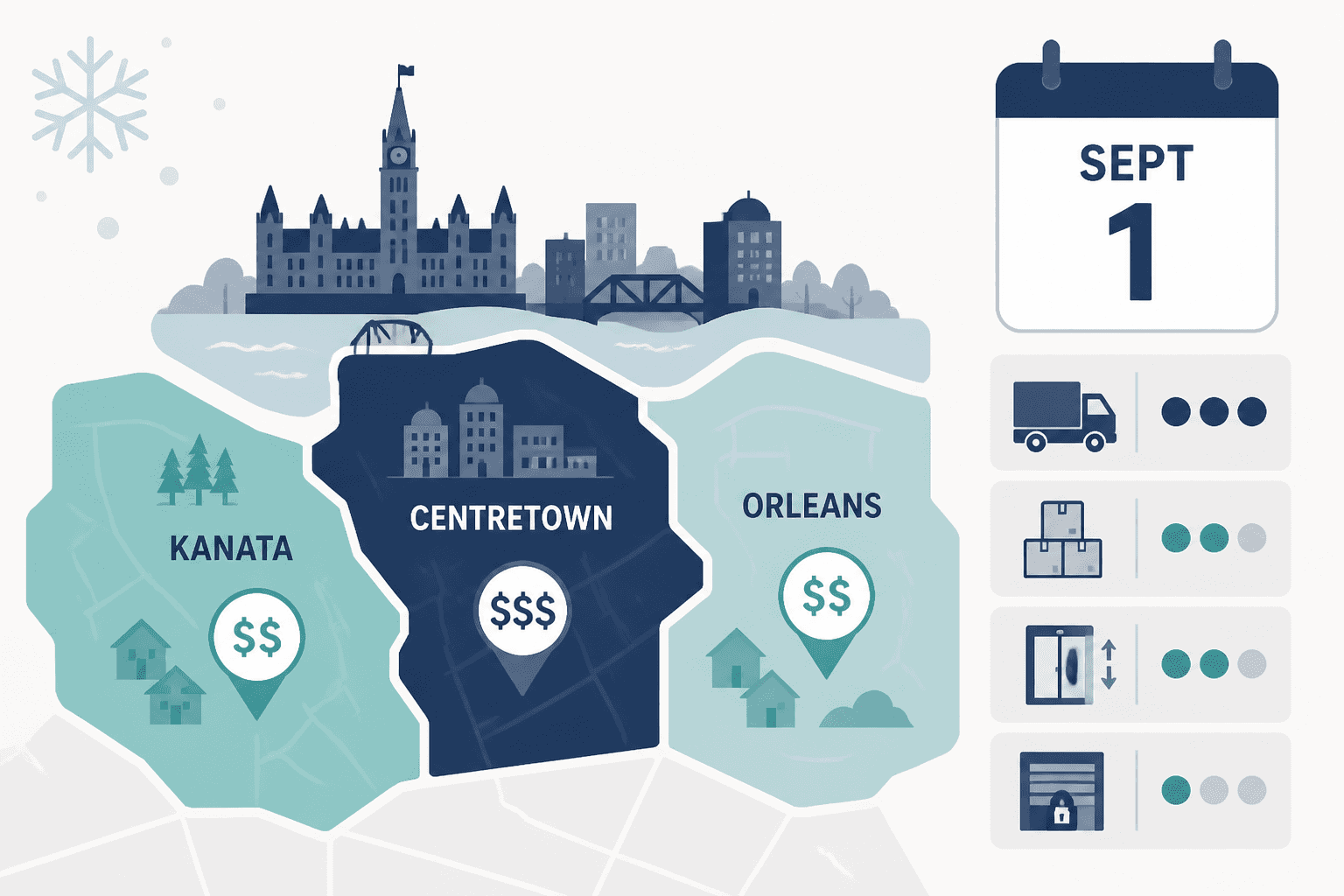
Why Sept. 1 is Ottawa’s peak moving window (and how surcharges are priced)
Moving on Ottawa’s September 1 lease start is notorious because the city’s demand spikes at the same time each year. Many leases in Ottawa (including large student/employee transitions in the downtown core and around uOttawa) line up with the start of the school and rental cycle. That means more households competing for the same moving inventory: late-summer truck availability, elevator/parking-window permissions, and crews that can complete loads, stairs, and tidy move-outs in one day. For ottawa september 1 moving cost 2026 peak pricing, the surcharge isn’t usually one single fee—it’s often the result of multiple cost drivers stacking together: higher hourly rates for short-notice bookings, premium pricing for “prime time” windows, and add-ons for packing, bulky items, and storage. If you’re relocating from Nepean to Centretown, or from Orleans toward Kanata’s job hubs, your schedule flexibility directly affects what you pay.
What to budget for peak pricing surcharges in Ottawa (typical line items)
To budget realistically for an Ottawa move timed to September 1, 2026, it helps to think in line items rather than one “all-in” number. In peak season, the biggest cost shift is commonly the move’s labour window: companies price availability and crew scheduling, so a full-service booking during high-demand hours can cost more than a similar move on a mid-week, off-peak day. Another frequent trigger is access logistics—Ottawa streets and many building lots require permits or strict move-in/move-out rules, especially around major corridors near Parliament Hill, Wellington West, and the Rideau Centre area. If your building only allows narrow time slots, you may face higher rates tied to shorter windows and increased coordination. Optional services can also rise in peak periods: packing supplies, bubble wrap/wardrobe boxes, and disassembly for items like beds or wall units. Storage can be especially expensive if you miss your desired move-in date, so planning ahead to avoid last-minute short-term storage matters.
How far in advance should you book for ottawa September 1 moving cost 2026 peak pricing?
When you’re planning for a September 1 lease start, booking timing often determines whether you get a standard rate versus peak pricing. While every move is different, peak calendars generally tighten quickly because moving companies must secure trucks, drivers, and sometimes equipment (dollies, ramps, protective flooring, or extra crew). If you wait until the month of the move, you can still find options, but they tend to be fewer, with less flexibility on arrival times and fewer choices for reduced labour hours. That’s where peak surcharges become harder to avoid. For example, a same-day or same-week booking is more likely to trigger premium “prime window” pricing compared with a confirmed slot set weeks earlier. Ottawa also has the added complexity of late-summer events, road works, and building-specific scheduling policies in areas like downtown, Old Ottawa South, and Westboro. A practical approach is to start inventory and quote requests early, then lock in the exact move-in and parking/elevator details once you’ve confirmed keys and building rules.
Strategies to reduce your move price without cutting safety or reliability
You can’t always eliminate peak pricing in Ottawa when your lease starts on September 1, 2026, but you can reduce the amount of peak multiplier you’re paying for. Start with volume control: declutter before you request a quote so the crew isn’t paid to move boxes you don’t need. Create an inventory list and group items by “keep in the room” versus “pack/label,” then leave a small, easy-access bag for essentials to reduce rummaging time on arrival. Pre-arranging packing can be the difference between a full-service packing premium and a more cost-effective load plan, especially for kitchens, books, and fragile décor. Another major saver is logistics readiness. Confirm whether your building in areas like Barrhaven, Orleans, or Kanata has elevator reservations, loading dock rules, or strict move-window limits; missing a rule can force time extensions, which are costly during peak demand. Finally, schedule your move path and item list realistically: disassembly for beds, secure wardrobes, and protect floors in advance. Paying for fewer labour minutes is often the most reliable way to soften ottawa september 1 moving cost 2026 peak pricing.
Ottawa weather, late-summer transitions, and why it affects your schedule even before winter
Even though your lease starts in early September (not winter), Ottawa’s conditions can still affect move execution and, indirectly, your cost. Late summer can bring rain, humidity, and sudden temperature swings that slow loading if stairs or walkways get slick, or if you need extra time to cover and protect items. Ottawa’s weather is not just about comfort—it can affect how long it takes to move furniture from curbside to the entryway, and whether your building requires bagging, tarping, or extra care for electronics and textiles. In peak windows, crews are scheduled tightly, so delays can matter more than they would during off-peak weeks. Also, if you plan a move from or to neighbourhoods such as Centretown, Mechanicsville, or the Glebe, you may be balancing street parking constraints with changing precipitation. The best way to protect budget predictability is to plan for buffer time, keep essentials dry, and provide your moving company with accurate item categories (e.g., “electronics,” “mattress only,” “fragile glass”) so the crew can bring the right protective approach without rework.
A realistic cost checklist for your September 1, 2026 move-in date in Ottawa
A realistic checklist helps you compare quotes apples-to-apples for ottawa september 1 moving cost 2026 peak pricing. Begin with confirmed dates and times: your lease start is September 1, but your move-in window depends on key availability, building permission, and elevator access. Next, note building details: do you have an elevator, a loading dock, a service entrance, or only stairs? Locations like Vanier, Hintonburg, and parts of downtown can differ dramatically block-to-block, so the same apartment size can move very differently. Then document items that change labour time: large appliances, long furniture, piano/TV installations, and any disassembly needs. Decide your packing scope: boxes you pack yourself reduce packing labour, but they increase your own time and preparation. If you expect a gap between move-out and move-in, ask about storage; short-term storage can become a budget hit if arranged last minute during peak dates. Finally, confirm payment and estimate assumptions: ask whether the quote includes protective materials, stairs, elevator time, and the number of trips. When each quote shares the same checklist, you’ll see the true peak-price difference.
Frequently Asked Questions
What is a realistic range for ottawa September 1 moving cost 2026 peak pricing?
Because every household is different and pricing depends on distance, stairs/elevator access, and the move services you choose (labour-only versus full packing), there isn’t one universal number for ottawa September 1 moving cost 2026 peak pricing. In Canada, moving companies commonly price by factors like the number of bedrooms, total labour hours, and truck size; during peak periods, the same move can cost noticeably more than an off-peak date. A practical way to estimate is to compare at least two quotes that use the same assumptions: exact move date/time window, whether you need packing, any disassembly, and how many floors/stairs are involved. If you’re within Ottawa (e.g., moving from Kanata to Nepean), your travel cost may be smaller than a cross-province relocation, but peak-date labour and scheduling can still raise the total. To reduce risk of surprises, ask your mover what typically triggers surcharges—prime time arrival, tight building windows, or additional crew hours—and confirm whether those are included in the estimate.
Will a weekend move on Sept. 1 cost more than weekdays in Ottawa?
Likely, yes—weekend and holiday-adjacent days often carry higher demand, which can increase pricing even beyond typical peak season effects. For Ottawa, the September 1 lease cycle usually creates heavy demand that can shift upward around weekends, when many renters prefer to complete moves after traditional workdays end. Even if the move is “only” September 1, the day-of-week matters because crews and trucks may be booked for multiple households back-to-back. In practice, if your lease starts on a Saturday, you may face less availability and narrower time windows from buildings, which can convert into a higher hourly rate or a prime-time surcharge. If you’re choosing between moving on Sept. 1 versus the day before or after, compare the quotes and ask whether the difference reflects labour window pricing, truck availability, or access constraints. The best cost control is usually flexibility—shifting your arrival time slightly earlier or later can sometimes reduce peak pricing, if the building rules allow it.
How do I avoid parking and elevator surprises in Ottawa condos and apartments?
Parking and elevator access are a common hidden cost driver during peak dates because they affect how long crews spend waiting, re-positioning, or making extra trips. For an Ottawa September 1 move, start by contacting your building management (or checking your move-in package) for: elevator reservation requirements, service elevator rules, permitted loading entrances, and any need for permits. Many downtown and inner-city properties in Ottawa—especially near high-traffic areas—set strict time windows for noise and loading. If you’re moving into or out of neighbourhoods like Centretown, the Glebe, Old Ottawa South, Hintonburg, or Westboro, assume that loading options may be limited. Then coordinate with your mover by providing floor count, estimated size/quantity of furniture, and whether you have bulky items requiring ramps or extra help. If you’re using an exterior parking spot, clarify where the truck can stage and how long it can remain. When access is confirmed early, peak pricing is more predictable because labour time won’t expand due to waiting.
Should I pack myself to reduce peak pricing in Ottawa?
Self-packing often reduces labour cost, but it depends on your time, item mix, and how much packing support your mover provides during peak windows. For ottawa September 1 moving cost 2026 peak pricing, the most consistent savings come from reducing the number of labour hours required for loading, protecting items, and preparing boxes. If you have the time to pack non-fragile items, using standard boxes and clear labels can reduce the full-service packing premium. However, if your move includes a lot of fragile items (glassware, framed art, collectibles) or you have many small items, professionally packed protection can reduce both risk and rework during a hectic September 1 day. A good compromise many families choose is: self-pack books and non-fragile household items while paying movers to pack the most delicate categories (or to handle disassembly and careful wrap). Ask your mover for a clear packing scope so your quote reflects exactly what you will and won’t pack. That way, you’ll compare quotes fairly and avoid “scope creep” that increases the final total.
Can I store items before move-in if my lease starts Sept. 1, 2026?
Yes, storage can be a solution when there’s a gap between move-out and move-in—or if your building’s move window doesn’t align perfectly with your schedule. But for peak-date pricing, storage planning should be deliberate because short-term storage arranged late can cost more, and it can add extra handling charges. To keep costs controlled, first confirm whether you have a hard deadline on September 1 for receiving keys or moving items in. Then check building flexibility: some Ottawa buildings can allow early move-in or schedule extra time slots for unloading, which might reduce or eliminate the need for storage. If storage is still necessary, ask your moving provider about: secure storage options, minimum time requirements, pickup and delivery scheduling, and whether you’ll pay by volume or by access time. Finally, pack storage-ready: keep essentials accessible, protect fragile items, and avoid storing items that require climate control if that’s not included. The more you can align move timing and minimize handling steps, the less storage will add to peak pricing.
What should I do first to get an accurate quote for September 1 peak pricing in Ottawa?
Start with a clear “move facts” summary, because accurate estimates depend on what your mover needs to plan labour, truck size, and access logistics—especially during peak periods. First, confirm the exact move-in and move-out dates (Sept. 1, 2026 in your case) and identify your preferred arrival window. Then measure and document your space: number of bedrooms, major furniture items (sofas, beds, dining sets), and whether you have appliances. Next, gather building details for both your move-out and move-in locations: floors, elevators, stairs, loading dock access, and any reserved move times. Provide your mover with this information when you request quotes, so you get comparable pricing assumptions rather than vague estimates. Include any special conditions: pets, restricted elevators, parking limits, or disassembly needs. Finally, ask your quote to list what’s included—protective materials, packing scope, stairs/elevator time, and whether peak pricing is already applied. If you share the same checklist across quotes, you’ll understand how ottawa September 1 moving cost 2026 peak pricing is being calculated and whether you can adjust anything to reduce it.