
Kitchener-Waterloo Moving Costs in 2026: The $100 to $175 Reality
Here's the part that catches almost everyone off guard: moving in Toronto is actually cheaper than in Kitchener-Waterloo. Canada's biggest city, and yet Toronto movers charge a median of $125 an hour for a two-person crew and truck. In KW? It's $130. The tech corridor next door costs more than the metropolis. And it's not for lack of competition — KW has 106 active moving companies, all fighting for business, and together they average a sky-high 4.73 stars across 10,548 Google reviews. No other city in this analysis comes close. The price range in KW runs from $100 to $175 per hour, and not a single company dips below $100. That's a higher floor than you'd expect for a mid-size Ontario city, likely thanks to KW's population boom (6.15% growth — double the Canadian average). If you're moving a typical 2-bedroom apartment, plan for $650 to $780 at median rates over 5–6 hours. And here's another surprise: the $75 spread between cheapest and priciest is the tightest of any city we've analyzed. Competition is fierce, but quality is consistently high.
Thinking about moving to Kitchener-Waterloo in September? Get ready to battle 60,000 university students for a moving slot. If you don't want to get shut out — or pay through the nose — book your movers at least 3 to 4 weeks ahead. January and May aren't much easier, thanks to the University of Waterloo's co-op cycle. Every four months, thousands of students swap homes, creating demand spikes you won't see anywhere else in Canada. For those months, 2–3 weeks' notice is your best shot at landing a crew.
That's the KW moving market in a nutshell: it's driven by forces that have nothing to do with the usual summer rush.
We analyzed 106 active moving companies serving the Kitchener-Waterloo-Cambridge corridor. Our data came from Boxly's marketplace, collected in February 2026. We reviewed hourly rates, Google review scores, insurance status, BBB accreditation, and service coverage across the tri-city region.
The median rate: $130 per hour for a standard two-person crew and truck. The full range spans $100 to $175 per hour — and here's what's unusual: not a single company prices below $100. In Toronto, you'll find movers at $95. In Montreal, $85. In KW, the floor is $100, and the ceiling is only $175. That $75 spread is the narrowest of any city we've analyzed.
What does $130/hour actually look like? For a 2-bedroom apartment — the most common move in KW's student-and-tech-worker demographic — expect 5 to 6 hours of work, totalling $650 to $780 at the median. A studio or 1-bedroom near the universities runs 3 to 4 hours, or $390 to $520. A 3-bedroom family home in Doon or Forest Heights? Plan for 6 to 8 hours and $780 to $1,040.
The other number that stands out: 4.73 stars across 10,548 reviews. That's the highest collective rating of any city in our analysis — higher than Toronto (4.65), Calgary (4.68), or Vancouver (4.73, though with a wider distribution). To put that in perspective, imagine a classroom where almost everyone scores an A; KW's moving market is that rare. The tech corridor's review culture, where leaving detailed Google reviews is second nature, may play a role. KW movers know they're being rated, and it shows.
How much do movers charge per hour in Kitchener?
The median rate across 106 Kitchener-Waterloo movers is $130/hr for a two-person crew and truck. Rates range from $100 to $175/hr. A 3-person crew (offered by only 4 companies) runs $195/hr median. These rates are current as of February 2026 marketplace data.
Silicon Valley North: How Does Kitchener-Waterloo's Tech Boom Affect Moving Costs?
No analysis of KW's moving market is complete without addressing the elephant in the room: this is Canada's tech hub, and it changes everything about who moves here, how often, and where.
The numbers are staggering. The Region of Waterloo reports 1,570+ tech-related businesses employing roughly 1 in 10 workers in the region. There are 291 startups with combined funding exceeding $288.5 million. Seven companies have achieved unicorn status — valued over $1 billion — including 1Password, ApplyBoard, and Arctic Wolf. Google maintains one of its largest engineering hubs outside the US here, with over 1,000 employees. OpenText is headquartered in Waterloo. BlackBerry, now a cybersecurity company, remains a major employer.
What this means for moving:
Inbound migration is constant. Tech workers relocate to KW from Toronto (for affordability — 31% lower cost of living, per Expatistan's 2025 comparison data) and from Vancouver (for the same reason, plus proximity to Toronto's venture capital). Statistics Canada's 2024–2025 internal migration data shows the Toronto CMA lost 77,492 people to net domestic out-migration — many landing in KW. The GO Train corridor, now with weekend service as of November 2025, makes KW viable for Toronto commuters who want to own rather than rent. This sustained inbound demand keeps mover schedules full even outside traditional peak season.
Young professionals move frequently. The tech workforce skews young (25-35), with average job tenure of 2-3 years. Each job change often triggers a move within the KW corridor — from a Northdale student apartment to an Uptown Waterloo condo, then to a downtown Kitchener townhouse. These aren't long-distance relocations; they're local moves that keep the 106 KW movers busy year-round.
Moves concentrate along the ION corridor. The $3.2 billion in building permits issued since the ION LRT was approved in 2011 — two-thirds of it residential — has created a dense strip of new condos along King Street from Conestoga Mall to Fairview Park Mall. Google's office, Communitech's innovation hub, and most startups cluster near ION stations. The result: an outsized share of KW moves happen within a narrow geographic band, making mover routing efficient and prices competitive.
The gap in the market: KW movers are exceptionally good at the condo-to-condo, apartment-to-apartment moves that tech workers need. Where the market falls short is larger family moves — only 4 companies offer 3-person crews, reflecting a market optimized for the dominant customer profile.

Breithaupt Street, Kitchener
Google's office in Kitchener is a major tech hub located in the city's Innovation District.
University Moving in KW: How Does the UW Co-op Cycle Change Everything?
The 4-month churn created by UW's co-op program means thousands of students are moving in and out at set points each year. But what does that mean for your move? Could shifting your lease move-in or move-out date by even ten days save you 10–15% or secure your first-choice mover? If you have the flexibility, consider scheduling outside those peak co-op transitions — September, January, and May. Strategic timing can turn academic calendar chaos into real dollars saved.
If you're moving near UW or WLU, you're entering a market shaped by a system that exists in no other Canadian city.
The Co-op Calendar
UW's cooperative education program sends students on alternating 4-month study and work terms. Beginning in fall 2025, UW streamlined its co-op cycle management with 3 cycles per term for greater flexibility — but the fundamental pattern persists: massive housing turnover every four months.
This creates three mini-moving seasons annually:
- September: Fall term begins. Thousands of students arrive or return.
- January: Winter term starts. Co-op students transition between work and study.
- May: Spring/summer begins. Another full rotation.
WLU follows a more traditional September/April calendar, but its 20,000+ students amplify those peaks significantly.
The Affected Neighbourhoods
Northdale (bounded by King, Phillip, Columbia, University) is the epicentre — the highest-density student housing area, with constant turnover. Movers know every building here.
Columbia / Lakeshore near both campuses sees similar patterns. Uptown Waterloo mixes students with young professionals. Lower Doon in south Kitchener attracts students seeking more affordable options further from campus.
Student Moving Economics
The average UW co-op student earns $16,000 per work term — decent income, but housing costs mean many optimize on moving. The informal economy thrives: friends with trucks, TaskRabbit labour, U-Haul rentals for small loads. Professional movers capture the students who've accumulated enough furniture (or enough bad DIY experiences) to justify $390-$520 for a 1-bedroom move.
The subletting dynamic adds complexity: students typically sign 12-month leases at $980/month but sublet at $600 when away on co-op — a $380/month loss that incentivizes minimal furniture and easy-to-move setups.
What the Data Shows
CMHC's 2025 Rental Market Report indicates vacancy rates in Waterloo's university zone (Zone 4) reached their highest level since 1993. The 2024 federal cap on international study permits eased demand in student-heavy areas. For movers, this means slightly less intensity during co-op transitions — but the pattern remains structurally entrenched. KW movers have adapted to this rhythm over decades, making them some of the most efficient student-move specialists in the country.

Waterloo Region Museum. Kitchener.
The museum showcases the history and culture of the Waterloo Region.
Kitchener vs the GTA and Southwestern Ontario: How Do Moving Costs Compare?
Why does bigger Toronto cost less per hour than mid-size cities like Kitchener? This is the question that surprises most people when comparing moving costs in Ontario.
The Ontario moving market doesn't follow the pattern you'd expect. A bigger city doesn't mean higher prices — it often means more competition and lower rates.
Kitchener-Waterloo: $130/hr (106 movers, 4.73 stars, 10,548 reviews)
Compare that to the corridor:
Toronto comes in at $125/hr with 514 movers and 57,529 reviews. Five dollars cheaper than KW, which feels wrong until you consider the math: Toronto has nearly 5x the competition. When 514 companies fight for business, prices compress. KW's 106 movers face less pressure to undercut.
Hamilton matches exactly at $130/hr — but with only 24 movers. Hamilton's market is thinner, so while the median matches, your options are far more limited.
Ottawa also lands at $130/hr with 39 movers. Three distinct markets, three identical medians. The Ontario mid-size city moving rate appears to have a natural equilibrium around $130.
London breaks the pattern at $155/hr — a full $25 more than KW, and with only 14 listed movers. London's higher rate likely reflects a supply constraint: fewer companies serving a growing university city (Western University drives similar seasonal demand to KW, but with far fewer movers to absorb it).
For anyone considering a move from Toronto to KW — and the GO Train expansion is making this increasingly common — the moving cost difference is minimal. The real savings come after: Kitchener-Waterloo's cost of living runs approximately 31% lower than Toronto's, according to Expatistan's 2025 comparison data. Average rent in KW sits at $1,779/month versus Toronto's significantly higher baseline.
What Does Your Kitchener-Waterloo Move Actually Cost by Home Size?
The $130/hr median tells you the rate. What it doesn't tell you is how long your specific move will take — and in KW, the housing stock varies dramatically.
Studio / 1-Bedroom (3-4 hours) Typical near universities or ION corridor: $390 to $525 at median, $300 to $700 at full range. Student moves in Northdale or Columbia/Lakeshore are the bread and butter of KW movers — they've done thousands of these and can often complete them in under 3 hours. New condo buildings along King Street have loading docks and freight elevators that speed things up. Older walk-ups near WLU add time.
2-Bedroom Apartment (5-6 hours) The most common move type in KW: $650 to $780 at median, $500 to $1,050 at full range. This covers most young professional and tech worker relocations — downtown Kitchener condos, Uptown Waterloo apartments, or first homes in Laurentian Hills. The key variable is access: a ground-floor unit with parking lot access loads in 4 hours. A third-floor walk-up with street parking adds 1-2 hours.
3-Bedroom House (6-8 hours) Family homes in Forest Heights, Doon, Country Hills, or Bridgeport: $780 to $1,040 at median, $600 to $1,400 at full range. These established neighbourhoods typically have driveways and wider doorways — faster loading than downtown. But older homes near Victoria Park (1920s-1950s builds) have narrow lot lines, no garages, and steep interior stairs that slow everything down.
4-Bedroom+ House (6-8 hours, 3-person crew) Larger family homes or heritage properties: $1,170 to $1,560 with a 3-person crew at $195/hr. Only 4 companies in KW offer 3-person crews — limited availability means booking 3-4 weeks ahead during peak months. Cambridge heritage homes along the Grand River in Galt present unique challenges: stone and brick construction, steep lots near the riverbank, and narrow heritage streetscapes.
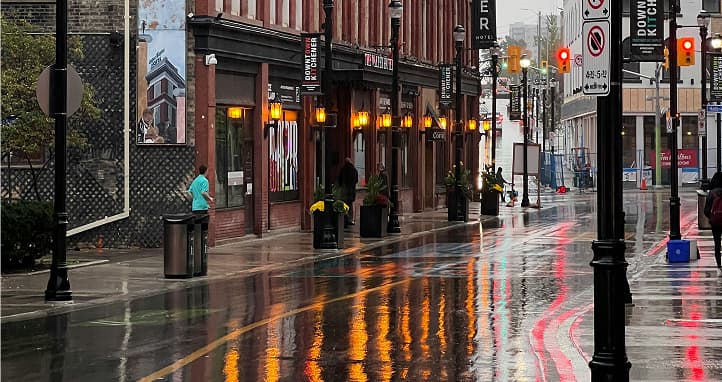
Downtown Kitchener-Waterloo
City streets on a rainy day.
Kitchener-Waterloo-Cambridge Neighbourhood Moving Guide: Where Are People Moving?
Downtown Core: Includes Downtown Kitchener (ION corridor condos, new towers), Uptown Waterloo (walkable urban, mix of mid-rises and old houses), and Cambridge's Galt downtown. Moves here often involve loading docks, elevator bookings, restricted moving hours, and potential condo-related fees. Travel time is usually minimal between Kitchener and Waterloo's core, but Cambridge is a 22-minute drive — enough to affect your quote. Downtown Kitchener has seen $1.2 billion in new development, making it the epicentre of condo moves, with efficient building access but sometimes stricter moving policies.
Suburban Easy-Access: This includes Forest Heights, Doon, Laurentian Hills in Kitchener; Beechwood, Lexington, Westmount in Waterloo; and newer subdivisions across the cities. Here you'll find driveways, garages, and wide streets — moves are more straightforward and often completed quickly. Forest Heights ($749K avg) and Doon draw families needing space and school access. Laurentian Hills offers first-time buyer value at an average price of $559K. Suburban Waterloo (Beechwood and Lexington) is all about new builds, ample parking, and fast load-outs.
Heritage Complex: This covers Kitchener's Victoria Park area, Cambridge's historic Galt, and student housing clusters in Northdale and Columbia/Lakeshore. These neighbourhoods have older homes with narrow doorways, steep stairs, no driveways, or heritage construction — challenging moves that usually take longer and run a higher risk of fees like long carry or stair surcharges. Movers who know these areas are worth the premium.
KW isn't one city — it's three, and where you're moving within the triangle directly affects your mover's quote. The critical factor most people miss: travel time between cities is billed.
KITCHENER
Downtown Kitchener has transformed. The ION LRT sparked a wave of new condo towers — Q Condos (34 stories), Station Park, DUO Living — creating a new urban core along King Street. Moves here involve loading docks, freight elevators, and building-specific scheduling rules. Fast access, modern layouts. Budget $650-$780 for a typical 2-bedroom condo move.
Victoria Park area is the architectural opposite: character homes from the 1920s-1950s with mature trees, narrow lots, and period details that complicate moving. Doorways are narrower, staircases are steeper, and many homes lack driveways. Budget an extra hour compared to new construction.
Forest Heights is an established residential southwest — average listing price $749K, with 65% homeowners. Good school catchments, proximity to Sunrise Centre shopping, and an active community centre. Moves here are straightforward suburban: driveways, garages, moderate home sizes.
Doon / Pioneer Park anchors the south end with easy Highway 401 access. Pioneer Park was developed in the 1970s-80s — mature suburbia with a mix of detached homes, townhomes, and bungalows. The Waterloo Region Museum and Homer Watson House are nearby landmarks.
Laurentian Hills offers the best value in Kitchener at $559K average — 36% below the city average. McLennan Park provides excellent family amenities. First-time buyers moving here from more expensive KW areas is a common pattern.
WATERLOO
Uptown Waterloo is the walkable, transit-connected heart — over 450 businesses, excellent ION access, vibrant dining and nightlife along King Street. A mix of older character homes and new mid-rise developments. This is where young professionals who want urban lifestyle settle.
Northdale is ground zero for student housing, bounded by King Street, Phillip Street, Columbia Street, and University Avenue. High turnover every 4 months (co-op cycle) means moves here are constant. Movers know these buildings intimately.
Columbia / Lakeshore and Beechwood offer suburban living near the universities. Lexington in the east is newer development — builder-grade homes, easy access, efficient moves.
CAMBRIDGE
Often the overlooked third city. Galt has a historic downtown along the Grand River — heritage stone and brick homes with character (and moving challenges). Hespeler blends old-town charm with newer subdivisions. Preston rounds out the heritage areas.
The travel time factor: Waterloo to Kitchener is 5 minutes — negligible. Kitchener to Cambridge is 22 minutes — that's 44 minutes round-trip your mover may bill at $130/hr, adding $95 to your quote before a single box moves. Always ask where the crew starts their day.
ION Corridor: How the LRT Transformed Moving in Kitchener-Waterloo
The ION LRT changed KW's geography as much as its transit options. Before the LRT, downtown Kitchener and Uptown Waterloo were pleasant but secondary to suburban residential life. After the LRT: $3.2 billion in new building permits concentrated along a narrow 19-km corridor. New condo towers replaced parking lots. Property values along King Street jumped. And movers adapted to a new category of client — the urban professional in a brand-new highrise, moving between ION stops.
What moves on the ION corridor look like:
New buildings — Station Park, DUO Living, Q Condos, DTK Condos, 60 Frederick, DREWLO's City Flats — have modern loading infrastructure designed for residential moves. Freight elevators large enough for a sectional sofa. Dedicated loading docks where a moving truck parks directly level with the building entrance. No long carry distances. No stair fees. The actual move is efficient.
The pre-move complexity more than compensates. Every major ION corridor building requires:
- Elevator booking: Typically 1-2 weeks advance notice. Some buildings restrict to 2-hour windows per day.
- Restricted moving hours: Most buildings permit moves weekdays only, 9am-5pm. Some allow Saturdays. Sunday moves are rare.
- Damage deposit: $200-$500 held by building management, returned if no damage occurs.
- Certificate of Insurance (COI): Some buildings require your moving company to provide a COI naming the building as additionally insured.
The ION effect on KW's moving market:
The corridor concentrates demand. Rather than scattered across three cities, a disproportionate share of KW moves happen within a narrow band along King Street. This has made movers unusually efficient at the urban condo move — they know which buildings have strict policies, which freight elevators are temperamental, and which building managers are flexible.
It has also created a new friction for non-ION movers. A mover who knows Forest Heights perfectly may not know Station Park's freight elevator booking system. When moving to or from an ION corridor building, ask specifically: "Have you moved in [building name] before?" Experience with that specific building matters.
Stage 2: What it means for Cambridge by 2032:
The November 2025 approval of the $3.1 billion Stage 2 extension to Cambridge (via Kitchener) will eventually connect the tri-city triangle with LRT. Construction will affect moving logistics along Hespeler Road and parts of south Kitchener through the early 2030s — expect periodic lane closures and access restrictions during construction. For Cambridge, Stage 2 will eventually bring the same ION-driven condo development wave that transformed Kitchener and Waterloo, though timelines extend well beyond the current market cycle.
Do I need to book an elevator to move into an ION corridor condo?
Yes — for virtually all major ION corridor buildings. Typical requirements: elevator booking 1-2 weeks in advance, restricted moving hours (usually weekdays 9am-5pm), a damage deposit of $200-$500, and some buildings require your mover to carry a Certificate of Insurance (COI). Contact building management immediately after closing — failure to book can result in being turned away on moving day.
The Co-op Calendar: When Should You Move in Kitchener-Waterloo for the Best Price?
Most Canadian cities have one moving season: summer. KW has four — thanks to a university co-op system that no other city replicates.
The UW Co-op Effect
The University of Waterloo operates the world's largest cooperative education program. Students alternate between 4-month study terms and 4-month work terms, with intakes in September, January, and May. That means roughly one-third of UW's 41,000+ students are changing living arrangements three times per year. Wilfrid Laurier University's 20,000+ students follow a more traditional September/April calendar, but the overlap with UW's September intake creates a perfect storm.
September (variation: +30%): The absolute peak. Both universities begin fall term. UW co-op students return from summer work terms. WLU students arrive. The general market's summer tail overlaps. Book 3-4 weeks ahead minimum. Expect premium pricing and limited availability, especially in the Northdale, Uptown Waterloo, and Columbia/Lakeshore corridors.
January (variation: +5%): The winter co-op spike. UW's winter term co-op rotation moves thousands of students — surprising newcomers who assume January is quiet. Less intense than September but enough to tighten availability in student-heavy areas. Roads may be snow-covered, adding time.
May (variation: +15%): The spring co-op surge. UW's spring/summer co-op intake coincides with the start of the general moving season. A double whammy that makes early May particularly busy.
February-March (variation: -10% to -15%): The sweet spot. The only extended window with zero university pressure. Winter weather keeps general demand low. This is when you'll find the best rates, the most flexible scheduling, and movers willing to negotiate. A 2-bedroom move that costs $780 in September drops to roughly $650-$665 in February.
October-November (variation: -5% to -10%): The autumn valley. September's chaos subsides, holiday season hasn't started, and movers have open calendars. Good rates, good availability.
What is the cheapest month to move in Ontario?
Across Ontario, February is typically cheapest — winter weather suppresses demand. In KW specifically, February and March offer the deepest discounts (10-15% below median) because they're the only months unaffected by UW's co-op rotation cycle. Avoid September in KW at all costs.

Kitchener in autumn
One of the most beautiful times of year in Kitchener.
Popular KW Moving Routes: What Do They Cost?
KW sits at the intersection of several major corridors, and the route you're travelling determines whether you need a local mover, a long-distance specialist, or something in between.
Toronto ↔ KW (108 km) This is the #1 route. The expanding GO Train service — now with weekend trains (launched November 2025) and express options cutting 10 minutes off the 1-hour-39-minute trip — has made KW a genuine commuter alternative to Toronto. People are moving TO KW for affordability while keeping Toronto jobs. A local-rate move within KW might cost $650-$780; a Toronto-to-KW move with a long-distance mover runs $2,000-$4,000 depending on volume. The Highway 401 corridor is straightforward — no mountain passes, no ferries, no border crossings.
KW ↔ Guelph (30 km) At 30 km and a 25-minute drive, this is essentially a local move. Most KW movers serve Guelph at standard hourly rates — verify before booking, as some charge a travel surcharge for the last 5 km outside their primary zone.
KW ↔ Hamilton (70 km) One hour via Highway 8 and the 403. This crosses into long-distance territory for most movers. Expect $1,500-$3,000 for a 2-bedroom depending on whether the mover bills hourly with travel or uses flat-rate long-distance pricing.
KW ↔ London (130 km) An hour and 15 minutes straight west on Highway 401. London movers charge $155/hr — significantly more than KW's $130. If you're moving TO London from KW, getting a KW-based mover to do the job may save on hourly rate, even with travel time.
Intra-Tri-City: The Travel Time Factor Waterloo ↔ Kitchener: 5 minutes — negligible billing impact. Kitchener ↔ Cambridge: 22 minutes — adds $48 each way at $130/hr. Waterloo ↔ Cambridge: 25-30 minutes — adds $55-$65 each way.
Always ask your mover: "Where does the truck start its day?" A Cambridge-based crew serving Waterloo adds nearly $100 in travel before touching a box.
KW ↔ Brantford (40 km) A 30-minute drive south via Highway 24. Brantford is growing rapidly as a spillover from both Hamilton and KW affordability seekers. Most KW movers treat this as a borderline local/short-distance route. Expect hourly billing with travel time, totalling $800-$1,200 for a standard 2-bedroom.
Metrolinx and the Future The GO Train expansion is reshaping KW's connection to the Greater Toronto Area. The Metrolinx-CN agreement for all-day, two-way hourly service is progressing, and once operational, will make KW-Toronto a true commuter corridor. For the moving market, this means continued inbound migration from people seeking KW's lower housing costs while maintaining Toronto careers. Movers along this corridor should see sustained demand for years.
Is it cheaper to move from Toronto to Kitchener or the other way?
Cost is similar either direction — it's the same 108 km on Highway 401. The key difference is mover availability: Toronto has 514 movers competing for business, so Toronto-based long-distance movers often offer better rates. KW currently lists zero dedicated long-distance movers on Boxly, so Toronto-based companies typically handle this corridor.
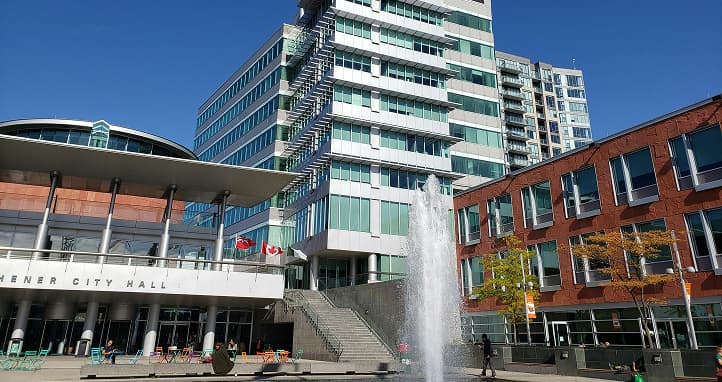
King St W, Kitchener, Canada
An area with condominiums, cafes and social life.
The Tri-City Triangle: What Moving Between Kitchener, Waterloo, and Cambridge Actually Costs
Most Canadian cities have one downtown. KW has three — and the travel time between them is billed.
The tri-city triangle — Kitchener, Waterloo, Cambridge — operates as a single economic region for most purposes: shared transit, shared employers, shared property market. But for movers, the geography matters because travel time is billable, and the three cities have different access profiles.
The Kitchener-Waterloo Route (5 minutes, ~5 km)
For practical purposes, Kitchener and Waterloo are one moving market. The route along King Street or University Avenue is 5 minutes driving and negligible billing impact. Most KW movers don't distinguish between a Kitchener-to-Waterloo move and a within-Kitchener move. The ION LRT connects the cities seamlessly. If you're moving between these two cities, travel time is rarely a meaningful cost factor.
The Kitchener-Cambridge Route (22 minutes, ~24 km)
This is where the tri-city arithmetic matters. Cambridge is a 22-minute drive from downtown Kitchener via Highway 8 or the Conestoga Parkway. At a $130/hr median rate, that translates to approximately $48 each way in travel time charges — or roughly $95 round-trip before a single box is moved.
The key variable: where the mover's truck starts its day. A Kitchener-based mover doing a Cambridge job starts billing when they leave Kitchener. A Cambridge-based mover doing a Kitchener job starts billing when they leave Cambridge. Ask explicitly: "Where does your truck start the day?"
Cambridge's unique access profile adds additional complexity beyond travel time:
- Galt heritage streetscape: Stone and brick homes on steep Grand River lots, narrow streets that limit truck manoeuvrability
- Hespeler growth zone: Newer subdivisions with good access, north of the Grand River
- Preston junction: Mixed heritage and modern, generally accessible
The Waterloo-Cambridge Route (25-30 minutes, ~27 km)
Slightly longer than Kitchener-Cambridge, and the least common intra-tri-city route. From north Waterloo (Lexington, Beechwood) to Cambridge adds 30+ minutes each way — potentially $65+ per direction. If your move involves north Waterloo and Cambridge, prioritize getting a quote from a mover based in between (Kitchener or south Waterloo) to minimize travel overhead.
The Growth Dynamic
Cambridge's population surpassed 150,000 in the 2021 Statistics Canada Census, growing faster than either Kitchener or Waterloo in recent years. The approved $3.1 billion Stage 2 ION LRT extension to Cambridge will eventually change the moving landscape, but with service estimated around 2032, today's reality is still car-and-truck dependent. Cambridge's growth means intra-tri-city moving demand is increasing — residents upgrading within the tri-city, or Kitchener/Waterloo residents discovering Cambridge's more affordable price points.
Strategy: Match Mover Base to Your Origin
The single most cost-effective decision for a tri-city move is choosing a mover whose garage or dispatch location is closest to your pickup address. Boxly's listing pages show each company's primary service area — use that to filter before requesting quotes. For Cambridge moves specifically, the list of movers based in Cambridge or south Kitchener is shorter than the KW-wide list, but the travel time savings are significant.
Do KW movers charge extra for moves between Kitchener, Waterloo, and Cambridge?
Most KW movers cover Kitchener and Waterloo without extra charges — the cities are only 5 minutes apart. Cambridge is different: at 22 minutes from downtown Kitchener, Cambridge adds approximately $48-$65 each way in travel time at $130/hr median. That's nearly $100 round-trip before touching a box. Always ask: "Where does your truck start the day?" and "Is travel time billed for Cambridge routes?"
Cambridge Movers: What Makes Moving in Cambridge Different from KW
Cambridge is the third city in the Tri-City region, but it operates as a distinct moving market in ways that neither Kitchener nor Waterloo fully shares. Understanding Cambridge's moving geography matters for both residents moving within Cambridge and those moving between Cambridge and the rest of the Tri-City.
Cambridge Is Three Former Cities
Cambridge was formed in 1973 by the amalgamation of three distinct communities, and each retained its own character:
- Galt (downtown Cambridge): The original urban core, on the Grand River. Stone and brick heritage buildings on hilly, narrow streets. The most challenging area to move in — steep grades, period architecture, and roads that weren't designed for modern moving trucks. A Grand River bluff property in Galt can require a longer carry than a similar-volume downtown Kitchener move.
- Preston: The middle section, more mixed in age and style. Generally accessible residential streets, a mix of heritage and post-war housing.
- Hespeler: North Cambridge, bordering Guelph. Newer subdivisions, wide streets, ground-level access, attached garages. Moving here feels like moving in suburban Waterloo — efficient and straightforward.
The Grand River Factor
Galt's defining geography is the Grand River running through its downtown core. Properties on the river bluffs have dramatic views and steep driveways. The heritage streetscape in downtown Galt (Water Street, Main Street, Queen Street) limits truck access in ways similar to Kitchener's heritage districts but with the added challenge of river-adjacent terrain.
Cambridge Moving Costs
Cambridge follows the KW market median of $130/hr for a two-person crew and truck. The variables:
- Galt heritage homes: Budget 20–30% more time than a comparable modern home due to terrain and access constraints
- Hespeler new-build subdivisions: Among the most efficient moves in the Tri-City — wide streets, driveway access, ground floor
- Travel time from KW-based movers: At $130/hr, a Kitchener-based crew adds ~$48 each way for the 22-minute Kitchener-Cambridge transit — nearly $100 round-trip before moving a single box
Finding a Cambridge Mover
The most cost-effective approach for a Cambridge move is a mover based in Cambridge or south Kitchener. Their truck starts the day in Cambridge, eliminating the KW-to-Cambridge travel charge. The list of Cambridge-based movers is shorter than the KW-wide list, but the travel time savings are significant.
Questions to ask any mover for a Cambridge job:
- Where does your truck start the day?
- Is travel time to Cambridge billed from your garage, or from when you arrive at my address?
- Have you done moves in Galt specifically, and how do you handle the heritage streetscape access?
Find Cambridge movers on Boxly — filter by Cambridge service area to see companies based near your pickup address.
Is Cambridge Part of the Kitchener-Waterloo Moving Market?
Functionally yes — Cambridge movers serve Kitchener and Waterloo, and KW movers serve Cambridge. But the travel time cost is real: the 22-minute Kitchener-to-Cambridge drive adds ~$48 each way in billable time, or nearly $100 round-trip at the $130/hr median. For a Cambridge-only move, a Cambridge-based mover eliminates that cost entirely. For a Kitchener-to-Cambridge move (or vice versa), the travel charge is unavoidable — but ask whether the mover bills from their dispatch location or from when they arrive at your address.
Residential Moving in Kitchener-Waterloo: Which Home Types Affect Your Quote?
The type of home you're moving from — or into — matters more than the distance in KW. Each housing category presents different logistics, time requirements, and potential surprise costs.
ION Corridor Condos (Downtown Kitchener, Uptown Waterloo) The newest and fastest-growing segment. Buildings like Q Condos, Station Park, and DUO Living have modern loading infrastructure, including dedicated loading docks, freight elevators, and covered parking areas. The trade-off: building management rules. Expect mandatory elevator booking (1-2 weeks advance), restricted moving hours, and potential damage deposits. Some buildings require your mover to carry a COI (Certificate of Insurance). These moves are efficient once you're inside — modern layouts, wide hallways, proper elevators — but the administrative overhead adds lead time.
Downtown Kitchener Character Homes (Victoria Park, Heritage Districts) Homes from the 1920s through 1950s with architectural charm and moving headaches. Narrow doorways may not accommodate standard furniture without disassembly. Steep interior staircases. Many lack driveways entirely — front-door access only, with the truck parked on the street (remember the 4,500 kg parking restriction). Budget an extra hour compared to an equivalent-sized modern construction project.
Waterloo Suburbs (Beechwood, Lexington, Westmount) Modern residential development with wide driveways, attached garages, and standard-width doorways. These are the most straightforward moves in the KW market. Ground-level access, ample parking for the truck, and predictable timing.
Cambridge Heritage Homes (Galt, Hespeler, Preston) Galt's downtown along the Grand River features heritage stone and brick construction — beautiful but heavy. Steep lots near the riverbank complicate truck positioning. Narrow heritage streetscapes limit maneuvering. If you're moving into or out of Galt, hire a mover who knows the area well.
Student Housing (Northdale, Columbia/Lakeshore) Multi-unit conversions near the universities — typically older homes divided into apartments. Frequent turnover (every 4 months during co-op), narrow shared hallways, and walk-up stairs are standard. These are the smallest-volume moves KW movers handle — but the highest frequency.
New Subdivisions (Doon South, East Kitchener, Huron Park) Builder-grade homes with modern access. Wide streets, double-car garages, minimal stairs. The easiest moves in the market — and often the cheapest per hour, since crews work faster with good access.
How to Choose a KW Mover: The 106-Company Framework
106 companies is a lot of options. Here's how to narrow it down using KW-specific criteria that matter more than generic "5 tips for hiring movers" advice.
Step 1: Filter for Insurance
Only 57 of 106 KW movers (54%) carry verifiable insurance. This is your first filter — it eliminates nearly half the market immediately. Under Ontario's Consumer Protection Act, movers aren't required to carry specific insurance levels, making this a voluntary quality signal. Ask for the certificate of insurance directly; don't accept "yes, we're insured" as sufficient.
Step 2: Check Review Quality (BBB is Unreliable Here)
BBB accreditation covers only 11 of 106 (10.4%) — the lowest ratio of any city in our analysis. This makes BBB nearly useless as a filter in KW. Instead, rely on Google reviews: 10,548 reviews across the market at 4.73 stars average. Look for companies with 50+ reviews and 4.5+ stars — this combination signals both quality and sufficient sample size. Companies with perfect 5.0 ratings but under 20 reviews may be too new to evaluate.
Step 3: Ask KW-Specific Questions
"Do you serve all of Kitchener, Waterloo, AND Cambridge without extra travel charges?" — Many movers list "KW" but charge travel time for Cambridge. Clarify upfront.
"Have you moved people in ION corridor condo buildings?" — Condo moves require experience with elevator booking systems, loading dock scheduling, and building-specific rules. A mover unfamiliar with these adds stress to your day.
"Do you offer student-move or small-apartment packages?" — KW's market has enough student demand that some movers have streamlined packages: smaller trucks, 2-hour minimums, and competitive rates for 1-bedroom moves.
"How do you handle Kitchener's parking bylaws?" — If the mover doesn't know about the 4,500 kg street parking restriction, they haven't done enough KW moves. Red flag.
Step 4: Compare on Boxly
Use Boxly's Kitchener movers page to filter by hourly rate, Google rating, insurance status, and service type. Compare quotes from at least 3 companies. The market's tight pricing ($100-$175) means small differences in service quality matter more than price gaps.
How far in advance should I book movers in Kitchener?
2-3 weeks is sufficient for most months. During September (both universities + general market), book 3-4 weeks ahead minimum. January and May co-op transitions also benefit from early booking. February and March — KW's quietest months — can often be booked 1 week out with good availability.
DIY vs Professional Movers in Kitchener-Waterloo: The Tech City Math
KW's tech-savvy, student-heavy population means the DIY vs. professional calculation gets run more often here than in most Canadian cities. Here's the honest math.
When DIY Wins (Studios and 1-Bedrooms)
Student moves are the bread and butter of KW's informal moving economy. A studio apartment near UW/WLU — bed, desk, a few boxes — fits in a friend's SUV or a $40 U-Haul cargo van. Total cost: $60-$150 including fuel and a case of beer for your friends. Professional movers quote $390-$520 for the same job. The math is obvious.
KW's co-op culture has perfected this: students have been doing mini-moves every 4 months for decades. The infrastructure exists — truck rental availability is high (proximity to Toronto means robust fleet allocation), and the terrain is flat enough that hauling a mattress up three flights doesn't require mountaineering gear.
When Pro Wins (2-Bedrooms and Up)
A DIY 2-bedroom move: rent a 16-foot truck ($80-$120), recruit 2-3 friends, buy packing supplies ($50-$100), fuel ($30-$50), and block out an entire day. Realistic total: $250-$400 in hard costs, plus 8-12 hours of physical labour and the risk of furniture damage, back injuries, and lost friendships.
Professional movers at $130/hr: 5-6 hours, $650-$780, done by lunch. They bring the truck, the dollies, the blankets, the expertise in navigating those narrow Victoria Park doorways without gouging the frames.
The Tech Worker Calculation
If you earn $80,000+/year (common in KW's tech corridor), your hourly rate is $40+. A DIY move that "saves" $300 but costs 10 hours of your time actually costs you $400+ in opportunity cost. Professional movers are the rational economic choice for anyone whose time has value — which, in KW's tech-forward market, is most people.
Winter Warning
DIY moves between November and March carry real risk in KW. Ice on walkways, frozen fingers struggling with boxes, and road conditions that make truck handling unpredictable. KW doesn't get Edmonton's -40°C extremes, but freezing rain and black ice are common through March. Professional movers carry salt, ice melt, and experience. Your friend with a truck does not.
The ION Corridor Micro-Move
One scenario where DIY wins regardless of income: the short-distance ION corridor move. If you're relocating from one downtown Kitchener condo to another along King Street — say, from Station Park to DTK Condos — you might be moving 800 metres. Some residents use moving carts and make multiple trips on foot. It's free, it works for studios and 1-bedrooms with minimal furniture, and the ION LRT's urban density makes it feasible. Professional movers still make sense when you have heavy furniture, appliances, or more than a few cartloads.
Moving to Kitchener-Waterloo: What Should New Residents Know?
If you're moving to KW from another part of Ontario or Canada, here's the moving-relevant context — not the tourism-board version.
Why People Move TO KW
Affordability relative to Toronto is the #1 driver. KW's cost of living runs approximately 31% lower than Toronto (Expatistan, 2025). Average home price: $734,991 — down 4.3% from 2024, with 3.9 months of inventory giving buyers negotiating power. Average rent: $1,779/month.
Tech jobs without Toronto prices. With 1,570+ tech businesses and salaries comparable to Toronto, KW offers the rare combination of big-city career opportunities and mid-size-city costs. The GO Train makes Toronto accessible for networking, meetings, or commuting.
Why People Move FROM KW
The same tech industry that attracts people also creates churn: job changes at Toronto, Vancouver, or international companies pull workers out. Some families find the student-town atmosphere (60,000+ students in a 685,000-person metro) less appealing as they age. Cambridge residents sometimes feel disconnected from the KW core — the Stage 2 ION LRT extension (approved November 2025, $3.1 billion) aims to fix this by 2032.
Housing Stock and Development
The ION LRT has been the single biggest driver of development. Since the LRT was approved in 2011, $3.2 billion in building permits have been issued across the region — two-thirds residential. Downtown Kitchener has been transformed with condo towers. Uptown Waterloo continues to densify.
The region is on track to reach nearly 1 million people by 2051, per the Region of Waterloo's growth projections. New development concentrates along the ION corridor, in south Kitchener (Doon, Pioneer Park), and in Cambridge (Hespeler, where Stage 2 ION will eventually connect).
Traffic and Access
Highway 401 connects KW to Toronto (east) and London (west). The Conestoga Parkway (Highway 85/Highway 7) links the three cities. GO Train service runs daily between Kitchener and Toronto Union Station — approximately 1 hour 39 minutes, $12-$16, with weekend service added November 2025 and express options since April 2025.
The ION LRT runs 19 km with 19 stations from Conestoga Mall (Waterloo) to Fairview Park Mall (Kitchener), with a bus connection to Cambridge. This has made car-free living viable along the corridor for the first time.
The Oktoberfest Factor
Kitchener-Waterloo Oktoberfest — the largest outside Germany — reflects the region's German heritage. For movers, it means early-to-mid October is busier than the calendar alone would suggest, as event-related logistics compete for truck and labour capacity.

Homer Watson Park. Wilson Avenue. Kitchener.
The scenic riverside park perfect for a peaceful walk.
Ready to Move in KW? Compare 106 Movers on Boxly
106 companies. $130/hr median. $100-$175 range. 10,548 reviews. 4.73 stars.
Those numbers tell the story of a moving market that's competitive, transparent, and shaped by KW's unique identity as a tech corridor and university town.
Here's what matters:
Know your timeline. September, January, and May are co-op crunch months. February and March are your best bet for savings and availability.
Know your route. Within Kitchener-Waterloo, travel time is negligible. Add Cambridge, and you're paying for 22+ minutes each way. Toronto-to-KW is a long-distance move — get quotes from Toronto-based movers too.
Know your building. ION corridor condos have specific rules. Victoria Park homes have specific challenges. Student housing has specific rhythms. Match your mover to your building type.
Compare on Boxly. Browse all 106 Kitchener-Waterloo movers, filter by what matters to you, and get quotes from the companies that match your specific move. The data is real. The reviews are verified. The comparison saves you money.
The KW market rewards informed consumers. You've now got the information. Use it.

Quickly find and book moving services across Canada with Boxly
Compare movers and book the best one instantly.
Frequently Asked Questions
How does the tech corridor affect moving costs in Kitchener-Waterloo?
KW's tech corridor — with 1,570+ tech businesses and companies like Google, OpenText, and BlackBerry — creates sustained inbound migration from Toronto and Vancouver, keeping mover demand elevated year-round. Young tech workers move more frequently (every 2-3 years on average) and concentrate in the ION LRT corridor downtown, meaning movers are especially busy in that narrow geographic band. The net effect on prices: KW's $130/hr median reflects steady demand, but the 4.73-star average suggests movers compete on quality rather than cutting rates. The tech demographic also means more condo and apartment moves than family home moves, which has made KW movers unusually efficient at small-to-medium residential relocations.
Is it cheaper to move from Toronto to Kitchener or Waterloo?
The cost is essentially the same — both cities are approximately 108 km from Toronto via Highway 401, with the same driving time (about 1 hour). The critical cost variable isn't which twin city you're moving to; it's which direction you source your mover from. Toronto has 514 movers competing for business, driving prices to a $125/hr median. KW has 106 movers at $130/hr. For a Toronto-to-KW long-distance move, getting quotes from Toronto-based long-distance companies often yields better rates due to higher competition. KW currently lists zero dedicated long-distance movers on Boxly, so Toronto-based companies typically handle this corridor. Budget $2,000-$4,000 for a 2-bedroom move depending on volume and services.
How does the UW co-op cycle affect mover availability in Kitchener-Waterloo?
Significantly. The University of Waterloo's co-op program moves thousands of students every 4 months — September, January, and May. September is the most impacted because both UW and WLU start fall term simultaneously. During these transitions, booking windows in student-heavy areas (Northdale, Columbia/Lakeshore, Uptown Waterloo) extend to 3-4 weeks. January is the quietest co-op transition because winter weather suppresses general demand, partially offsetting the student spike. May overlaps with the start of general moving season, creating a double peak. If you're not moving near the universities, the co-op cycle has less direct impact on availability — but movers redirect crews to high-demand student areas, which can indirectly reduce availability citywide.
Do KW movers serve all three cities — Kitchener, Waterloo, and Cambridge?
Most KW movers serve all three cities, but the critical question is whether they charge travel time between them. Kitchener to Waterloo is a 5-minute drive — virtually no impact on your quote. Kitchener to Cambridge is 22 minutes — that's potentially $48 each way at $130/hr, or nearly $100 in travel charges before a single box moves. Waterloo to Cambridge is 25-30 minutes. Always ask: 'Where does your truck start its day?' and 'Is travel time billed separately for Cambridge routes?' Some movers absorb travel time within their hourly rate; others bill it separately. This single question can save you $50-$100 on a tri-city move.
What's the moving situation near ION LRT stations?
The ION corridor (19 km, 19 stations from Conestoga Mall to Fairview Park Mall) has seen over $3.2 billion in building permits since 2011, mostly new condo and apartment developments. Moving near ION stations means dealing with modern building rules: mandatory elevator booking (1-2 weeks advance), restricted moving hours (often weekdays 9am-5pm only), damage deposits ($200-$500), and potentially a COI requirement from your mover. The upside: these buildings have proper loading docks, freight elevators, and modern layouts that make the actual move faster once you're inside. Street parking near ION stations is limited — moving trucks may need to use loading zones or building-specific access points.
What should I expect cost-wise when moving to KW from Toronto?
For a standard 2-bedroom move from Toronto to Kitchener-Waterloo (108 km via Highway 401), budget $2,000-$4,000 depending on volume, packing services, and the time of year. This is a long-distance move — hourly rates don't apply. Most movers quote flat rates based on estimated weight or volume. Get quotes from both Toronto-based and KW-based movers. Toronto's larger market (514 movers) often yields more competitive long-distance quotes. The GO Train corridor (1h39min, $12-$16) makes the route straightforward — no mountain passes, ferries, or border crossings. September is the worst month for this route due to combined university demand in KW and general summer tail-end demand in Toronto.
Which KW neighbourhoods are best for tech workers relocating?
The top three for tech workers: Downtown Kitchener along the ION corridor (walking distance to Google, Communitech, most startups; new condo stock; vibrant King Street amenities), Uptown Waterloo (walkable, ION-connected, 450+ businesses including restaurants and nightlife; close to UW and WLU campuses; mix of character homes and new condos), and Midtown Kitchener between the two downtowns (more affordable, ION-accessible, emerging development). For those wanting more space, Beechwood and Westmount in Waterloo offer suburban quiet with reasonable transit access. Laurentian Hills in Kitchener offers the best value ($559K average — 36% below city average) for tech workers willing to drive 10-15 minutes to downtown offices.
How does WLU's academic calendar affect September moves?
Wilfrid Laurier University's 20,000+ students follow a traditional September-to-April academic calendar, unlike UW's 4-month co-op rotation. This means WLU's biggest moving impact concentrates in late August and early September, when students move into Northdale, Uptown Waterloo, and surrounding areas. The overlap with UW's fall term start creates September's perfect storm — 60,000+ students from both institutions settling in simultaneously, plus the general market's summer-to-fall transition. WLU's April end-of-term creates a secondary spring spike as students vacate rentals, though this is less intense than September since not all students leave the region.
What are the cost differences between moving in Cambridge vs Kitchener?
The hourly rates are the same — movers don't typically charge different rates based on which of the three cities you're in. The cost difference comes from logistics. Cambridge moves involving heritage homes in Galt (stone construction, steep Grand River lots, narrow heritage streetscapes) take longer than equivalent-sized moves in Kitchener's newer suburbs. The bigger factor: if your mover is based in Kitchener or Waterloo, the 22-minute drive to Cambridge adds travel time charges of approximately $48-$65 each way at $130/hr. For Cambridge-specific moves, look for movers based in Cambridge or south Kitchener to minimize travel charges. The ION LRT Stage 2 extension to Cambridge (approved November 2025, service ~2032) will eventually improve connectivity but won't affect moving logistics directly.
Are Guelph movers cheaper than Kitchener movers?
Guelph and Kitchener share a border and overlap in service areas, but Guelph's smaller mover pool means less competition. KW's 106 movers at $130/hr median create a competitive market. Guelph has fewer listed companies and rates tend to be similar or slightly higher due to less price competition. For a Guelph-to-KW move (30 km, about 25 minutes), most KW movers serve Guelph at standard hourly rates — it's effectively a local move. For a move within Guelph itself, KW-based movers may charge a modest travel surcharge for the last stretch beyond their primary zone. Compare quotes from both markets — the $130/hr KW median with 106 companies to choose from often provides better value than Guelph's thinner market.
Do I need a condo move-in booking for ION corridor buildings?
Yes, for virtually all new condo buildings along the ION LRT corridor in downtown Kitchener and Uptown Waterloo. Requirements vary by building but typically include: advance elevator booking (1-2 weeks notice), restricted moving hours (many buildings allow moves only on weekdays 9am-5pm; some permit Saturdays; Sundays and holidays are generally not available), damage deposit ($200-$500 held by building management and returned if no damage occurs), and potentially a Certificate of Insurance (COI) from your moving company. Contact your building's property management at least 2 weeks before your move date to confirm specific requirements. Failure to book may result in being turned away on moving day.
How does the GO Train expansion affect KW's moving market?
The GO Train has made KW a viable commuter destination for Toronto workers, directly increasing inbound migration. Key developments: weekend service launched November 2025 (previously weekday-only), express options added April 2025 cutting about 10 minutes off the 1h39min trip, and Metrolinx reached an agreement with CN for all-day, two-way hourly service to Kitchener (full implementation in progress). Each improvement makes KW more attractive to Toronto workers weighing a move for affordability. The Toronto CMA lost 77,492 people to internal migration in 2024-2025 — many landing in KW. For the moving market, this means sustained demand for Toronto-to-KW long-distance moves and steady growth in KW's local moving volume.
Why is Kitchener's BBB accreditation rate so low at 10.4%?
Only 11 of 106 KW movers (10.4%) hold BBB accreditation — the lowest ratio of any city in our analysis. This isn't necessarily a quality indicator. BBB accreditation is voluntary and costs money (annual fees plus per-complaint charges). In a market with many small operators, particularly those serving the student segment, the cost-benefit of BBB accreditation doesn't make sense for many companies. KW's tech-savvy population relies heavily on Google reviews instead — the market's 10,548 total reviews and 4.73-star average provide robust quality signals. Rather than using BBB as a filter (you'd eliminate 90% of options), focus on Google review quality (50+ reviews, 4.5+ stars), insurance verification, and direct references.
What parking restrictions affect moving trucks in Kitchener?
Kitchener's parking bylaws create specific challenges for moving trucks. Vehicles over 4,500 kg cannot park on city streets — this applies to most full-size moving trucks (16-foot trucks typically exceed this weight loaded). A 3-hour maximum applies to all vehicles on city streets from 6am to 11pm unless signs indicate otherwise. Winter overnight parking ban runs December 1 to March 31 — no street parking without an exemption (call 519-741-2345). During snow events (8+ cm forecast or declared Snow Event), all street parking is prohibited. For moves involving street parking, your mover may need to use a smaller truck (which adds trips) or coordinate with building management for off-street loading zones. University-area streets have particularly limited parking during term time.
How does the winter overnight parking ban affect moves in Kitchener?
From December 1 to March 31, overnight street parking is banned in Kitchener unless you request an exemption from the city at 519-741-2345. This primarily affects moves that extend past typical working hours or that require the moving truck to remain parked overnight (common with two-day moves). It also impacts access for early-morning starts if the truck needs to be positioned the night before. Most professional movers are aware of this and plan accordingly, but if you're coordinating a DIY move with a rental truck, you'll need to ensure the vehicle is parked off-street overnight during winter months. Snow events with 8+ cm of forecast accumulation trigger additional immediate parking bans.
Is the ION LRT corridor driving up condo move-in fees?
Yes, indirectly. The new condo buildings along the ION corridor (built since the LRT was approved in 2011) tend to have more formalized move-in/move-out procedures than older buildings. These include mandatory elevator booking, restricted moving hours, damage deposits ($200-$500), and in some cases COI requirements. These aren't fees charged by movers — they're building management policies. However, the restricted moving windows (often weekdays only, 9am-5pm) mean movers may charge premium rates for the limited time slots available. Some buildings also charge a direct move-in/move-out fee to residents. As more ION corridor buildings complete and fill up (the $3.2 billion development wave continues), expect these requirements to become standard rather than exceptional.
What's the cheapest way to move from Toronto to KW for a DIY move?
For a small DIY move (studio/1-bedroom), rent a cargo van from U-Haul or Enterprise ($40-$80/day) and do it yourself — total cost including fuel: $80-$150. For a 2-bedroom, a 16-foot truck ($80-$120/day) plus fuel ($40-$60 for the round trip) and basic supplies ($30-$50) runs $150-$230 in hard costs, plus a full day of labour. The Highway 401 route is straightforward (108 km, about 1 hour). Key tip: rent from a Toronto location with better truck availability and return it at the Kitchener location (one-way rentals cost more but save you the return drive). Avoid September, when both truck rental availability drops and KW parking becomes congested near universities. If you have a small load, consider a portable container service (PODS or similar) that lets you load on your schedule.
How do I move during UW co-op changeover without overpaying?
The co-op changeover months (September, January, May) create predictable demand spikes. To save: book 3-4 weeks early (availability is the constraint, not just price), move mid-week (Tuesday-Thursday) when weekend premium disappears, avoid the first and last days of the month (lease transitions create one-day bottlenecks), and consider the week before or after the official transition (most co-op students move within a 3-day window — shift a week in either direction and demand drops substantially). For September specifically, if your lease allows it, moving in mid-to-late August avoids the September 1 crush entirely. KW movers know the co-op schedule — they've been navigating it for years and can suggest optimal timing.
Are Cambridge heritage homes harder to move into?
Yes, particularly in Galt's historic downtown along the Grand River. Heritage homes in Galt feature stone and brick construction (heavier furniture protection needed), steep lots descending toward the riverbank (difficult truck positioning), narrow heritage streetscapes (limited maneuvering for large trucks), and period architectural details like narrow doorways and steep interior stairs. Preston and Hespeler have similar heritage sections but generally less extreme topography. Budget an extra 1-2 hours compared to a modern home of equivalent size. Ask your mover specifically about Galt experience — not all 106 KW companies regularly work in Cambridge's heritage areas, and local knowledge of parking, access points, and building quirks matters.
What's the travel time surcharge for Cambridge-to-Waterloo moves?
Cambridge to Waterloo is approximately 25-30 minutes driving via Highway 8 or the Conestoga Parkway. At $130/hr median rate, this translates to approximately $55-$65 per direction in travel time charges, or $110-$130 round-trip if the mover bills travel separately. Not all movers bill travel time the same way: some include it in their quoted hours, others add it on top. Ask explicitly: 'Is the travel time from your base to my address included in the quoted hours, or billed separately?' For Cambridge-to-Waterloo moves specifically, look for movers based in Cambridge or south Kitchener to minimize this cost. The ION LRT doesn't help here — it connects Kitchener and Waterloo but doesn't extend to Cambridge yet (Stage 2 approved, ~2032).
How does KW's 4.73-star average compare to other Ontario cities?
KW's 4.73-star average across 10,548 reviews is the highest of any city in our analysis — higher than Toronto (4.65 across 57,529 reviews), Ottawa (comparable), Calgary (4.68 across 33,969 reviews), and Vancouver (4.73 but with wider distribution). Two factors likely explain this: KW's tech-savvy population has a strong culture of leaving detailed Google reviews, creating accountability pressure. And the student market — where word-of-mouth in tight-knit university communities travels fast — penalizes bad movers quickly. The 106-company market is large enough for genuine competition but small enough that reputation matters. A 4.5-star mover in KW has earned that rating across a market where the average is nearly 5 stars.
Is KW's $100-$175 price range narrow or normal for Ontario?
It's the narrowest of any city we've analyzed. The $75 spread (from $100 to $175) compares to Calgary's $90 spread ($89-$179), Toronto's $104 ($95-$199), and Ottawa's $127 ($98-$225). This tight range suggests a market in equilibrium: enough competition (106 companies) to prevent price gouging, but stable enough demand (tech workers + students + general population growth) that no one needs to undercut dramatically. For consumers, the narrow range simplifies decision-making — you're less likely to drastically overpay, but also less likely to find a steal. The differentiator in KW isn't price; it's service quality, specialization (condo moves, student moves, Cambridge heritage moves), and availability during peak periods.
How much do movers cost per hour in Kitchener?
Based on Boxly's February 2026 analysis of 106 active Kitchener-Waterloo moving companies, the median hourly rate is $130 for a standard two-person crew and truck. The full range spans $100 to $175 per hour. A 3-person crew (available from only 4 companies in KW) runs approximately $195/hr. For practical budgeting: a studio or 1-bedroom move costs $390-$525 (3-4 hours), a 2-bedroom costs $650-$780 (5-6 hours), and a 3-bedroom house costs $780-$1,040 (6-8 hours). KW's price range is notably tight — the $75 spread is the narrowest of any city in our analysis, suggesting a competitive market in pricing equilibrium.
How far in advance should I book movers in Kitchener-Waterloo?
It depends entirely on the month, and in KW, the university calendar matters more than the general season. September (both universities + general market): book 3-4 weeks ahead minimum — this is the tightest month. January and May (UW co-op transitions): book 2-3 weeks ahead — less intense than September but still elevated demand. June-August (general summer peak): 2-3 weeks is usually sufficient. February-March (quietest months): 1 week is often fine — movers have open calendars and may even negotiate rates. October-November (autumn valley): 1-2 weeks. If you're moving in a student-heavy area (Northdale, Uptown Waterloo), add an extra week to these estimates.
What does moving insurance cover in Ontario?
Ontario's Consumer Protection Act requires movers to be responsible for items in their care, but coverage levels vary significantly. Basic valuation (included by most movers) covers approximately $0.60 per pound per item — meaning a 50-pound TV worth $2,000 would only be compensated at $30. Full value protection (available as an add-on from some movers) covers repair or replacement at current market value — but premiums vary. In KW, only 57 of 106 movers (54%) carry verifiable insurance, and the type of coverage differs. Always ask for the Certificate of Insurance and read what it covers. For high-value items (electronics, artwork, antiques), consider a separate rider through your homeowner's or renter's insurance. Under Ontario law, if the final bill exceeds the written estimate by more than 10%, you are not legally obligated to pay the excess — a useful consumer protection during any KW move.
Should I tip movers in Kitchener-Waterloo?
Tipping is customary but not mandatory in KW. The standard range is 15-20% of the total bill or $20-$40 per mover for a standard half-day move. For a $650 two-person, 5-hour move, that translates to $50-$130 in total tips. Factors that warrant higher tips in KW specifically: navigating Victoria Park character homes with narrow doorways and no driveways, handling multiple flights of stairs in student housing walk-ups, completing a September move when every mover is overbooked and stress levels are high, or working through winter conditions (ice, cold, shortened daylight hours). Cash is preferred. Many KW tech workers also leave detailed Google reviews — in a market where 4.73 stars is the average and 10,548 reviews exist, a specific, positive review often means as much to a mover's business as the tip itself.
How long does a typical move take in Kitchener-Waterloo?
Move duration in KW depends heavily on home type and access conditions. Studio/1-bedroom (student housing or ION corridor condo): 2-4 hours. These are KW movers' bread and butter — they're fast at them. 2-bedroom apartment (most common KW move type): 4-6 hours. Ground-floor with parking access: closer to 4. Third-floor walk-up with street parking: closer to 6. 3-bedroom house (established Kitchener or Waterloo suburbs): 6-8 hours. Newer homes with driveways (Doon, Beechwood): faster. Victoria Park character homes: add an hour for narrow access. 4-bedroom+ house (Cambridge heritage or large suburban): 8-10 hours, often requiring a 3-person crew. The unique KW factor: travel time between the three cities. A Waterloo-to-Cambridge move adds 45 minutes of billable transit compared to a Waterloo-to-Kitchener move of the same size.
What is the best neighbourhood to move to in Kitchener-Waterloo for families?
For families, the top neighbourhoods in KW combine school quality, park access, and moving-friendly housing. Forest Heights in Kitchener ($749K average, 65% homeowners) offers established tree-lined streets, proximity to Forest Heights Community Centre, and driveways that make moves straightforward. Doon/Pioneer Park in south Kitchener provides easy Highway 401 access for commuters, newer builds with wide garages, and lower crew hours due to modern home layouts. Beechwood in Waterloo is popular with young families — relatively new development, standard-width doorways, and quick access to both UW and the tech corridor. Country Hills in Kitchener offers similar suburban convenience at slightly lower price points. Avoid downtown Kitchener and Uptown Waterloo if you need 3+ bedrooms — these areas skew heavily toward condos and apartments, and any houses that exist are often older character homes with challenging move logistics.
Can I move on weekends in Kitchener-Waterloo or are there noise bylaws?
Yes, you can move on weekends in KW, but noise bylaws apply. The City of Kitchener's noise bylaw restricts construction-type noise (including moving trucks, dollies on pavement, and general commotion) to 7:00 AM - 9:00 PM Monday through Saturday and 9:00 AM - 9:00 PM on Sundays and holidays. Waterloo follows similar hours. Weekend moves are the most popular — especially Saturday mornings — so mover availability is tighter. Book Saturday slots 2-3 weeks ahead during any peak month (September, January, May, July-August). Sunday moves are easier to book and some movers offer slight discounts for Sunday scheduling. One caution: the winter overnight parking ban (December 1 - March 31) removes all street parking between 2:30 AM and 6:00 AM, which can affect early-morning staging for large moves in areas without driveways.
How does the ION LRT construction affect moving in downtown Kitchener?
The ION LRT's Stage 1 (Conestoga Mall to Fairview Park Mall) has been operational since 2019, and the initial construction disruption is over. However, Stage 2 to Cambridge was approved in November 2025 at a cost of $3.1 billion, with service expected around 2032. Stage 2 construction will impact moving along the King Street and Hespeler Road corridors in Cambridge and south Kitchener over the coming years — expect lane closures, parking restrictions, and detours that could add 15-30 minutes to moves in affected areas. For now, the ION corridor in Kitchener-Waterloo is actually a moving advantage: the $3.2 billion in building permits since ION approval created dense clusters of new condo buildings with modern loading docks, freight elevators, and dedicated moving-day infrastructure. Moves along the ION corridor are typically among the fastest in the KW market — provided you book the building's elevator in advance.
What is the average home price in Kitchener-Waterloo and how does it affect moving demand?
The average home price in Kitchener-Waterloo was $734,991 in 2025, down 4.3% from 2024. The market has shifted in favour of buyers, with 3.9 months of inventory — well above the seller's market threshold of 2 months. This buyer-friendly environment means more transaction activity: when homes sell faster and buyers have more leverage, both sides schedule moves with less urgency, spreading demand more evenly across months. The price correction also brings more first-time buyers from Toronto (where averages exceed $1M) into the KW market, sustaining inbound moving demand. For movers, this translates to steady business year-round rather than extreme seasonal concentration.
Do KW movers charge extra for moves between Kitchener, Waterloo, and Cambridge?
Most KW movers cover Kitchener and Waterloo without extra charges — the cities are only 5 minutes apart. Cambridge is different. At 22 minutes from downtown Kitchener (and 30+ from north Waterloo), Cambridge moves often incur additional travel time charges. Some movers base their travel time from their warehouse, and if they're Waterloo-based, a Cambridge pickup adds 25-30 minutes each way — that's nearly an hour of billable time (~$65-$85) before moving a single box. Always ask whether the quote includes travel time between the tri-cities, and confirm whether the clock starts at the warehouse or at your door.
Is Kitchener-Waterloo a good city to move to from Toronto?
For affordability, yes — KW's cost of living runs approximately 31% lower than Toronto's according to Expatistan comparison data. Average rent is $1,779/month vs Toronto's significantly higher baseline. Average home prices around $735K vs Toronto's $1M+. The trade-off: KW's job market is tech-heavy (1,570+ tech companies), so opportunities outside technology, education, and manufacturing are more limited. The GO Train now runs to Toronto Union Station in 1h39min with weekend service, making hybrid commuting feasible. The moving cost itself is comparable — Toronto movers actually charge $5/hr less ($125 vs $130 median) due to more competition, so hiring a Toronto-based mover to bring you to KW may save slightly on the move itself.
What should I know about moving into a new condo along the ION LRT corridor?
ION corridor condos (Station Park, DUO Living, Q Condos, etc.) have modern infrastructure that speeds up moves — freight elevators, loading docks, and wide hallways. But they also come with rules: mandatory elevator booking (1-2 weeks advance), restricted moving hours (typically weekdays 9 AM - 5 PM, some allow Saturdays), damage deposits of $200-$500, and some require your mover to provide a Certificate of Insurance (COI). Failure to book the elevator means waiting for regular elevators with other residents — adding hours. The best approach: contact building management immediately after closing, book the freight elevator, and share the building's moving rules with your mover in advance.
How does the winter overnight parking ban affect moving in Kitchener?
From December 1 to March 31, the City of Kitchener enforces an overnight parking ban on all city streets from 2:30 AM to 6:00 AM. This affects early-morning move staging — if you planned to have a moving truck parked on the street overnight before an early start, it could be ticketed or towed. The ban applies regardless of weather conditions during those dates. For winter moves, plan to have the truck arrive after 6 AM, or use a driveway or private parking lot for staging. Additionally, Kitchener bans vehicles over 4,500 kg from parking on city streets entirely — most commercial moving trucks exceed this weight. For street-dependent moves (older homes without driveways in Victoria Park or downtown Kitchener), you may need a temporary parking permit from the city.
Are there any Kitchener-Waterloo movers that specialize in student moves?
Given that over 20% of Waterloo's population is university students, most KW movers have significant student move experience. However, no companies exclusively specialize in student moves — it's more of a market feature than a niche. Several companies in the $100-$130/hr range handle frequent small-load student moves in the Northdale and Columbia/Lakeshore areas. For a typical student studio or 1-bedroom move, expect 2-3 hours at $200-$390. Many students opt for DIY using U-Haul or friends with trucks for moves under $300 in furniture value — the informal moving economy near UW is well-established. Browse KW movers sorted by price to find the best rate for a small student move.
What is the cheapest way to move within Kitchener-Waterloo?
For a studio or small 1-bedroom with minimal furniture, DIY is cheapest: a U-Haul cargo van rents for approximately $40/day plus mileage in KW, and Waterloo-to-Kitchener is only 5 km. Add $50-$80 for TaskRabbit or Kijiji labour helpers. Total: $90-$120 vs $300-$390 for professional movers. For 2-bedroom and larger, professional movers become more cost-effective when you factor in time, injury risk, and potential damage. The cheapest professional option in KW starts at $100/hr — a 4-hour small move = $400. The sweet spot: book during February or March (10-15% winter discount) on a weekday (less demand than Saturday) for the best possible rate. Compare KW mover prices to find who's at the floor right now.
How many movers should I hire for a 3-bedroom house in Kitchener?
A standard 2-person crew can handle most 3-bedroom houses in KW, but it will take 6-8 hours at $130/hr median = $780-$1,040. A 3-person crew cuts time to 5-6 hours but costs $195/hr median = $975-$1,170. The 3-person crew is faster but not cheaper — it's worth it for time-sensitive moves (rental overlap, closing deadlines). The catch: only 4 companies in KW offer 3-person crews, so availability is limited. Book 3-4 weeks ahead during peak months. For homes with challenging access — Victoria Park character homes, Cambridge heritage properties — the 3-person crew saves significantly more time relative to the cost premium.
What happens if my KW mover damages my belongings?
Ontario's Consumer Protection Act makes movers responsible for items in their care. However, coverage levels vary dramatically. Basic valuation (standard with most movers) covers approximately $0.60 per pound per item — a 50-pound $2,000 TV would only be compensated at $30. Full value protection covers repair or replacement at market value but requires an add-on premium. In KW, only 57 of 106 movers (54%) carry verifiable insurance — meaning 49 companies may have minimal or no coverage beyond basic liability. Before your move: request the mover's Certificate of Insurance, ask about their claims process, and photograph high-value items. For irreplaceable items, consider purchasing a separate moving insurance rider through your homeowner's or renter's insurance policy.
Is the Guelph-to-Kitchener corridor considered a local move?
Yes — most KW movers treat Guelph (30 km, ~30 minute drive) as a local move and charge hourly rates rather than long-distance per-km or per-pound rates. The Guelph-to-Kitchener corridor along Highway 7 is well-travelled by KW movers. However, the 30-minute travel time each way adds approximately 1 hour of billable transit compared to a Kitchener-to-Kitchener move — roughly $130 extra at median rates. Some Guelph-based movers may offer slightly lower rates for this corridor. Always confirm whether the quoted hourly rate includes travel from the company's base location.
What is the ION LRT Stage 2 extension and how will it affect moving in Cambridge?
The ION LRT Stage 2 was approved by the Region of Waterloo in November 2025 at a cost of approximately $3.1 billion. It extends the LRT from its current terminus at Fairview Park Mall in Kitchener southward to Cambridge (Hespeler), with service estimated to begin around 2032. For moving in Cambridge, Stage 2 means two things: short-term disruption and long-term transformation. During construction through the late 2020s to early 2030s, expect lane closures, road access changes, and detours along Hespeler Road and parts of south Kitchener — movers may add time surcharges for routes through construction zones. Long-term: Cambridge will see the same condo development boom along the LRT corridor that transformed downtown Kitchener and Uptown Waterloo, creating new building types, new move-in protocols, and a denser urban core with modern loading infrastructure.
Which ION corridor condo buildings have the strictest move-in rules in Kitchener-Waterloo?
The major ION corridor buildings in downtown Kitchener and Uptown Waterloo all require elevator bookings, but the strictness varies. Generally, the newer and larger the building, the more formalized the process. Station Park (King Street South, Kitchener) and DUO Living are among the largest and most procedurally strict — elevator booking windows are tight, damage deposits can reach $500, and building management enforces move-in hours rigorously. Q Condos (34-storey, downtown Kitchener) has a dedicated building concierge managing move-in scheduling. Older mid-rises along King Street in Uptown Waterloo vary — some are fairly flexible, others match the newer towers for strictness. The consistent rule: contact building management immediately after closing, before you book your mover. Share the building's specific requirements with your mover so they can plan around loading dock schedules and COI requirements.
How do corporate relocations from Toronto to Kitchener-Waterloo work?
Corporate relocations from Toronto to KW — among the most common type of inbound move — have several distinct characteristics. Distance-wise, the 108-km Highway 401 route is straightforward: no mountain passes, no ferries, one road. Cost-wise, expect $2,500-$5,000 for a full-service 2-bedroom relocation with packing and unpacking. For corporate moves, companies like Graebel, SIRVA, and Allied handle the logistics under relocation packages. For individually-managed corporate moves, getting three quotes from both Toronto-based and KW-based long-distance movers is essential — Toronto's 514-mover market creates more competitive long-distance pricing than KW's 106-mover market (which lists zero dedicated long-distance movers). September is the worst month for this corridor due to combined tech worker migration, university intake, and general market activity. The GO Train corridor (weekend service added November 2025) has made KW increasingly viable for hybrid Toronto commuters — the move may be one-way, but the connection remains.
Is there a difference in mover availability between Kitchener and Waterloo?
Practically speaking, the two cities share a single mover pool — the 106 KW movers operate across both cities with a 5-minute drive between them. You're unlikely to find meaningfully different availability just by switching between cities. The real availability difference comes from location relative to student demand: movers in Northdale and Columbia/Lakeshore (Waterloo) face the most intense availability pressure during the UW co-op changeover (September, January, May). Movers based in south Kitchener or suburban areas tend to have slightly more flexibility during those periods. For late-evening or weekend slots, Uptown Waterloo bookings can be tighter on Saturday mornings due to event-related activity on King Street. The net difference is minimal — think in terms of specific building requirements and co-op timing rather than city boundaries.
What's the fastest possible KW move vs the slowest KW move scenario?
Fastest: A studio or 1-bedroom with minimal furniture in a ground-floor unit at a modern ION corridor condo with a dedicated loading dock, booked on a mid-week February day with a fresh crew. Realistic time: 90 minutes to 2 hours. Cost: $195-$260 at median. Slowest: A large 4-bedroom Victorian character home in Cambridge's Galt neighbourhood — three floors, stone construction, narrow streets, no driveway, move scheduled for a September Saturday with two experienced movers (a 3-person crew is needed but unavailable). Time: 10-12 hours. Cost: $1,300-$1,560 at median, potentially more. The KW factors that extend moves most: Cambridge heritage access, no driveways in older Kitchener neighbourhoods, ION corridor elevator booking delays, and September mover overload.
How do I move during WLU convocation in April without paying peak prices?
Wilfrid Laurier University holds spring convocation in late April, triggering a mini-demand spike in Northdale and Uptown Waterloo as graduating students vacate rentals. The effect is smaller than UW's September co-op surge — WLU convocation moves a narrower demographic (4th-year graduates rather than 41,000 rotating co-op students). To avoid the crunch: book 2-3 weeks ahead, target mid-week slots (Tuesday-Thursday), and if possible, shift your move to early April (before convocation) or early May (after the graduation departure wave subsides). For moves within the affected area (Northdale, Uptown Waterloo, University Avenue corridor), movers are in highest demand April 28-30. A week earlier or later significantly reduces competition for time slots.
Are there KW movers that specialize in piano and antique moving for heritage homes?
No KW mover formally advertises heritage/antique specialization as a primary service, but several companies have extensive experience — particularly in the Victoria Park area of Kitchener, Galt in Cambridge, and older character home areas in Uptown Waterloo. The KW market is experienced with piano moves because the University of Waterloo and WLU communities include a high proportion of musicians. Key questions to ask: 'Do you carry soft-touch dolly pads and furniture blankets for antique pieces?' 'Have you moved in Victoria Park homes before?' 'Do you use floor runners to protect original hardwood?' For piano moves specifically: ask whether they can tilt and manoeuvre an upright piano through a standard 1920s doorway (typically 30-32 inches). For grand pianos, ask about leg removal procedures and vehicle size (some models won't fit in standard moving trucks). Cambridge heritage moves in Galt — stone homes, steep Grand River lots — require movers with specific experience in that corridor.
Does the Communitech innovation hub location affect moving demand in downtown Kitchener?
Yes, directly. Communitech — Canada's largest startup hub, located on Breithaupt Street in Kitchener's Innovation District — anchors approximately 250 startups and 7,000+ tech workers within walking distance of the ION corridor. Staff at Communitech-affiliated companies tend to live along the ION LRT, creating dense moving demand in the downtown Kitchener condo corridor. When companies graduate from Communitech's incubator programs and scale rapidly, they often trigger office moves, and their employees frequently relocate locally (from student housing to professional condos). The effect on the moving market: sustained demand in a narrow geographic band between Kitchener's Innovation District and Google's office, making movers experienced with ION corridor condo protocols unusually common in this city. KW's 4.73-star average partly reflects this tech-savvy demographic's culture of detailed Google review-leaving.
What should I know about moving into a Victoria Park heritage home in Kitchener?
Victoria Park is Kitchener's most architecturally significant residential neighbourhood — homes built from the 1880s to the 1950s, ranging from Victorian and Edwardian to Craftsman bungalows. For movers, it presents the most challenging residential access conditions in the KW market: narrow front doorways (often 30-32 inches vs the modern standard of 36 inches) that may require furniture disassembly; no driveways on most lots, meaning the moving truck parks on the street under the City of Kitchener's 4,500 kg vehicle restriction; steep interior staircases with landings; and small landings between floors that prevent long-piece furniture from being carried without tilting. Budget 1-2 extra hours compared to a modern suburban home of equivalent size. Choose a mover who has specifically worked in Victoria Park — they'll know which doorways require disassembly, which corners need padding, and which streets have the least parking conflict.
How does KW compare to other Ontario cities for moving market transparency?
KW stands out as one of Ontario's most transparent moving markets, thanks to the tech community's culture of detailed public reviews. With 10,548 reviews across 106 movers at a 4.73-star average, the market has more data per company than most mid-size Ontario cities. Compare: Hamilton has 24 movers with fewer total reviews; London's 14 movers have a thinner review base. Only Toronto (514 movers, 57,529 reviews) exceeds KW's review volume in absolute terms. The density of reviews in KW reflects two factors: the tech and student population is culturally predisposed to leave Google reviews, and the high frequency of moves (co-op cycle creates 3 moving seasons per year) generates more review events per capita. The practical benefit: you can find movers with 100+ reviews at multiple price points across KW, making the signal more reliable than in markets where a 20-review company is considered well-established.
Can Kitchener-Waterloo movers handle lab equipment or tech hardware moves for startups?
KW's startup ecosystem — 291+ startups and companies like 1Password, ApplyBoard, and Faire — occasionally requires specialized moves involving server racks, lab equipment, or high-value hardware. Standard moving companies can handle most office and hardware moves with proper packing, but for sensitive lab equipment (calibrated instruments, cleanroom-grade components), purpose-built IT relocation specialists (such as those used by enterprise clients at OpenText or Google) are the appropriate choice. For typical startup moves — desks, monitors, standard servers in transit cases — KW's 106 movers can handle the task, but look for companies that have moved tech offices and ask specifically: 'Do you use anti-static wrapping for electronics?' 'Can you move server racks without disassembly?' 'What's your process for high-value hardware inventory?' The co-op student culture also means many KW movers have done hundreds of electronics-heavy apartment moves, making them careful handlers of tech.
How is the Waterloo-to-Kitchener tech commute corridor affecting real estate and moving patterns in 2026?
The Waterloo-to-Kitchener corridor along King Street is now a continuous urban strip, not two distinct cities with a gap. The ION LRT's 12 stations between Uptown Waterloo and downtown Kitchener have catalyzed infill development at every stop. In 2026, the dominant pattern is movement within this corridor — tech workers upgrading from student rentals near UW to professional condos near Google, or from 1-bedroom downtown condos to 2-bedroom units in slightly less expensive areas like Midtown or Victoria Park (now gentrifying). Statistics Canada's 2021 Census recorded the Waterloo CMA at 685,000+ with 6.15% growth (double the national average). The Region of Waterloo's growth projections target nearly 1 million people by 2051. For movers, this means intra-corridor demand will grow steadily — the same geographic band where demand is highest today will absorb a significant share of new housing and new residents over the next decade.
What makes Kitchener-Waterloo different from other Ontario university cities for moving?
Three factors distinguish KW from other Ontario university cities (London, Kingston, Hamilton, Thunder Bay). First: scale of the co-op system. UW's co-op program — the world's largest, per the University of Waterloo's own documentation, with 22,000+ co-op students and 7,100+ employer partners globally — creates three moving seasons per year instead of the one that cities like London (Western) or Kingston (Queen's) experience. Second: the tech-student overlap. In most university cities, students graduate and move away. In KW, many UW and WLU graduates stay — joining the tech ecosystem rather than leaving for Toronto. This creates a rare combination: a large permanent young professional population layered on top of the student population. Third: tri-city geography. No other Ontario university city has three separate urban centres within a 30-km triangle, each with its own character (modern condo downtown Kitchener, walkable Uptown Waterloo, heritage Cambridge). The sum of these differences makes KW's moving market more complex and more interesting than any comparable city.