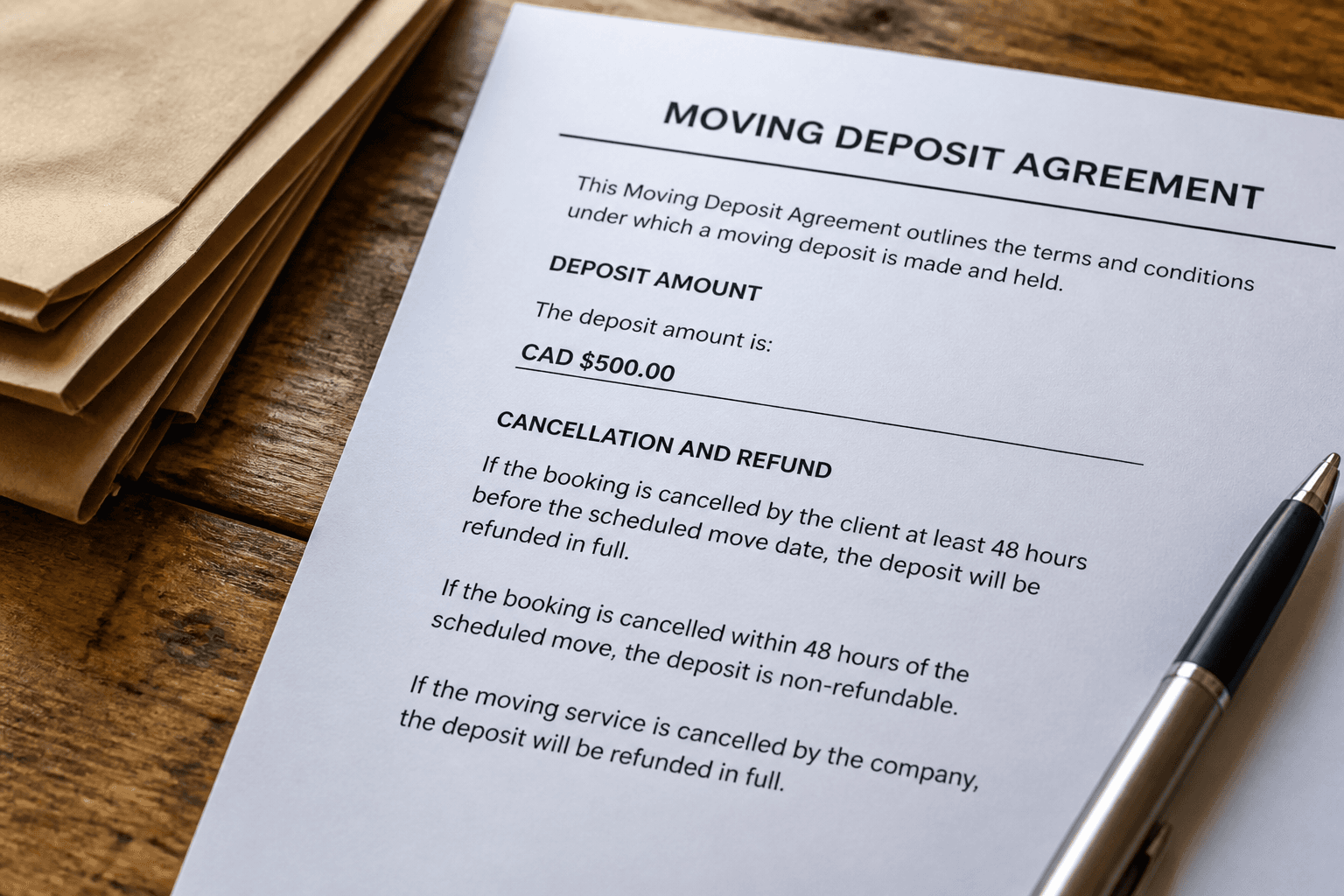
Why deposits happen—and how deposit payment protection works in Canada
In Calgary neighbourhoods like Beltline, Kensington, and Airdrie-area commutes, moving dates can shift fast—summer work schedules, condo board rules, or elevator booking windows can all change. That’s why many Canadian movers ask for a deposit: it reserves labour, truck time, and scheduling priority. Deposit payment protection in Canada isn’t a single national rule; it usually comes from contract clarity plus consumer protections under provincial law and payment rules that govern chargebacks or dispute rights. For renters and homeowners, the practical question is less “Are deposits legal?” and more “What does the contract say happens to my deposit if the move can’t proceed?” A protected deposit should be tied to a specific service reservation, have a refund or credit pathway, and clearly define non-refundable amounts. Always request the deposit terms in writing before you pay.
Moving deposit payment methods in Canada (and which ones help your refund path)
In Canada, deposit payment methods commonly include credit card, Interac e-Transfer, debit, and sometimes prepaid or “cash-only” arrangements. While legitimate movers may accept many forms, your deposit payment protection red flags contracts 2026 usually show up around vague payment instructions and refusal to provide receipts. In general, credit cards are often easier to dispute if terms aren’t honoured because you have a defined process to seek resolution for billing issues. Interac e-Transfer can still be traceable, but it typically doesn’t offer the same built-in dispute leverage as card payments. Debit and cash can be harder to dispute—especially if the contractor can argue you paid “as a reservation fee” with no written refund rules. Your best protection is a detailed receipt showing the amount, date, and the exact service reserved, plus an agreement that explains refund timing and conditions. Avoid arrangements where a mover pressures you to pay before you see full written terms.
Contract red flags for 2026: wording that can swallow your refund
When you’re booking a move for Calgary in summer, you’re usually racing calendars: elevator reservations in downtown towers, loading rules near 17 Avenue SW, and the need to coordinate parking permits in areas like Bridgeland or Mount Royal. That makes it even more important to review contract wording before paying a deposit. The most common moving deposit payment protection red flags contracts 2026 include: (1) “non-refundable deposit” with no stated percentage or dollar amount; (2) a deposit described as “fully earned upon booking” even if the mover hasn’t confirmed access to your property; (3) cancellation clauses that don’t set a notice period; (4) refund timing missing entirely (“we’ll get back to you”); (5) exclusions that are too broad, like “any reason whatsoever” becomes non-refundable; and (6) no schedule details—no date window, no truck size, no labour estimate, and no inventory checklist. Another red flag is inconsistent pricing: a low quote followed by “deposit required” terms that later claim extra fees automatically reduce your refund.
How to request refund clarity before you pay: a Calgary checklist
To get deposit clarity without friction, ask direct questions that force measurable answers. Start with your moving date window and property access constraints: Calgary move days often hinge on condo board policies, parking/loading zones, and elevator scheduling. Then request written answers to these items, ideally by email so you have a paper trail: What portion of the deposit is refundable and what portion is non-refundable? If you cancel, what notice period applies (e.g., days/weeks before the move)? Under what exact circumstances will the mover keep the deposit (crew shortage, inability to access unit, weather-related truck changes, storage availability)? If the move is rescheduled, will the deposit transfer to the new date automatically, and is there any rebooking fee? How long after cancellation will the refund be processed, and how will it be sent (original payment method or account credit)? Also ask for the receipt format and whether GST applies to the deposit. If the mover won’t provide specifics, that’s a signal to pause.
What to do if your move changes: cancellation, rescheduling, and proof of delivery
In summer 2026, Calgary’s moving market can be busy, and plan changes are common—job relocations, lease timing, or construction delays near major corridors. Deposit protection becomes real when you need to cancel or reschedule. First, notify the mover as soon as your plans change, and do it in writing (email is best). Ask for a written confirmation of the decision and how your deposit is handled: refund amount, refund method, or deposit transfer to the new date. Second, avoid informal “phone agreements” that later get disputed; your contract should reference cancellation procedures and timelines. Third, document key dates: your notice date, the move date originally booked, and any access issues (like missed elevator reservation windows). Proof matters if you later need to dispute the charge. If you paid by credit card, keep records for the charge slip and correspondence. If paid by e-Transfer, keep transaction details plus any receipt. Finally, confirm what happens to any add-ons—packing materials, storage days, or disassembly fees—because these can affect whether the deposit is treated as a credit.
Choosing a safer booking approach with Boxly: transparent terms and deposit-first communication
Deposit disputes usually come down to a mismatch between expectations and contract wording. A safer booking approach is “deposit-first communication with clarity.” Before you commit, verify that your quote includes the key moving variables that affect deposit value: date window, service type (local vs. long-distance), packing or storage add-ons, and inventory expectations. When comparing providers through Calgary-focused marketplace workflows, look for movers who clearly explain what the deposit is for—reserving truck time and crew—then state exactly what happens if you cancel or reschedule. Transparent providers will offer a receipt, show the refund/credit pathway in plain language, and align pricing so your deposit won’t be “absorbed” by unclear fees. Using Boxly can help you communicate with clearer structure and reduce surprise changes by focusing on documented terms from the start. Ultimately, your best protection is paying with a traceable method, insisting on written cancellation terms, and not accepting broad “non-refundable” clauses without numbers.
Frequently Asked Questions
What counts as a “deposit” versus a “reservation fee” in Calgary moving contracts?
In practice, Calgary movers may use different labels—deposit, reservation fee, booking fee, or retainer—to describe money paid upfront to secure a moving window. Legally and contractually, the key issue is not the name; it’s what the agreement says the money is for and what happens when you cancel or the move is changed. For moving deposit payment protection red flags contracts 2026, the problem is often when the document says “non-refundable” for the entire fee without specifying a dollar value or refund conditions. A protective contract ties the payment to concrete services already reserved (for example, crew dispatch time or truck scheduling) and explains what portion becomes earned versus refundable. Ask for a receipt that matches the contract language, and confirm whether your payment is refundable as a whole, partially, or transferable to a rescheduled date. If the mover can’t explain the distinction in writing, treat it as a red flag.
Is GST/HST applied to a moving deposit in Alberta?
For Alberta bookings, GST/HST treatment depends on how the mover structures the invoice and which services are taxable. Many Canadian moving invoices include applicable taxes on services and sometimes on deposits as part of the overall charges. The key deposit protection point is that your receipt should state what the deposit represents and whether tax is included or charged separately. Under consumer expectations, you should be able to see: the deposit amount, any tax line items, and the remaining balance expected closer to the moving date. If a mover refuses to provide itemized documentation, that’s a risk factor for later refund disputes because you can’t verify what portion of the deposit relates to taxable services. When you request refund clarity, ask: “Is the deposit taxed, and will refunds reverse tax accordingly?” A legitimate mover can answer that directly and provide paperwork that matches the contract.
If I pay by Interac e-Transfer, can I still get a refund if the mover cancels?
Yes, but the “how” matters. Interac e-Transfer payments are traceable, and if the mover cancels, your contract should explain whether you receive a full refund, a partial refund, or a credit. Deposit payment protection red flags contracts 2026 often appear when a contract fails to specify what happens if the provider cancels, leaving refunds unclear or delayed. If the mover cancels, request written confirmation and a refund schedule. Keep the e-Transfer confirmation, your booking email, and the contract terms that describe cancellation outcomes. If the refund is not honoured, your ability to resolve the issue may rely more on contract dispute channels and less on immediate payment dispute tools compared with credit cards. Still, documentation is your leverage: a paper trail of dates, amounts, and the mover’s promises. If possible, pay in a way that gives you dispute options (like a credit card) while ensuring the contract clearly states refund conditions for provider cancellations.
What notice period should I look for before cancelling a move in Calgary?
Notice periods are typically spelled out in the mover’s cancellation policy, but they vary by provider and service type. The deposit protection goal is to ensure the notice period is specific and connected to a defined refund outcome. Moving deposit payment protection red flags contracts 2026 include policies that say cancellation is “subject to availability” or “fees may apply” without stating the notice timing, the percentage kept, or the refund process. When reviewing your contract, look for: how many days before the move you must cancel to obtain a full refund (or the minimum kept amount); whether weekends and holidays count; whether the policy differs for local versus long-distance moves; and whether rescheduling is treated as a deposit transfer with no penalty. In Calgary’s summer market, last-minute changes can be expensive for any business, but clarity is not optional—your contract should state the actual notice period and corresponding deposit treatment.
How long should a mover take to refund a deposit after cancellation?
A protective contract or written agreement should include a refund timeline. Moving deposit payment protection red flags contracts 2026 often show up when the contract doesn’t set a date (“refunds processed when available”) or when it says “up to” a vague time frame. In Canada, best practice for customer clarity is a stated number of business days after cancellation confirmation and after any final accounting is completed. Your goal is to see: when the cancellation is officially recognized (the date you emailed vs. when they confirm), when the deposit refund request is initiated, and whether refunds return to the original payment method. Ask for that timeline in writing: “How many business days will it take for my deposit to be refunded after you confirm cancellation?” If the mover can’t commit to any timeline, request a written “processing within X business days” commitment. That’s especially important when your deposit impacts your next booking with a different mover.
What evidence should I keep if I need to dispute a deposit charge?
If you later need to dispute a charge or resolve a disagreement, evidence is what converts the contract into a solvable problem. Save: the signed or accepted contract/estimate showing the deposit amount, the cancellation policy language, and the refund terms; the receipt or invoice that shows deposit payment details; booking confirmation emails that include the move date window and service level; and all cancellation/rescheduling communications, including timestamps. If you paid by credit card, keep screenshots or copies of the charge details and any relevant correspondence about the refund. If you paid by Interac e-Transfer, keep transaction confirmations and the account details used. Also keep records of any property access issues that affected the move (parking permissions, elevator booking approvals, or notice of access limitations), because contracts often treat these differently. Moving deposit payment protection red flags contracts 2026 frequently rely on vague wording—documentation helps you show exactly what was promised and whether it was fulfilled.