Why your Calgary moving quote changes so much (2026 basics)
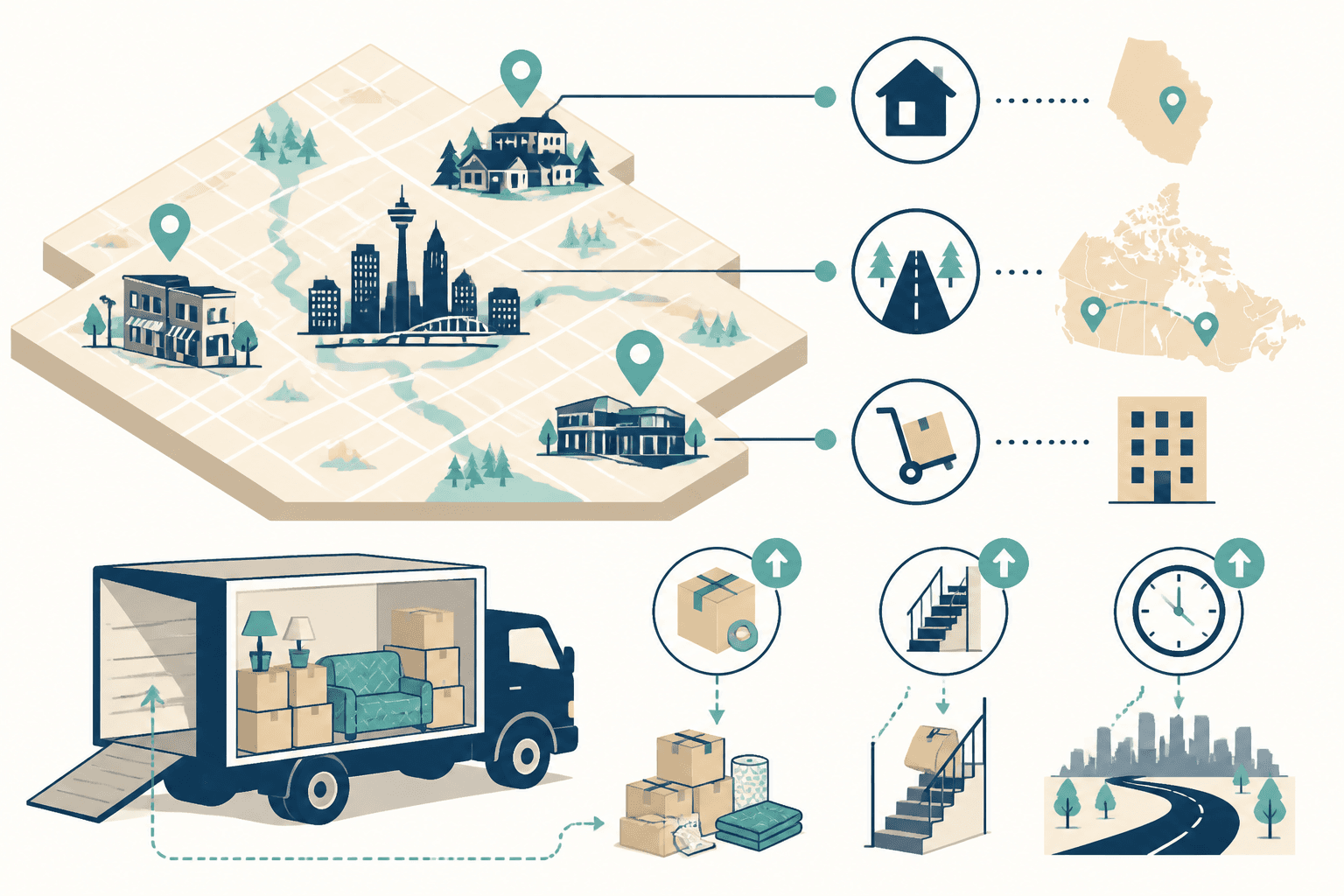
If you’re planning a move in Calgary—whether you’re heading out of Sage Hill, living near Kensington, or relocating between Auburn Bay and Seton—your final price usually isn’t tied to the “miles to miles” idea people expect. In practice, moving costs in Canada in 2026 are built from time and risk: how long movers spend loading, lifting, packing, and travelling, plus the complexity of accessing your home. Calgary also has weather-driven scheduling challenges: winter shutdowns, spring melt, and summer heat can impact truck loading efficiency and day-of coordination. The move type matters, too. A simple local move within the city often prices around truck + crew time, while a long-distance move includes more days, mileage, and cross-province logistics. Most quotes you see can swing quickly when you add stairs, long carries, tight street access, elevator availability, or bulky items like grills and mattresses.
How city factors shape the “average moving costs Canada 2026” range
When people search “average moving costs Canada 2026 what drives price by city,” they’re asking why the same household can cost more in one metro area than another. In Calgary, several city-specific factors influence pricing even for similar move volumes. First is labour market pressure: demand for movers can spike around peak residential seasons, making crew availability tighter. Second is the practical reality of access. Many Calgary neighbourhoods—think Signal Hill, Rocky Ridge, or Copperfield—include a mix of detached homes and walk-up basements with driveways that don’t always accommodate a large truck. That affects the “effective distance” from curb to door, which changes labour time. Third is parking and loading logistics: downtown and inner-city areas often require stricter curb management, and the need for permits or careful staging can slow crews. Finally, weather affects throughput. In summer, heat and humidity can slow unpacking and increase breaks; in winter, traction and snowbanks can reduce how fast movers can safely move furniture.
Move type pricing: local vs long-distance vs labour-only in 2026
The “move type” is one of the biggest levers behind average moving costs Canada 2026. Local Calgary moves are often priced with a truck and crew for a block of time (or a half-day/day estimate), because the crew’s work is concentrated: packing help, loading, short-distance travel, and unloading in the same metro. Long-distance moves are usually a different category altogether—more calendar time, fuel and mileage exposure, and additional coordination across routes and destination availability. Labour-only moves (where you rent a truck or have a vehicle lined up) tend to cost less than full-service because you’re providing transportation, but labour can still be substantial if your home needs stairs, furniture wrapping, or multiple trips. For example, a 1–2 bedroom move from Bridgeland to another Calgary community may remain relatively predictable, while a move to Ontario or British Columbia introduces travel day structure and “can’t-miss” scheduling windows. In 2026, transparent estimates should also clarify what’s included (disassembly, packing materials, appliance handling, and protection), because those inclusions change the labour hours.
What drives price the most: stairs, parking, distance to door, and packing
Even when two Calgary households have the same number of bedrooms, moving costs can differ sharply due to access and packing complexity. A basement move with a narrow stairwell, a tight hallway turn, or a long carry from garage to truck can require extra time and careful handling. Similarly, parking constraints—such as finding a safe spot near Westmount or managing a loading zone near 17 Avenue—can add minutes per load, and those minutes multiply across repeat trips. Packing is another major driver. If you provide all packing materials and pre-pack most items, your movers can focus on loading and protection; if you need full-service packing, labour time rises because each box must be filled, wrapped, labelled, and arranged for efficient stacking. Appliances raise complexity too: fridges, freezers, and washers require more care for safe moves, and many providers follow specific steps (like disconnecting and securing). Finally, the “distance to door” factor—how far movers carry items from the curb to the interior—can be the hidden cost behind quotes that appear similar on paper. The best way to control price is to be precise with your inventory, access details, and what you’re handling yourself.
Realistic 2026 cost expectations for Calgary moves (by home size)
For 2026 planning, it helps to think in ranges rather than a single number, especially in a city like Calgary where driveway access, basement conditions, and neighbourhood layout can vary widely. While the exact “average moving costs Canada 2026 what drives price by city” figure depends on whether you’re doing local or long-distance and whether it’s full-service or labour-only, most Canadian movers price around crew hours plus truck time, then adjust for complexity. As a budgeting guide for Calgary local moves, many households find that 1-bedroom moves typically cost less than 2-bedroom moves due to reduced crew time and fewer bulky items; likewise, 3-bedroom moves cost more because they generally include heavier furniture, more boxes, and more disassembly/reassembly. If you’re moving in the summer, expect scheduling demand to affect how quickly you can lock in dates and how tightly quotes reflect availability. To estimate more accurately, count large items (sofas, beds, dining sets, wardrobes) and note any stairs, elevators, or long hallway carries. For a trustworthy number, request an on-site or video walkthrough and confirm inclusions (blanket wrap, shrink wrap, mattress protection, and appliance handling).
Frequently Asked Questions
What is the average moving cost in Calgary in 2026 for a local move?
For a local move within Calgary in 2026, “average” costs depend mainly on how many hours your crew is on site and how complex the access is—not just the number of rooms. In general terms across Canada, local moves are often calculated from labour time plus truck time, then adjusted for factors like stairs, long carries, packing needs, and bulky-item handling. Calgary pricing can be particularly sensitive to driveway and loading constraints in neighbourhoods such as Nolan Hill or Somerset, where the effective distance from curb to door may require multiple trips. A 1-bedroom move usually requires less crew time than a 2-bedroom, while a 3-bedroom is typically more labour-intensive due to heavier furniture, more boxes, and more disassembly/reassembly. To get a dependable number for your address, request a walkthrough and confirm what’s included (movers’ protection materials, packing supplies if any, and appliance handling). That’s the fastest way to turn an estimate range into a quote you can trust.
What drives price the most for Calgary movers: distance or stairs?
In Calgary, stairs often drive price as much as or more than distance, because they change how quickly a crew can move items safely. Distance “to door” matters too: if the truck can’t park close to the entrance in parts of the city, the carry time increases and that increases labour minutes. For example, a short move from Bridgeland to another inner-city location may still cost more if there are multiple flights of stairs, a narrow stairwell, or tight turns in a hall. By contrast, a move of the same household into a ground-floor or elevator-access unit (where available) can be faster even if the neighbourhood distance is slightly longer. The best way to predict cost is to list access realities: how many steps, whether furniture must go around corners, whether there’s a basement with narrow entries, and how far movers must transport items between curb and interior. Then choose your service level—labour-only versus full-service packing and protection—because packing complexity can amplify the impact of stairs and access.
Is summer (June–August) more expensive for moving in Calgary?
Yes—moving demand typically rises in summer months across Canada, and Calgary is no exception. When more households are relocating during peak residential periods, movers can book up faster and quotes may reflect tighter availability. Even if your move is priced by time rather than by a per-item tariff, higher demand can influence scheduling choices and overall estimate accuracy. In summer specifically, some crews plan for longer breaks and careful handling because heat can affect both comfort and productivity during loading and unloading. Neighbourhood layouts can add to the practical summer complexity too: curb conditions, street access, and how quickly crews can stage a truck on busy roads around areas like Inglewood or Marda Loop can affect turnaround time. If you’re moving in summer, the best pricing strategy is to book earlier, choose flexible arrival windows when possible, and ensure the scope of work is clear (what’s being packed, what’s being disassembled, and which items require extra protection).
How can I reduce moving costs without risking damage to furniture?
The safest way to reduce moving costs is to target controllable complexity, not to cut corners on protection. Start with packing. If you can pack non-essentials yourself (kitchen, books, seasonal items) and clearly label boxes, you can often lower labour time compared with full-service packing. Next, prepare for access: declutter hallways, ensure stairs are clear, and measure doorways and elevator openings if applicable. For Calgary homes—especially those with basement stairs—protecting the path matters as much as protecting the furniture. You can also consolidate items into fewer, properly sized boxes to reduce time spent handling or correcting damaged boxes. For bulky furniture, decide in advance whether you’ll disassemble items yourself (where appropriate) or keep that as a mover add-on; either way, the quote should reflect the choice. Another cost lever is timing: avoid last-minute changes on moving day and confirm when the truck can park and when doors will be accessible. Finally, compare quotes based on inclusions and insurance, not just the lowest number.
What’s the difference between a full-service move and labour-only in 2026?
A full-service move in 2026 generally means the moving company handles more of the work: packing (often with professional wrapping and protective materials), loading, transport, unloading, and sometimes unpacking or placing furniture. Labour-only moves usually mean you provide the transportation (for example, a rented truck) and the movers provide crew time for loading and unloading, plus wrapping if included. The cost difference comes from the time required for packing and protection, not from transportation alone. In Calgary, packing can be the deciding factor because houses and condos vary widely in layout: some homes in communities like Tuscany or Ranchlands have many smaller rooms and tight hallways, increasing packing time. Labour-only can still be cost-effective if you have manageable access and you can pack efficiently with sturdy boxes. For many customers, a hybrid approach works well: professional packing for fragile items and labour-only for the rest. To choose, ask for an itemized scope so you can see whether the labour cost difference is driven by packing supplies, disassembly, appliance handling, or additional protection steps.
Do moving costs change for apartments or condos in Calgary?
Yes, apartment and condo moves in Calgary can change the cost structure because building rules and access requirements can affect labour time. Unlike detached homes, multi-unit buildings may have elevators, restricted loading windows, designated loading bays, and sometimes move-in booking procedures managed by the property. If your move requires elevator reservation or coordination with building management, the movers may have a tighter schedule and fewer options to stage the truck. That can affect the time it takes to complete loading and unloading. Additionally, condo moves often include more “high-effort” items—like larger flat-screen TV setups, wardrobes, and framed artwork—that require careful handling and protection. If you’re moving near downtown corridors or established areas like the Beltline, curb and loading zone constraints can also add to effective distance to door. When getting quotes, provide details such as elevator availability, any reservation requirements, and the loading window. Clear information helps movers plan crew time and can prevent surprise costs.